

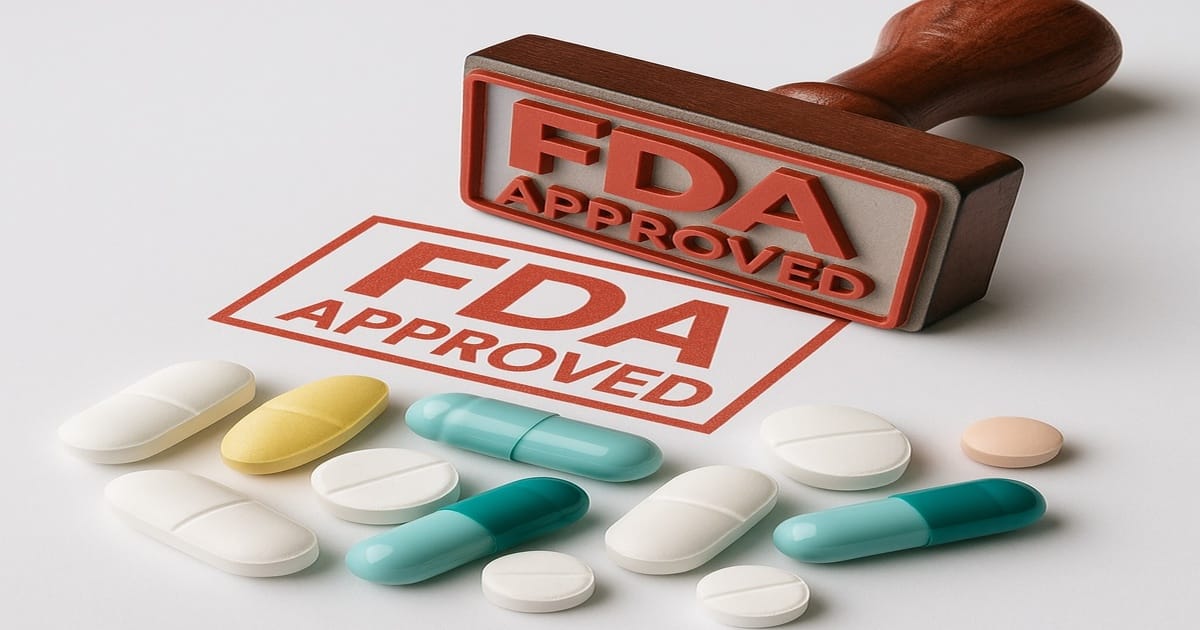
On June 2, 2026, the U.S. Food and Drug Administration (FDA) approved Cavhanza (Cycle Pharmaceuticals), an orally disintegrating tablet (ODT) formulation of the second-generation BCR-ABL1 tyrosine kinase inhibitor nilotinib, for adults with Philadelphia chromosome-positive chronic myeloid leukemia (Ph+ CML). The significance lies not in the molecule but in its delivery: the ODT removes nilotinib’s long-standing real-world constraints—strict fasting, avoidance of proton pump inhibitors (PPIs), and timing separation from acid reducers.
Who Is It For
The indication mirrors existing nilotinib: (1) adults with newly diagnosed Ph+ CML in chronic phase, and (2) adults with chronic- or accelerated-phase Ph+ CML resistant to or intolerant of prior therapy that included imatinib—covering both first-line and previously treated patients.
Basis for Approval and Nilotinib’s Role
CML is driven by the BCR-ABL1 fusion gene, whose constitutively active tyrosine kinase fueled what was once a lethal leukemia. Tyrosine kinase inhibitors (TKIs) transformed it into a long-term, manageable chronic disease. Nilotinib (originator Tasigna), a second-generation TKI following imatinib, inhibits BCR-ABL1 more potently and selectively and has been a backbone of first- and second-line therapy.
Yet nilotinib carried formulation liabilities. First, a strong food effect: taking it with food markedly increases exposure and the risk of QT prolongation, so labeling requires fasting (no food 2 hours before to 1 hour after). Second, pH-dependent solubility: as gastric pH rises the drug dissolves poorly, so PPIs reduce absorption and should be avoided, while antacids and H2 receptor antagonists (H2RAs) require separated dosing.
Using Flex Pharma’s formulation technology, Cavhanza is an ODT engineered for improved solubility and dissolution such that nilotinib bioavailability is maintained even with concomitant PPIs or H2RAs and the tablet can be taken with or without food. The approval references nilotinib’s established efficacy and safety, supported by pharmacokinetic/bioequivalence bridging data—rather than a new large efficacy trial.
What Was Actually Solved—The Hidden Barrier of “How to Take It”
CML outcomes hinge on achieving and maintaining deep molecular responses, and the key lever is adherence. Because TKIs are taken daily, essentially for life, the cumulative effect of missed or mistimed doses can translate into loss of molecular response and treatment failure.
Nilotinib’s “fast strictly / avoid PPIs” requirements were an under-appreciated but real barrier. Many CML patients are older and routinely use PPIs or acid reducers for GERD or GI symptoms; strict fasting burdens daily life and dose-spacing is cumbersome. These threaten not whether the drug works, but whether it can be taken correctly and continuously.
Cavhanza removes that barrier through formulation: being able to take it alongside acid-reducing agents without timing separation, and independent of meals, is a practical advance for patients with comorbidities and for older patients managing polypharmacy. The ODT format itself eases dosing for those with swallowing difficulty or fluid restrictions. The molecule is unchanged, but raising the probability that the drug is reliably absorbed and taken can lift real-world effectiveness.
Safety Profile
Cavhanza’s safety essentially follows nilotinib’s. Nilotinib carries a boxed warning for QT prolongation and sudden death, mandating ECG and electrolyte (potassium, magnesium) monitoring before and during therapy.
Other established risks include cardiovascular and vascular occlusive events, myelosuppression (thrombocytopenia, neutropenia, anemia), hepatotoxicity, pancreatitis/lipase elevation, electrolyte abnormalities, and fluid retention. While mitigating the food effect may theoretically ease management of food-related overexposure, it does not waive the need for cardiovascular—especially QT—monitoring.
Regulatory Significance and Clinical Position
Cavhanza is an approval of a new formulation, not a new molecule—an example of value creation through drug delivery and formulation optimization, an increasingly visible theme in oncology. Approaches that keep the active ingredient but improve administration burden, drug interactions, and adherence (e.g., subcutaneous conversion, improved oral absorption) carry real, patient-centered value.
CML options now span imatinib, nilotinib, dasatinib, and bosutinib, plus generic nilotinib and the allosteric inhibitor asciminib (Scemblix). In this mature, competitive field, Cavhanza differentiates not on added efficacy but on fewer interactions and administration constraints—usability—answering the concrete unmet need of patients on chronic acid suppression.
That said, efficacy is presumed equivalent to existing nilotinib; price, access, reimbursement, and differentiation from generic nilotinib will determine uptake. How much the formulation’s clinical value translates into improved real-world adherence and long-term outcomes will be tested in post-marketing practice.
Optimizing formulation and route of administration to create value has become a theme in oncology. Replacing intravenous infusions with roughly one-minute subcutaneous injections—as with rituximab and trastuzumab, and the subcutaneous mosunetuzumab (Lunsumio VELO) approved in late 2025—improved administration time, clinic burden, and tolerability without changing the active ingredient. Cavhanza brings this “optimize the delivery” lineage to an oral agent, in the form of removing interactions and dosing constraints.
This advance also aligns with an era in which CML care reaches beyond deep molecular response (DMR) toward treatment-free remission (TFR) after stopping therapy. Achieving and maintaining TFR presupposes stable, sustained deep response, whose foundation is reliable daily dosing. Reducing administration constraints is therefore not mere convenience—it can support the probability of reaching the long-term goal of TFR.
Commercially, the calculus differs from a novel agent. With generic nilotinib available, payers will weigh the added convenience against cost, and uptake will depend on reimbursement and on how strongly guidelines and clinicians value interaction-free, meal-independent dosing for specific segments—older patients, those on chronic acid suppression, and those facing adherence challenges.
My Thoughts and Future Outlook
Newcomers may wonder how “the same drug” makes approval news. But for a medicine taken every day for life, like CML therapy, “ease of taking” itself shapes outcomes. Being unable to fast, or to combine it with a common stomach medicine—those small frictions accumulate into the large consequence of losing molecular response. Cavhanza removes that invisible barrier through formulation, a practical advance that meets patients where they live.
Stepping back, this exemplifies how value creation in oncology is layering beyond “finding new targets” toward “optimizing how existing drugs are delivered.” Engineering bioavailability and drug-interaction profiles has a lifecycle-management dimension, but it also carries clinical logic for the real-world need of older, polypharmacy cancer patients. The question ahead is how far such formulation and delivery improvements can build evidence for both differentiation from generics and measurable gains in adherence and outcomes. Innovation in the molecule and innovation in delivery—both wheels are redefining patient value, and this approval is one concrete entry in that record.
This article was edited by the Morningglorysciences team based on FDA and developer disclosures and medical news reporting. Always consult your treating physician for any diagnostic or treatment decisions.
Related Reading
- Oncology Approval News series (FDA approvals, one by one)
- FDA Oncology Approval Archive, April–May 2026 (index by indication/modality)
If you leave a comment telling us which cancers or conditions you’d like us to cover next, we’ll prioritize them in future features.

Comments