

In Part 1 of this series, we asked why the ADC land grab is happening now, and we positioned ADCs within the broader landscape of cancer therapies, di
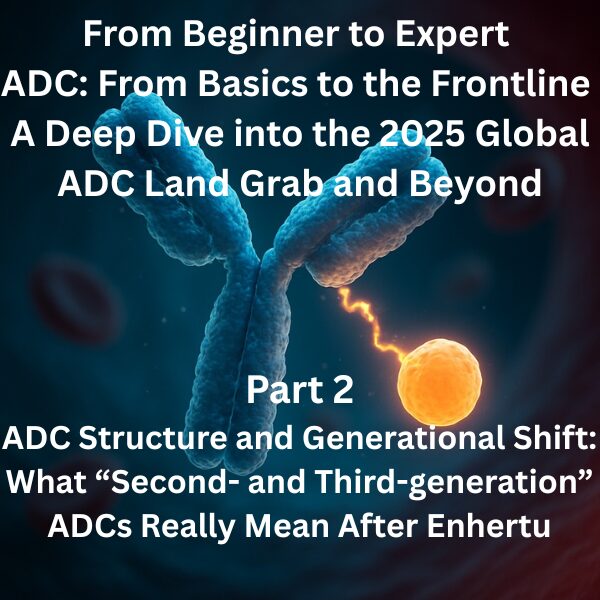
In Part 1 of this series, we asked why the ADC land grab is happening now, and we positioned ADCs within the broader landscape of cancer therapies, discussed the impact of Enhertu, and looked at how pharma, biotech, and investors are reacting. In this second part, we take a step closer to the technology itself and focus on how ADCs are designed.
What you will learn
- Breaking Down ADCs: Antibody, Payload, Linker, and DAR
- From First to Third Generation: Making Sense of “Generational” ADCs
- Design Dimensions: Target, Antibody, Linker, Payload, and Conjugation
- The Meaning of the “Enhertu Generation”: Topo-I ADCs as Platforms
- A Practical Checklist: How Non-specialists Can Read ADC Technical Descriptions
Even though we label them all as “ADCs,” the internal architecture can be very different. Early or “first-generation” ADCs were developed when the field was still experimenting with combinations of antibodies, linkers, and payloads, often running into safety and manufacturing issues. Later “second-generation” ADCs improved linkers and payloads to achieve a more practical balance of efficacy and tolerability. Now, with Enhertu and other Topo-I–based ADCs, people increasingly talk about “second- and third-generation ADCs,” sometimes referring to site-specific conjugation and novel payload classes as features of a new generation.
In this article, we will first review the basic structure of ADCs (antibody, payload, linker, and DAR), then walk through the practical differences between first-, second-, and “third-generation” ADCs. Finally, we will look at how these design elements influence clinical performance and deal value, and offer a simple checklist for non-specialists—pharma executives, VCs, and consultants—when they read technical descriptions of ADC programs.
Breaking Down ADCs: Antibody, Payload, Linker, and DAR
Antibody: The “Guide” That Finds the Target
The first core component of an ADC is the antibody. The antibody recognizes specific antigens on the surface of cancer cells (such as HER2, TROP2, CD30) and serves as the “guide” that delivers the toxic payload to its destination.
Two aspects matter here: which antigen to target and the properties of the antibody itself. From a biological perspective, an ideal target antigen typically:
- is highly expressed on tumor cells but minimally expressed on normal tissues,
- is located on the cell surface and can be internalized after antibody binding,
- plays a functional role in tumor growth or survival, making it difficult for the tumor to “give up.”
The antibody’s own properties also matter: its isotype (e.g., IgG1 vs IgG2), Fc engineering, and whether antibody-dependent effector functions (ADCC/CDC) are preserved or attenuated. All of these choices shape the overall pharmacology of the ADC.
Payload: The Highly Potent “Execution Unit”
The second component is the payload, typically a highly potent small molecule that can kill cells at nanomolar concentrations. Major classes include:
- microtubule inhibitors (maytansinoid, auristatin derivatives),
- DNA-damaging agents (such as calicheamicin, PBDs, duocarmycin analogues),
- topoisomerase I inhibitors (camptothecin derivatives and related compounds).
Payload choice drives both efficacy and safety. Microtubule inhibitors, for example, have a long history in chemotherapy and a relatively well-understood safety profile, but they can cause neuropathy and bone marrow suppression. Topo-I payloads can produce powerful antitumor effects via DNA damage but may be associated with ILD and gastrointestinal toxicities, among others.
Linker: The “Switch” That Controls When and Where the Payload Is Released
The third key component is the linker. It connects the antibody and payload and acts as the “switch” that determines where and how the payload is released. Broadly, linkers can be categorized as:
- Cleavable linkers: designed to be cut under specific conditions such as acidic pH, presence of particular enzymes, or a reducing intracellular environment.
- Non-cleavable linkers: payload is released only after the antibody is degraded inside the cell.
Cleavable linkers can be designed to make use of the bystander effect: once the payload is released, part of it can diffuse out of the target cell and kill neighboring tumor cells. This can help overcome intratumor heterogeneity but increases the risk of off-target toxicity if the linker is not stable enough in circulation. Non-cleavable linkers are generally more “on-target,” but may struggle in tumors with highly heterogeneous antigen expression.
DAR (Drug-to-Antibody Ratio): How Many Payload Molecules per Antibody?
A concept unique to ADCs is the Drug-to-Antibody Ratio (DAR), which indicates how many payload molecules are attached to a single antibody.
Higher DAR values mean a stronger theoretical “hit” once the ADC is internalized. However:
- pharmacokinetics (PK) can deteriorate,
- nonspecific uptake and off-target toxicity can increase.
If DAR is too low, safety may improve but higher doses may be needed to achieve sufficient efficacy. Most ADC development programs are essentially an optimization exercise over the triad of DAR, linker stability, and payload potency.
From First to Third Generation: Making Sense of “Generational” ADCs
First-generation ADCs: Proof of Concept and Safety Challenges
So-called first-generation ADCs emerged at a time when the field was focused on proving the basic concept: “attach a powerful toxin to an antibody and deliver it to cancer cells.” From today’s standpoint, many of these combinations—targets, linkers, payloads—look crude. These ADCs could demonstrate efficacy in certain cancers, but safety and manufacturing issues were frequent.
Typical characteristics of first-generation ADCs included:
- heterogeneous DAR distributions due to random conjugation,
- linkers with limited stability, leading to premature payload release,
- suboptimal combinations of target, payload, and indication.
These early experiences, both positive and negative, laid the foundation for the improvements that followed.
Second-generation ADCs: More Stable Linkers and “Workable” Payloads
Second-generation ADCs built on the lessons from the first wave. They aimed for a more practical balance between clinical benefit and safety by:
- optimizing cleavable and non-cleavable linkers,
- using payload classes with better-understood safety profiles, such as microtubule inhibitors,
- refining target selection and indication strategies.
These improvements led to products that provided clear benefits for specific patient groups. However, many second-generation ADCs still had relatively narrow indications and were not yet able to fully overcome intratumor heterogeneity or expand broadly into earlier lines of therapy.
Third-generation ADCs: Post-Enhertu Designs and Site-specific Conjugation
The term “third-generation ADCs” is often used to describe programs that combine elements such as:
- Topo-I–based payloads with by-stander effects,
- site-specific conjugation technologies,
- new targets (e.g., Claudin 18.2, B7-H3) and tumor-agnostic development strategies.
These ADCs aim for “controlled high firepower”. Enhertu-like designs, for example,:
- maintain relatively high DAR while managing PK and safety through linker and payload design,
- leverage the by-stander effect to reach HER2-low and other partially expressing populations,
- pursue multi-tumor expansion based on a common payload-linker platform.
Site-specific conjugation further enhances this by enabling more uniform products with precisely controlled DAR. By attaching payloads only at defined sites on the antibody (via engineered amino acids or tags), developers can improve product homogeneity, PK reproducibility, and predictability of safety profiles. This is particularly valued by regulators and partners looking for consistent quality and scalable manufacturing.
Design Dimensions: Target, Antibody, Linker, Payload, and Conjugation
Target Selection: Balancing Biology and Market Reality
Target selection is one of the earliest and most critical decisions in ADC development. It has both biological and business dimensions.
On the biological side, developers consider:
- differential expression between tumor and normal tissues,
- internalization kinetics and mechanisms,
- antigen turnover and recycling.
On the business side, they look at:
- which tumor types and how many patients can be addressed,
- positioning versus existing and emerging therapies (first-in-class vs best-in-class),
- the current and future landscape of diagnostic testing and biomarker infrastructure.
Some targets are biologically attractive but difficult to commercialize due to limited testing capabilities. Others may be easier to commercialize but biologically less compelling. Effective ADC strategies require research and commercial teams to work closely from an early stage.
Antibody Design: Isotype and Fc Engineering
Antibody design choices include:
- isotype (IgG1, IgG2, IgG4, etc.),
- whether to preserve or attenuate ADCC/CDC activity via Fc engineering,
- whether to introduce changes for half-life extension or altered immune interactions.
In some cases, the naked antibody has therapeutic potential on its own, and preserving effector functions may be desirable. In other cases, the main goal is to deliver the payload, and excessive immune activation would only complicate safety management. The optimal design is context-dependent.
Linker Design: Triggers and Stability
Linker design is essentially about controlling the balance between stability in circulation and efficient release at the site of action. Common strategies include:
- pH-sensitive linkers that are cleaved in acidic compartments such as endosomes,
- enzyme-sensitive linkers cleaved by specific proteases (e.g., cathepsins),
- linkers sensitive to the reducing intracellular environment.
As our understanding of tumor microenvironments and intracellular biology grows, linker designs become more sophisticated. Recent ADC successes and failures underscore that linkers do not just modulate efficacy; they also heavily influence toxicity profiles.
Payload Selection: Potency and “Manageability”
Payload choice is not simply “the stronger, the better.” In addition to potency, developers must consider:
- synthetic and manufacturing feasibility,
- metabolism and excretion pathways,
- patterns of off-target toxicity.
Extremely potent DNA-damaging payloads such as PBDs can cause severe toxicity even with minimal leakage. Topo-I payloads, by contrast, can leverage by-stander effects to reach heterogeneous tumors, while offering a different balance of manageable and monitorable toxicities. Which trade-off is acceptable depends on the indication, line of therapy, and available alternatives.
Conjugation Technology: Random vs Site-specific
Finally, there is the matter of how the payload is attached to the antibody. Traditional approaches rely on random conjugation to lysine or cysteine residues. These methods are technically straightforward but produce mixtures of ADC molecules with varying DAR and conjugation sites.
Site-specific conjugation aims to address this by:
- introducing engineered amino acids or tags at predefined positions,
- using enzymes to achieve selective conjugation at specific sites.
This yields ADCs with a defined DAR and consistent attachment pattern, which can improve product homogeneity, PK consistency, and predictability of safety. From a regulatory and commercial standpoint, these attributes make development, scale-up, and lifecycle management more robust.
The Meaning of the “Enhertu Generation”: Topo-I ADCs as Platforms
Design Logic of Enhertu-like ADCs: High DAR and By-stander Effect
Enhertu-like Topo-I ADCs often share the following design features:
- relatively high DAR,
- enzyme-cleavable linkers,
- membrane-permeable payloads capable of a by-stander effect.
This combination enabled Enhertu not only to treat HER2-high breast cancer but also to show benefit in HER2-low populations that had previously been outside the scope of HER2-targeted therapy. The key conceptual shift here is that patient selection is no longer based on a strict “high vs negative” binary for antigen expression. Instead, the design explicitly aims to reach patients with lower levels of target expression.
This logic is now being applied to other targets such as TROP2. Several companies are building Topoisomerase I ADC platforms that reuse the same payload-linker-conjugation backbone across multiple targets, combining economies of scale in development and manufacturing with diversification across indications.
Positioning in “Generational” Terms: Bridging Second and Third Generations
Enhertu-like ADCs are sometimes seen as sitting between classic second-generation and emerging third-generation ADCs. Their linkers and payloads clearly depart from earlier designs, but their conjugation may or may not be fully site-specific. Technically, there is a gradient rather than a sharp boundary.
While there is no universally accepted definition of generations, it is practical to think of them roughly as:
- Second generation: improved linkers and payloads providing a more reliable efficacy–safety balance in specific patient populations.
- Enhertu generation: Topo-I payloads and by-stander effects that broaden eligible populations and open new indications such as HER2-low.
- Third generation: site-specific conjugation and novel payloads that pursue further control, homogeneity, and scalability.
Using this mental model can help non-specialists place individual ADC programs within the broader evolution of the field.
A Practical Checklist: How Non-specialists Can Read ADC Technical Descriptions
Checkpoint 1: Target and Patient Population
For pharma, VCs, and consultants, the first question when assessing an ADC is: “Which target, and which patients?”
- What is the target antigen, and how common is its expression in the relevant tumor types?
- Which line of therapy is the ADC aiming for (first-, second-, third-line)?
- How feasible is biomarker testing in the real world, now and in the future?
If this foundation is weak, even a beautifully engineered ADC will struggle commercially.
Checkpoint 2: Payload and Linker Reveal the ADC’s “Personality”
Next, look at the payload and linker combination:
- What payload class is used (microtubule inhibitor, DNA-damaging agent, Topo-I inhibitor)?
- Is the design intended to harness a by-stander effect, or is it more strictly on-target?
- How is the linker cleaved, and what does that imply for stability in circulation?
From these details, you can infer the ADC’s “attack style”—how broadly and how aggressively it is intended to act— and form a preliminary picture of its likely toxicity profile.
Checkpoint 3: Conjugation and Manufacturing Realism
Finally, examine conjugation technology and the manufacturing strategy:
- Is the ADC produced via random or site-specific conjugation?
- At what scale can it realistically be manufactured, and what CDMO arrangements are in place?
- Is there a clear plan to generate the CMC data regulators will require for approval?
A technically exciting ADC that cannot be manufactured consistently or at scale is unlikely to succeed. When evaluating ADC programs, it is essential to look beyond the science and consider the practical realities of production and supply chains.
My Reflections
When we categorize ADCs by “generation,” the evolution may appear neat and linear. In practice, however, what matters most is not the label itself but how many of the critical design elements are under deliberate control. Target selection, antibody properties, linker stability, payload potency, and conjugation homogeneity— the degree to which these can be intentionally tuned is what really defines an ADC’s maturity.
The Enhertu generation of Topo-I ADCs marked a turning point in that regard. By explicitly embracing the by-stander effect, these ADCs opened new patient segments such as HER2-low and, at the same time, raised the level of understanding of ADCs among regulators, clinicians, and payers. This did not just produce successful products; it also accelerated the platformization of ADCs as a modality.
At the same time, many of the technologies associated with “third-generation” ADCs—site-specific conjugation, novel payloads—are still maturing. Not every program using such technologies has outperformed Enhertu-like ADCs in the clinic. Rather than taking generational labels at face value, I believe it is more useful to ask: “For this particular ADC, which dimensions—target, linker, payload, conjugation—are truly one step ahead of the status quo?”
In Part 3, we will connect these technological advances with patent-cliff mitigation strategies at big pharma. We will explore why ADCs, in particular, are being chosen as engines for the next decade of growth, and how portfolio design and deal-making strategies reflect that choice.
This article has been edited by the Morningglorysciences team.
Related Articles















Comments