

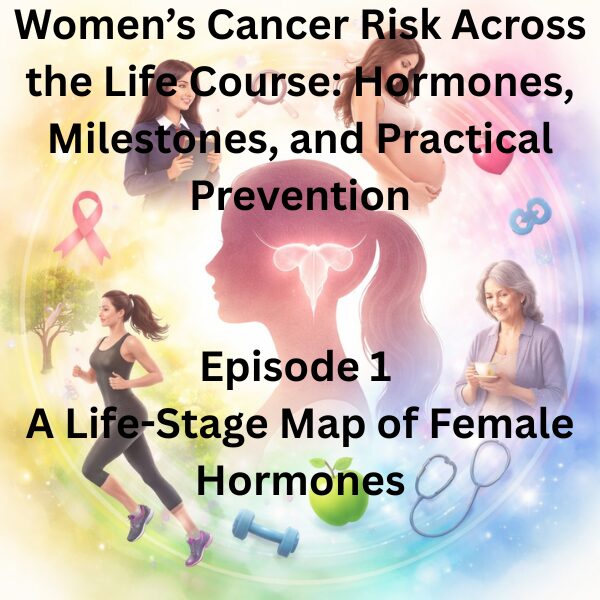
Episode 1 | A Life-Course Map of Female Hormones: From Puberty to Post-Menopause
Women’s health topics are often discussed in separate “boxes”: symptoms (PMS, menstrual pain, menopause) on one side, and diseases (breast cancer, ovarian cancer, endometrial cancer) on the other.
Women’s health topics are often discussed in separate “boxes”: symptoms (PMS, menstrual pain, menopause) on one side, and diseases (breast cancer, ovarian cancer, endometrial cancer) on the other. In reality, many of these questions become easier to understand when you place them on the same foundation: hormonal rhythms (“fluctuations”) and life-stage transitions.
What you will learn
- What you’ll learn in this article
- How to read this series: See a woman’s life as one continuous line
- Hormones 101: Estrogen, progesterone, and ovarian function
- The life-stage map: Puberty → reproductive years → pregnancy/childbirth → perimenopause → post-menopause
- Fluctuation-related symptoms: Organizing PMS and menstrual pain without fear
This series is written for general readers, not as clinical guidance. The goal is to help you organize what is happening without amplifying anxiety: when symptoms may reflect normal hormonal dynamics, when it is reasonable to seek professional input, and how to think about risk in a calm, structured way. This content does not recommend specific tests or treatments. If symptoms are severe, changing, or disruptive, please consult a healthcare professional.
What you’ll learn in this article
- A single “timeline” view of life stages: puberty → reproductive years → pregnancy/childbirth → perimenopause → post-menopause
- The essentials of estrogen, progesterone, and ovarian function—framed as “level” and “rhythm”
- A practical way to interpret PMS and menstrual pain as fluctuation-related patterns (without fear-based thinking)
- How to place breast cancer, ovarian cancer, endometrial cancer, and menopausal symptoms on the same map
- A clear distinction between relative risk and absolute risk
How to read this series: See a woman’s life as one continuous line
Why “fluctuation” matters
Female hormones are not static. They are better described as a rhythmic system that rises and falls over short cycles (such as the monthly menstrual cycle) and also shifts dramatically across the life course. Puberty is the “startup phase” of cyclicity. Pregnancy and lactation create a hormonal environment that is fundamentally different from the usual cycle. Perimenopause is often challenging because levels do not simply decline—they can swing. Post-menopause is typically a lower, more stable baseline, while other age-related factors (metabolism, body composition, inflammation) become more prominent.
Many symptoms—PMS, mood changes, sleep disruption, menstrual pain—can be partly understood as the body’s response to these rhythms and to individual sensitivity. Cancer risk, meanwhile, is shaped by multiple factors (age, genetics, metabolic health, lifestyle, reproductive history) and is sometimes discussed in relation to hormonal environments. A shared map helps you interpret both without overreacting to any single data point.
The advantage of putting symptoms and diseases on the same map
- You can interpret current symptoms (PMS, perimenopausal symptoms) within a life-stage context.
- You can treat future risk (breast/endometrial cancer, etc.) as something to manage—not something to fear as an all-or-nothing threat.
- When reading about hormonal therapies (contraceptive pills, HRT), you can keep relative vs absolute risk separate and avoid unnecessary panic.
Hormones 101: Estrogen, progesterone, and ovarian function
Estrogen: a system-wide “maintain and adapt” signal
Estrogen influences far more than reproduction. It is involved in breast and endometrial tissues, but also bone, blood vessels, brain, skin, and metabolism. It is safest to think of estrogen as a system-wide regulatory signal, not a “good hormone” or “bad hormone.” Its effects depend on timing, tissue context, and individual biology.
Progesterone: not only “the pregnancy hormone” but a key balancer
Progesterone supports pregnancy and shapes the endometrium, but it is also associated (with substantial individual variability) with how people experience mood, sleep, and body sensations across the cycle. The practical takeaway is that estrogen and progesterone are best understood as a paired system, where balance and timing matter more than a single number.
Ovarian function = “level” and “rhythm”
Ovarian function can be organized along two axes:
- Level: how much hormonal output is available
- Rhythm: how stable and predictable the cyclic pattern is
Puberty often involves an unstable rhythm as the system matures. Perimenopause often involves both declining level and disrupted rhythm. This difference in the “quality of fluctuation” is a major reason why symptoms can feel so different across life stages.
The life-stage map: Puberty → reproductive years → pregnancy/childbirth → perimenopause → post-menopause
A simple timeline (one-line overview)
Ages vary widely; what matters most is the life event and the corresponding hormonal environment.
- Puberty: the cycle starts up and may be irregular
- Reproductive years: cycles are often more stable, but can still fluctuate with stress, weight change, illness, and sleep
- Pregnancy/childbirth/lactation: a “different world” hormonally than the usual cycle
- Perimenopause: transition phase with pronounced swings (not a smooth decline)
- Post-menopause: lower, more stable baseline; aging-related metabolic factors become more central
Puberty and reproductive years: building and maintaining rhythm
In puberty, the hormonal system is learning its rhythm; irregular cycles and stronger menstrual symptoms can occur. In reproductive years, cycles may become more predictable, but fluctuations can intensify with sleep debt, stress, rapid weight change, or other physiologic stressors.
Pregnancy and lactation: a distinct hormonal environment
Pregnancy and breastfeeding reshape the hormonal landscape. Symptoms may differ from typical PMS patterns, and individual variation is large. In Episode 7, we will revisit how to think in terms of life events (pregnancy, fertility treatment, menopause, etc.) rather than “age alone.”
Perimenopause: fluctuation is often the main driver of symptoms
Perimenopause is often described as “hormones declining,” but many people feel worse because levels can swing. Hot flashes, sleep disruption, mood changes, fatigue, and joint discomfort can appear in this transition phase (discussed in detail in Episode 5).
Post-menopause: stability at a lower baseline + aging-related factors
After menopause, some symptoms settle as the system stabilizes at a lower hormonal baseline. At the same time, bone health, cardiovascular risk, metabolism, body composition, and inflammation may become more prominent. Cancer risk, too, is best viewed as multi-factorial rather than driven by one variable.
Fluctuation-related symptoms: Organizing PMS and menstrual pain without fear
PMS/PMDD: body, mood, and sleep can shift together
PMS is a broad term for symptoms that can occur before menstruation: irritability, low mood, breast tenderness, bloating, sleepiness, difficulty concentrating, and more. The key is to avoid the false binary of “it’s nothing” versus “it’s something dangerous.” A more useful frame is: how does my body respond to hormonal rhythm? That question supports calmer interpretation and better communication when you seek care.
Menstrual pain, heavy bleeding, irregular cycles: identify the “dimension”
When everything is labeled as “hormonal imbalance,” the next steps become unclear. As a general organizing framework (not self-diagnosis), it helps to separate:
- Pain: uterine contractions, inflammatory pathways, and sometimes structural contributors
- Bleeding volume: endometrial build-up and shedding patterns; anemia risk may matter
- Cycle timing: ovulation patterns can be influenced by stress, weight change, thyroid factors, and more
This structure is meant to help you describe patterns and decide when professional input is warranted—not to replace medical evaluation.
When it may be reasonable to seek medical advice
Without fear-based messaging, here are examples of commonly used “seek help” signals:
- Bleeding patterns change suddenly, or bleeding occurs after menopause
- Symptoms disrupt daily function (work, sleep, home life)
- Possible anemia symptoms (marked fatigue, shortness of breath, palpitations)
- Persistent and worsening abdominal symptoms
Keeping the right distance from “cancer risk”: not too close, not too far
Risk is not 0/1; it moves as a continuous probability
Cancer risk is not simply “present” or “absent.” It shifts gradually as multiple factors combine: age, genetics, lifestyle, metabolic health, reproductive history, and exposure patterns. Thinking in probabilities helps you avoid overreacting to isolated headlines.
Relative risk vs absolute risk: the core concept for calm reading
If something is described as “1.2× higher risk,” that is a relative statement. But if the baseline probability is low, the absolute change may still be small. Conversely, where baseline rates are higher, the same multiplier can matter more. In later episodes—especially Episode 2 (breast cancer) and Episode 5 (menopause/HRT)—we will repeatedly return to this distinction so you can interpret information without spiraling into anxiety.
Placing the four main themes on one map
- Breast cancer: often discussed in relation to hormones; abundant screening and treatment information (Episode 2)
- Ovarian cancer: sometimes “silent” and harder to detect early, which can drive anxiety (Episode 3)
- Endometrial cancer: easier to organize when you understand hormones and metabolism together (Episode 4)
- Menopausal symptoms: fluctuation-driven; trade-offs include bone and cardiovascular health (Episode 5)
The goal is not to label topics as “scary” or “minor,” but to understand them as different points on the same timeline, with different risk dynamics and different decisions.
How to use this map: A preview of what comes next
What each episode will deepen
- Episode 2 (Breast cancer): life events, weight, hormonal therapies, and screening at a general level
- Episode 3 (Ovarian cancer): reproductive aging, ovulation-based framing, and a gentle intro to hereditary syndromes
- Episode 4 (Endometrial cancer): unopposed estrogen concepts; obesity/diabetes/PCOS intersections
- Episode 5 (Menopause): symptom overview; HRT vs non-hormonal approaches; trade-offs beyond cancer
- Episode 6 (Lifestyle): realistic strategies for weight, activity, alcohol, sleep—without perfectionism
- Episode 7 (Summary): a life-event-based prevention framework from teens to older adulthood
What changes when you have a map
In information-dense areas, people often pick up fragments and become anxious. A map helps you:
- locate your current life stage and likely patterns
- organize symptoms and risk on the same coordinate system
- avoid excessive fear and seek help when it is truly appropriate
This “calm decision-making infrastructure” is the main aim of this series.
Key takeaways
- Female hormones are rhythmic and fluctuate across both monthly cycles and the life course.
- Many symptoms (PMS, menstrual pain, sleep/mood shifts) can be organized as responses to fluctuation.
- Cancer risk is continuous, not binary; relative and absolute risk must be separated.
- Breast cancer, ovarian cancer, endometrial cancer, and menopausal symptoms can be placed on one life-stage map.
- Next episodes will deepen each theme while maintaining a calm, practical perspective.
My Commentary
Women’s health is one of the easiest domains to become overwhelmed by search results. In my view, the core problem is structural: symptoms and diseases are presented as separate narratives, and discussions are often divided by age alone. Yet physiology does not behave that way. Hormones fluctuate within each cycle and across the entire life course. That is why building a single, continuous timeline—and placing both symptoms and cancer risk on that map—is the most practical first step. Once you have a map, the goal is not to “eliminate fear” or chase zero risk. The goal is to break risk into manageable components, reduce it where realistic, and seek professional input at the right time. If this series can help readers maintain that balanced distance—neither panic nor neglect—it becomes a foundation for health literacy in an era of information overload.
Morningglorysciences Editorial Note: This article is for general information only and does not replace individualized medical advice.
Related Articles



Comments