

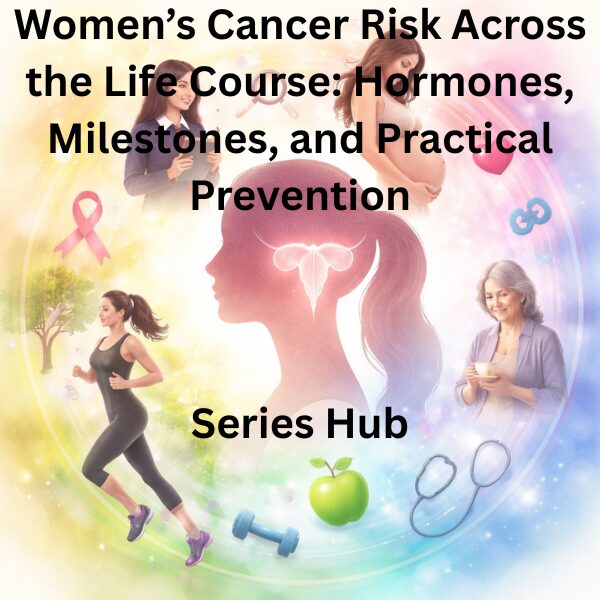
This series places women’s cancer risk on a single life-course map—from puberty and reproductive years to pregnancy/childbirth, the menopause transition, and postmenopause.
This series places women’s cancer risk on a single life-course map—from puberty and reproductive years to pregnancy/childbirth, the menopause transition, and postmenopause. We align breast, ovarian, and endometrial cancer considerations with hormone dynamics and real-world decisions (screening, symptom timing, and lifestyle levers).
What you will learn
- Who this series is for
- How to read (recommended paths)
- Episodes (Table of Contents)
- Common misconceptions (our stance)
- My Commentary
The goal is not fear-based messaging. The goal is to help you think in life events (not just age) and treat prevention as a system that lowers decision friction—so you can act calmly and early when it matters.
Who this series is for
- Anyone who wants a clear framework for “hormonal fluctuations” across life stages
- Readers who want risk “distance and context,” not zero-or-one thinking
- Those who want screening and care-seeking to be a system, not a panic response
- Anyone looking for realistic lifestyle strategies (weight, activity, alcohol, sleep) that are sustainable
How to read (recommended paths)
- Start with the map: Episode 1 → then follow your highest-interest topic
- If menopause is your main concern: Ep1 → Ep5 → Ep6 → Ep7
- If abnormal bleeding is your main concern: Ep1 → Ep4 → Ep7
- If family history/genetics is your concern: Review Ep2 & Ep3 → then Ep7 (special considerations)
Episodes (Table of Contents)
- Episode 1 | A Life-Stage Map of Female Hormones
Read - Episode 2 | Breast Cancer: How Risk Shifts Across Life Stages
Read - Episode 3 | Ovarian Cancer: The “Silent” Challenge and Reproductive Aging
Read - Episode 4 | Endometrial Cancer, Hormone Balance, and Metabolic Health
Read - Episode 5 | Perimenopause and Menopausal Symptoms: Balancing Risk and Quality of Life
Read - Episode 6 | Lifestyle and Women’s Cancer Risk: Weight, Activity, Alcohol, and Sleep
Read - Episode 7 | A Life-Course Prevention Playbook: Summary and Strategy
Read
Common misconceptions (our stance)
- This is not a “do X and you’ll never get cancer” series. It is about probability and decision support.
- Symptoms do not automatically mean cancer. The skill is tracking change over time and seeking care when patterns persist.
- Guidelines vary by country, organization, and personal risk. We present general principles; individual decisions belong with clinicians.
My Commentary
Women’s health sits at the intersection of hormones, metabolism, sleep, and life events. Fragmented information increases anxiety; systems reduce it. My intention with this series is to turn “risk” into a comparison tool rather than a headline, and to make screening and care-seeking feel like an operational routine. If this hub page helps you navigate the series as a practical “prevention OS,” it has done its job.
Morningglorysciences Editorial Note: This series is for general information only and does not replace individualized medical advice.
Editors Note
This article covered the following key points:
- Who this series is for
- How to read (recommended paths)
- Episodes (Table of Contents)
- Common misconceptions (our stance)
Rather than fragmented news or definitions, the aim was to present these as a single connected flow. For one step deeper on the same theme, see the related articles below.

Comments