

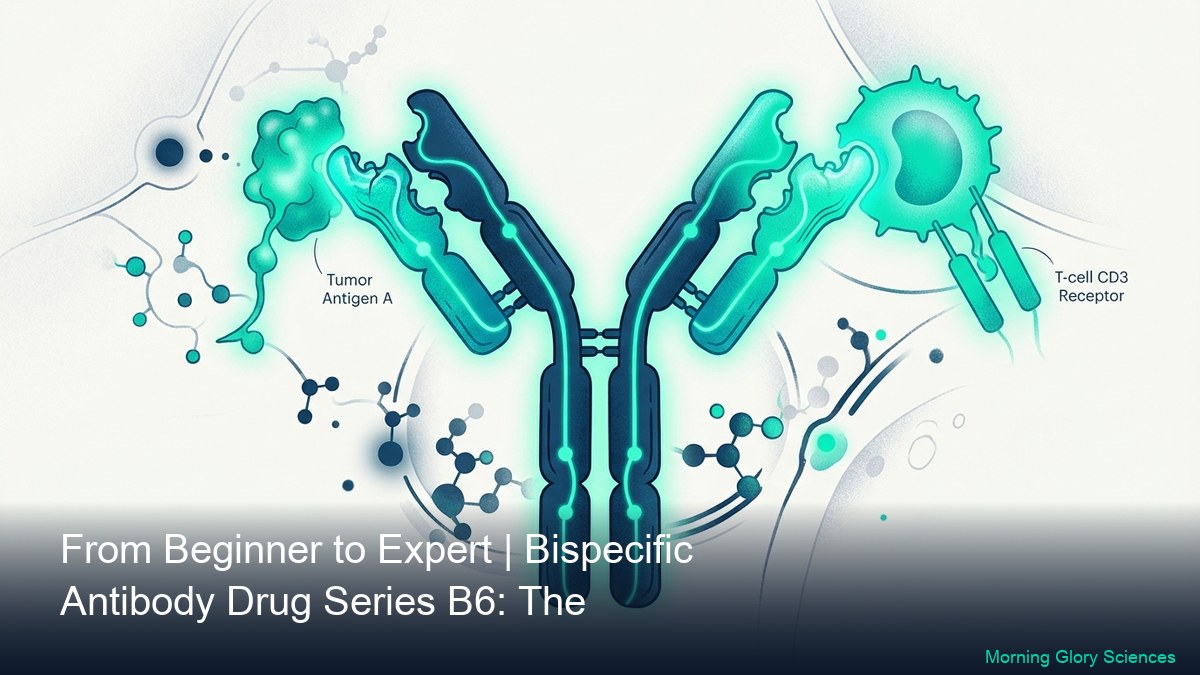
Bispecific antibody drugs are now discussed as one of the important modalities in cancer therapy.
Bispecific antibody drugs are now discussed as one of the important modalities in cancer therapy. However, this field did not begin in anything close to its current level of maturity. Its history is better understood as a long period in which the concept was clearly interesting but difficult to turn into real medicines, followed by gradual advances in structural design, manufacturing technology, half-life engineering, safety control, and clinical strategy that eventually brought the field closer to practical treatment.
What you will learn
- The early idea: if one molecule can recognize two targets, new pharmacology becomes possible
- The first major barrier: the distance between being able to make a molecule and being able to make a drug
- The technical turning point: improvements in structural control and manufacturing
- The clinical turning point: proving that the concept truly works in hematologic malignancies
- The real meaning of historical improvement: a shift from pursuing strength to pursuing control
As we have seen from A1 through A6 and B1 through B5, the essence of bispecific antibody drugs lies in the ability of a single molecule to engage two targets or conditions and thereby create a new pharmacological effect. But to make that idea work as an actual drug, it was never enough just to create two binding functions. The molecule also had to be structurally correct and stable, avoid excessive unwanted pairing, achieve sufficient half-life, limit dangerous toxicity, and fit into realistic dosing strategies. Many conditions had to be satisfied at the same time.
In this B6 article, we will organize the technological evolution of bispecific antibody drugs as a progression from the era of early concepts, through a period of technical stagnation, into the era of structural improvement, then clinical establishment, and finally toward the transition into next-generation designs. The important point is to understand today’s bispecific antibody drugs not simply as “new technology,” but as the result of a long chain of trial, error, and refinement. Once that is clear, it becomes much easier to see why current designs look the way they do, and why certain next-generation directions are now becoming so important.
The early idea: if one molecule can recognize two targets, new pharmacology becomes possible
The basic idea of bispecific antibody drugs is not new at all. The concept that an antibody might recognize two different targets at the same time, and thereby do things that conventional single-target antibodies cannot do, has existed for a long time. The possibilities were immediately attractive: bringing cells into proximity, controlling two receptors simultaneously, or creating condition-dependent activity.
The reason this idea had such force is straightforward. The biology of cancer and immunity is not simple enough to be controlled through one molecule alone. So there was an early intuition that if one could build a molecule capable of acting on two targets simultaneously, then one could intervene in disease biology in a way that was closer to reality. In that sense, bispecific antibody drugs carried from the beginning the potential to move antibody therapeutics beyond simple single-target inhibition toward control of biological relationships.
But an attractive concept is not the same as a viable medicine. In the early era, it was possible in principle to show that one molecule could bind two things, but the technology needed to produce such molecules reproducibly, stably, and in a clinically usable form was still insufficient. This gap between concept and implementation was the defining barrier of the field for a long time.
The first major barrier: the distance between being able to make a molecule and being able to make a drug
One of the biggest early problems was simply the difficulty of making the molecule cleanly. Compared with a standard IgG antibody, a bispecific antibody often requires different heavy and light chains to pair correctly, which creates a major risk of mispairing and heterogeneous products. In concept, a molecule with two binding specificities could be made, but in manufacturing it often came with too many mixed or incorrect species to be handled as a real medicine.
Even when the molecule itself could be generated, it often failed to satisfy the broader conditions required of a drug. Stability, half-life, manufacturing reproducibility, and immunogenicity were all common challenges. A small molecule with strong activity might be possible, but disappear too rapidly in the body. A larger and more stable molecule might be possible, but then the intended cell-bridging or local activity could become harder to optimize. There was a large distance between having a functional research molecule and having a drug candidate.
The essential problem in this era was that bispecific antibodies often remained “interesting research molecules.” They could look appealing in cell-based experiments, but they did not yet satisfy the conditions required to become products. This is one of the reasons the field long appeared full of promise but slow to deliver.
The technical turning point: improvements in structural control and manufacturing
A major turning point in the history of bispecific antibody drugs came with advances in structural control and manufacturing technology. More effective ways of pairing different chains correctly, improved IgG-like format design, and the use of stable Fc-containing architectures all helped improve molecular uniformity and production reproducibility. For the first time, bispecific antibodies started to move from things that could merely be made into things that could be handled as stable therapeutic candidates.
This improvement mattered enormously. The value of bispecific antibody drugs lies in the novelty of their pharmacology, but that novelty means nothing unless it can be turned into a viable medicine. Progress in structural control allowed concepts that had once been mostly theoretical to become actual development programs.
It was also important that this period was not just about being able to make cleaner molecules. It was also when the field began to learn which structures supported half-life, which formats were more compatible with safety management, and which designs made sense for practical dosing. In other words, the field began to develop not only structural solutions, but real drug-design logic. This was the stage at which bispecific antibodies began to shift from a technological curiosity toward a development platform.
The clinical turning point: proving that the concept truly works in hematologic malignancies
Another major turning point, after the technical improvements, was the emergence of real clinical value in hematologic malignancies. In particular, the success of T-cell engager formats had decisive significance for the field. It showed that bispecific antibody drugs were not simply interesting theoretical constructs or laboratory tools, but could make meaningful contributions to actual patient treatment.
This clinical success was important not because “being bispecific” had value on its own, but because the intended mechanism of action was shown to work in the clinic. The idea of pharmacologically bringing T cells and tumor cells together moved from theory into reality. At that point, the field shifted from being driven mainly by conceptual hope to being driven by real competitive clinical development.
At the same time, this success also exposed the limitations of first-generation approaches. CRS, narrow therapeutic windows, the challenge of early dosing management, and the difficulty of extending directly into solid tumors all became much clearer. So clinical success was not the end of the story. It was also the event that made the next set of technical challenges unmistakably visible.
The real meaning of historical improvement: a shift from pursuing strength to pursuing control
Looking back at the history of bispecific antibody drugs, one major pattern becomes visible. The field has gradually shifted from trying simply to make stronger molecules toward trying to make more controllable ones. In the early days, the main focus was on whether one could create molecules that recognized two targets and generated strong activity. Over time, however, it became clear that strength alone was not enough to make a useful drug.
That is where ideas such as half-life tuning, Fc control, valency optimization, careful affinity adjustment, localized activation, and conditional selectivity began to matter. These were not ways of weakening the pharmacology. They were ways of making the pharmacology usable. In that sense, the real meaning of historical improvement was not to give up on strength, but to learn how to control strength.
This trajectory connects directly into current next-generation designs. The emphasis we saw in A6 on conditional selectivity and localized activation is not a sudden new trend. It sits on the same historical line of refinement. The key point of B6 is to understand that what the field now needs is emerging as a rational answer to the failures and limits that became visible in earlier stages.
Why current bispecific antibody drugs are not just “extensions of the past” but closer to “evolved versions”
Today’s bispecific antibody drugs are not simply early concept molecules that have been polished slightly. They are the result of integrated design that includes manufacturing, structure, half-life, safety, dosing strategy, indication selection, and clinical development strategy. In that sense, even though they clearly evolved from the early ideas, they are much closer in practical terms to “evolved versions” than to simple extensions.
For example, early efforts emphasized simply linking two targets. Today, the field asks where the drug should act, how long it should remain active, what kind of dosing strategy can make it safe, and in which indication it should first be established. The perspective has expanded from designing the molecule alone to designing the full therapeutic system.
This is an important difference. Technological maturity does not mean only that molecular performance improves. It also means that the field begins to understand what the bottlenecks are, and what kinds of control are needed to turn pharmacology into medicine. That is exactly the stage that bispecific antibody drugs have now entered.
Connection to the next generation: understanding the history makes future directions easier to see
The reason it matters to look back at the history of bispecific antibody drugs is not just to organize knowledge. The deeper value is that once we understand what the barriers were in the past, it becomes much easier to see where the field should go next. The directions we discussed in A6—conditional selectivity, localized activation, solid-tumor-oriented redesign, multifunctionality, and refined development strategy—are all natural extensions of the limitations that history has already revealed.
For example, the early challenge was simply how to connect two targets in one molecule. Now the challenge is where to connect them, and under what conditions to connect them. Early on, making the molecule at all was the main barrier. Now the barrier is how to make it function safely. In other words, as the technology has matured, the questions themselves have become higher-order questions.
In this sense, understanding the past also helps us think about the future. Once we see what has already been improved, it becomes easier to see what still needs to be improved next. B6 is therefore also an article about that connection between historical learning and future design.
What B6 means within the overall series
The central message of B6 is that the current position of bispecific antibody drugs is the result of a long accumulation of technical refinement and clinical learning. From A1 through A6, the series mainly organized how to understand bispecific antibody drugs as they exist today. In B6, we have now placed that understanding back into history and asked why the current design logic looks the way it does.
With that historical perspective, future evolution becomes easier to interpret not as a random change in fashion, but as rational improvement in response to problems that have accumulated over time. In that sense, B6 is near the end of the series, but it also serves as one of the integrative chapters.
At this point, bispecific antibody drugs can be seen not as a single isolated technology, but as a field in which concept, structure, pharmacology, safety, development strategy, and history all overlap. That is one of the central goals of the series as a whole.
Conclusion
The technological development of bispecific antibody drugs is not the story of an attractive concept that immediately became a medicine. In the early period, the concept of recognizing two targets at once was already there, but the field lacked the technology needed to make such molecules stably, give them appropriate half-life, and use them safely in the clinic. Over time, structural control, manufacturing, half-life engineering, dosing strategy, and safety management gradually accumulated, making today’s practical bispecific antibody drugs possible.
The essential pattern in this history is a shift from pursuing strength to pursuing control. And that same historical line continues directly into next-generation designs such as conditional selectivity, localized activation, solid-tumor adaptation, and multifunctionality. To understand current bispecific antibody drugs properly, it is essential to understand the barriers of the past and the accumulation of refinement that followed.
What this series as a whole reveals is that bispecific antibody drugs are not merely a new modality, but a field with a long evolutionary trajectory inside antibody engineering and cancer therapy. Seen from that perspective, the future development of the field also becomes easier to understand in a more three-dimensional way.
Related Articles
Editors Note
This article covered the following key points:
- The early idea: if one molecule can recognize two targets, new pharmacology becomes possible
- The first major barrier: the distance between being able to make a molecule and being able to make a drug
- The technical turning point: improvements in structural control and manufacturing
- The clinical turning point: proving that the concept truly works in hematologic malignancies
Rather than fragmented news or definitions, the aim was to present these as a single connected flow. For one step deeper on the same theme, see the related articles below.




Comments