

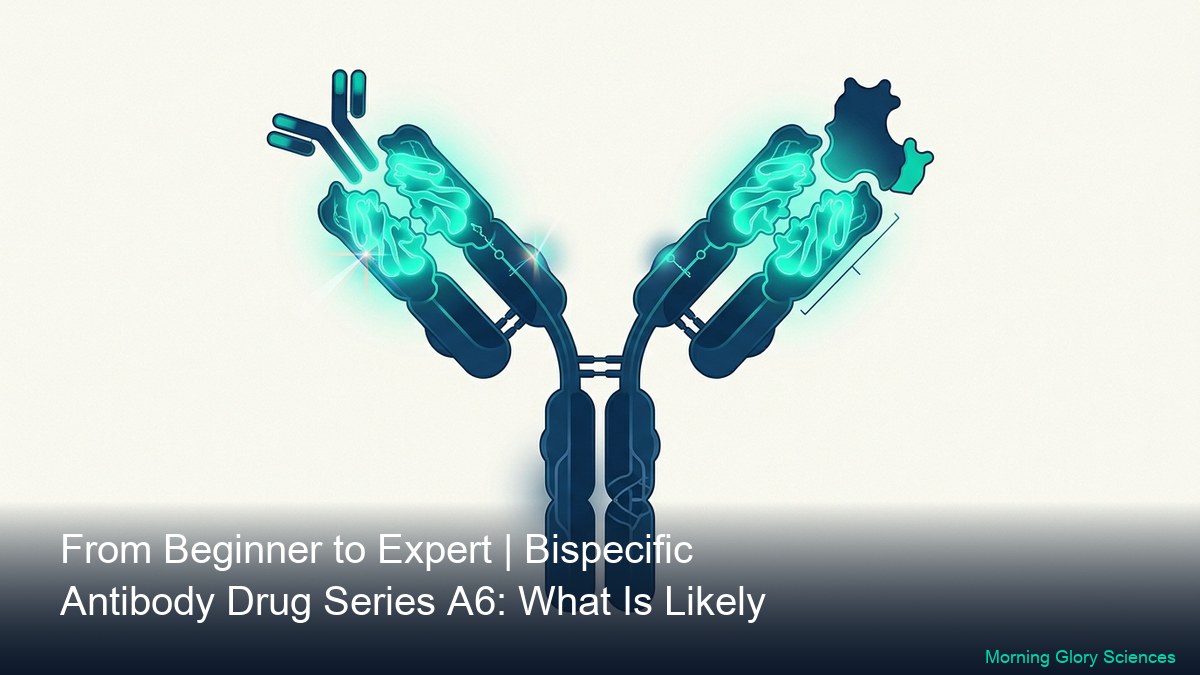
Bispecific antibody drugs are already beginning to establish a distinct clinical presence, especially in hematologic malignancies, and are starting to build their own place within cancer therapy.
Bispecific antibody drugs are already beginning to establish a distinct clinical presence, especially in hematologic malignancies, and are starting to build their own place within cancer therapy. However, this field is far from a completed technology. Rather, it is now at a stage where the successes and limitations of the first generation have become visible, making the next directions of evolution clearer. As we have seen from A1 through B5, bispecific antibody drugs can implement powerful pharmacology, but they also face many challenges, including safety, viability in solid tumors, limits of target selection, PK/PD, and practical dosing implementation.
What you will learn
- Why is next-generation evolution necessary?
- 1. Stronger conditional selectivity: making where the drug works more precise
- 2. Localized activation design: creating pharmacology at the tumor site rather than throughout the body
- 3. Solid tumor redesign: not simply importing the blood-cancer success model
- 4. Multifunctionality: from bispecificity toward more integrated pharmacological control
For that reason, the truly important question in this field is not the abstract question of whether bispecific antibody drugs are promising. The more essential question is which design philosophies may become the next answers to the specific problems already identified. The next generation will not emerge simply by making the same molecules slightly better. It will emerge through better control of where activity occurs, how the therapeutic window is widened, and how these drugs can be extended into solid tumors.
In this A6 article, we will organize a map of next-generation bispecific antibody drugs. We will first confirm why next-generation evolution is needed, and then examine the directions most likely to grow: stronger conditional selectivity, localized activation design, solid-tumor-oriented redesign, multifunctionality, combination-oriented design, and more refined development strategy. The important point is not to think of the “next generation” as flashy novelty, but as rational evolution in response to the challenges already identified.
Why is next-generation evolution necessary?
The main reason bispecific antibody drugs require a next-generation evolution is that the success of the first generation also made its limits visible. For example, T-cell engager formats showed strong clinical value in hematologic malignancies, but at the same time they exposed problems such as CRS, complexity of early dosing management, and the difficulty of extending directly into solid tumors. In other words, simply expanding the current successful model will not be enough to unlock the full potential of the field.
Also, the major attraction of bispecific antibody drugs—their high functional power—is directly connected to their development difficulty. Strong pharmacological activity often narrows the therapeutic window, and freedom in target design increases structural and strategic complexity. In solid tumors especially, antigen heterogeneity, the tumor microenvironment, infiltration barriers, and toxicity to normal tissue remain obstacles that are difficult to overcome with first-generation logic alone.
So next-generation evolution does not mean simply making molecules stronger. More fundamentally, it means evolving toward designs that act in the right place, to the right extent, and on the right cellular partners. In that sense, the design philosophy of next-generation bispecific antibody drugs is shifting from a primary focus on strength toward a primary focus on control.
1. Stronger conditional selectivity: making where the drug works more precise
One of the most important future directions is stronger conditional selectivity. This means going beyond simply choosing targets that are highly expressed in tumors and instead using two or more conditions together to create more tumor-selective activity. As we saw in A2 and B2, bispecific antibody drugs are inherently well matched to this direction because they are built to handle two conditions at once.
This matters because ideal, completely tumor-specific antigens are rare. Especially in solid tumors, it is often necessary to work with targets that are also expressed to some extent in normal tissue, which means the safety window can easily become narrow with single-target logic alone. By using two conditions together, it may become possible to create relative selectivity even with targets that would be too risky on their own.
In the future, this idea of designing conditions under which meaningful activity occurs primarily in tumors is likely to become increasingly central. This is not only about improving safety. It is also crucial for extending bispecific antibody drugs into solid tumors. In that sense, conditional selectivity is not a peripheral technical feature. It is one of the core axes of next-generation evolution.
2. Localized activation design: creating pharmacology at the tumor site rather than throughout the body
Localized activation design is also likely to become increasingly important. This refers to designing the drug so that it does not act equally strongly everywhere in the body, but instead produces strong activity primarily at the tumor site or within a specific microenvironment. As we saw in A2 and A4, one of the strengths of bispecific antibody drugs is their ability to produce strong pharmacology. But that same strength can easily translate into systemic toxicity.
That is why control over where the drug acts becomes so important. For example, one can imagine designs in which immune activation becomes more likely only after tumor-local accumulation, or designs in which full function of one arm only emerges after binding by the other arm, or designs that exploit specific features of the tumor microenvironment to amplify activity locally. This is not about reducing strength. It is about concentrating strength in the right place.
The reason this direction is likely to grow is straightforward. Future competition in this field will not be about building molecules that are simply strong. It will be about building molecules that are strongly effective in a safe and controlled way. In that sense, localized activation design could become a central differentiation axis not only for solid tumors but for next-generation bispecific antibody drugs more broadly.
3. Solid tumor redesign: not simply importing the blood-cancer success model
One of the biggest future challenges for bispecific antibody drugs is true expansion into solid tumors. But what matters here is not to simply transplant the success model from hematologic malignancies. Cell-bridging formats and target strategies that work in blood cancers often fail to carry over directly because of the tumor microenvironment, limited infiltration, antigen heterogeneity, and normal tissue expression patterns found in solid tumors.
For that reason, what is likely to grow in solid tumors is not merely “the same T-cell engager applied to a new indication,” but rather bispecific antibody drugs redesigned with the specific barriers of solid tumors in mind. This may include designs that increase localization, improve tumor infiltration or retention, enhance discrimination from normal tissues, or simultaneously modulate the immunosuppressive microenvironment.
In other words, expansion into solid tumors is not merely a matter of indication expansion. It is in large part a problem of modality redesign. Without this recognition, it becomes difficult to understand why so many programs struggle. The real next step will depend on treating solid tumors not as simply the next market, but as the next design problem.
4. Multifunctionality: from bispecificity toward more integrated pharmacological control
Another important direction for next-generation evolution is multifunctionality. This does not simply mean increasing the number of targets. It means integrating more than one type of pharmacological function into the design. For example, one could imagine molecules that combine tumor localization, immune activation, and signal control in a coordinated way.
This direction is natural because cancer itself is a multilayered disease, and it is often difficult to control it adequately through a single type of intervention. In the future, the design principles learned from bispecific antibody drugs may evolve toward more precise multi-condition control. At the same time, complexity is not valuable just because it is complexity. The more complicated a molecule becomes, the more difficult manufacturing, PK/PD, safety, and clinical development also become.
For that reason, multifunctionality is meaningful only when it provides a clear additional value. It is an important direction of interest, but the key is to identify the necessary level of complexity rather than to pursue complexity for its own sake. Rational functional integration, not complexity alone, is what matters.
5. Combination-oriented design: from single-agent completeness to built-in combinability
Another direction likely to grow is combination-oriented design. This means that instead of trying to solve everything through monotherapy, molecules are designed and developed from the start with the expectation that their greatest value may emerge in combination with other treatments. As we saw in B5, especially in solid tumors, there are many settings in which a bispecific antibody drug alone is unlikely to overcome all of the barriers present.
That is why it is likely to become increasingly important to design around complementarity with immune checkpoint inhibitors, chemotherapy, radiation, ADCs, or radiopharmaceuticals. This is not simply a development compromise. It reflects the broader reality that cancer therapy is moving toward increasingly integrated, multimodal strategies.
The key point is to treat combination not as something added later, but as part of pharmacological design from the beginning. Which partner modality fits best, how toxicities overlap, and in which patient population the value is greatest should all be built into the strategy. This may become one of the most realistic paths to success for next-generation bispecific antibody drugs.
6. More refined development strategy itself: starting where the molecule is most likely to work
Next-generation evolution is not only about molecular design. It is also about refinement of development strategy itself. As we saw in B5, in bispecific antibody drugs it is often more rational to begin in the indication or patient population where the drug is most likely to work, rather than aiming broadly from the start. This is likely to become even more important in the future.
The reason is that the more advanced and complex the design becomes, the more strategic the development pathway needs to be in order to show its value appropriately. Decisions about which biomarkers to use for patient selection, what dosing strategy is needed for safety, and which indication should generate the first proof of concept all become directly linked to how the molecule will be judged.
In that sense, the future competition in bispecific antibody drugs will not only be a competition to make more novel molecules. It will also be a competition to make those molecules work in the most intelligent way. Development strategy itself is likely to become a stronger source of differentiation.
How can we tell what is truly likely to grow?
Taking all of this together, the criteria for identifying the bispecific antibody drugs most likely to grow become fairly clear. First, does the design create strong pharmacology without sacrificing safety? Second, does it treat the barriers of solid tumors as a real design problem rather than ignoring them? Third, is the next step a rational evolution that creates clear additional value, rather than complexity for its own sake?
It is also important that not only the molecule, but the development strategy be clearly defined: which patients it is meant for, in which indication, and in combination with what. If evaluation is based only on superficial novelty, the true substance of the next generation will be missed. What matters most is whether the design really answers one of the unresolved problems in the field.
So when we ask what is likely to grow, we should not simply follow whichever technology is fashionable. We should ask how cleanly the design corresponds to the actual problem. Once that perspective is in place, the phrase “next generation” can be read not as a slogan, but as a form of rational evolution.
How this connects to the rest of the series
The central message of A6 is that the evolution of next-generation bispecific antibody drugs will not be about simply making stronger molecules, but about creating efficacy in a more controlled way. Stronger conditional selectivity, localized activation, solid-tumor-oriented redesign, multifunctionality, combination-oriented design, and more refined development strategy all point in the same direction.
In the next article, B6, we will step back into the historical trajectory of the field and examine how bispecific antibody drugs reached the present stage through technical trial and error, and what kinds of improvements have accumulated over time. If A6 is a map of the future, B6 will trace the path of evolution that led to it.
Conclusion
The key to next-generation evolution in bispecific antibody drugs is not simply making molecules stronger or more complicated. The real issue is moving toward designs that act on the right targets, in the right place, to the right degree, while preserving safety. That is why conditional selectivity, localized activation, solid-tumor-oriented design, multifunctionality, combination-oriented design, and refinement of development strategy will all matter.
Also, identifying what is truly likely to grow requires more than noticing which technology is fashionable. The key is to ask whether the design provides a rational answer to one of the unresolved problems in the field. The essence of next-generation bispecific antibody drugs is not that they are merely new, but that they evolve more correctly in response to real challenges.
In the next article, B6, we will organize the technological development and historical path of improvement in bispecific antibody drugs. After looking ahead to the future, we will then look back at the evolutionary path that brought the field to where it is now, helping integrate the full series more completely.
Related Articles
Editors Note
This article covered the following key points:
- Why is next-generation evolution necessary?
- 1. Stronger conditional selectivity: making where the drug works more precise
- 2. Localized activation design: creating pharmacology at the tumor site rather than throughout the body
- 3. Solid tumor redesign: not simply importing the blood-cancer success model
Rather than fragmented news or definitions, the aim was to present these as a single connected flow. For one step deeper on the same theme, see the related articles below.




Comments