

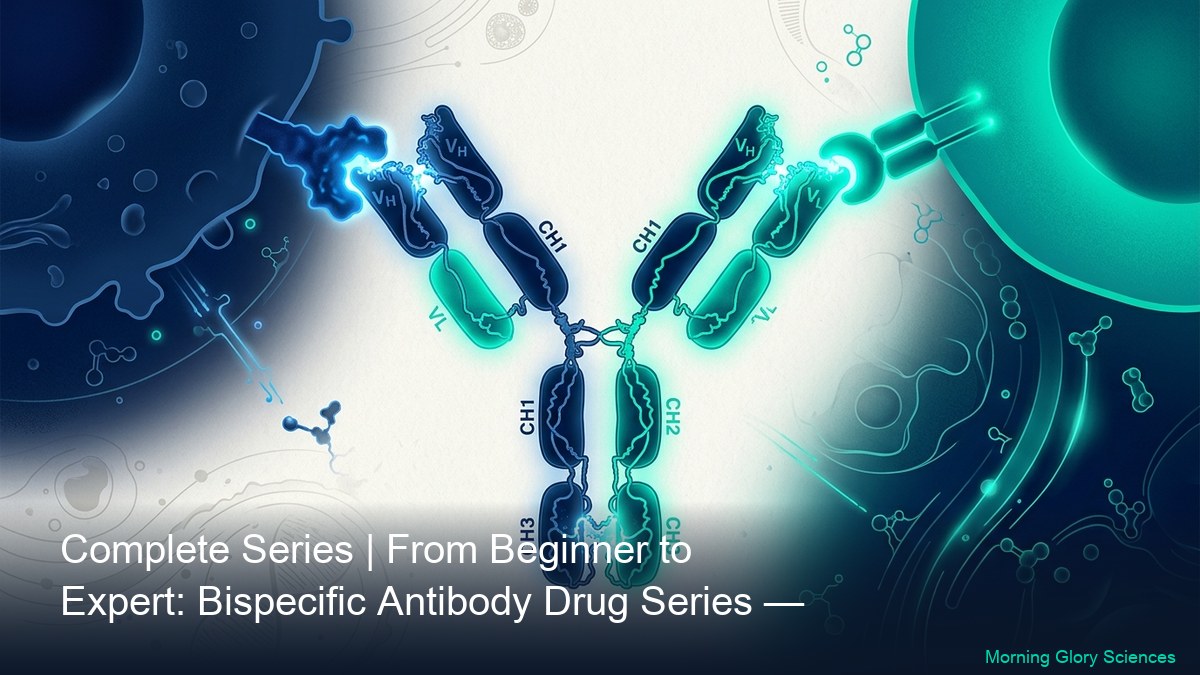
Across 12 deep-dives we have rebuilt how to think about bispecific antibodies—from molecular geometry to clinical strategy. This index maps every turning point and signals what the next decade will be about.
This series, “From Beginner to Expert: Bispecific Antibody Drug,” was designed to provide a systematic understanding of bispecific antibody drugs from the fundamentals to advanced specialist-level issues. Rather than stopping at fragmented news items or simple drug introductions, the series has organized structural design, mechanism of action, target design, safety, PK/PD, clinical development strategy, and next-generation design as one connected flow.
What you will learn
- What this series helps you understand
- How to read this series
- Full Index | Article List
- Overall Summary of the Series
- Who this series is for
Bispecific antibody drugs are one of the fastest-evolving areas in cancer therapy. At the same time, their essence is not something that can be explained adequately in a single phrase, and it is not enough to understand them merely as “antibodies that bind two targets.” Throughout this series, the goal has been to build a framework that remains accessible to beginners while preserving enough density to remain meaningful even for expert readers.
This final overview page serves as the main entry point to the full series. It explains what the series helps readers understand, in what order the articles are easiest to read, and how each article fits into the overall structure. For first-time readers, it can serve as a guide; for those who have already read individual installments, it can serve as a hub for review and reorganization.
What this series helps you understand
The most important insight that runs through this series is that bispecific antibody drugs are not simply “next-generation antibody therapeutics.” Their essence lies in being design-driven modalities that use one molecule to handle two targets or conditions, thereby creating new pharmacological relationships. To understand them properly, one must therefore look not only at basic definitions, but also at structure, mechanism, targets, modality differences, safety, PK/PD, and indication strategy as one connected whole.
More specifically, this series explains what bispecific antibody drugs are, how they differ from standard antibodies, how structural design changes pharmacological properties, how mechanisms such as T-cell redirection or dual signal control work, how targets are selected and combined, how safety and toxicity emerge, why hematologic malignancies and solid tumors differ so much, and what kinds of next-generation directions are now becoming important.
In other words, this series is not just for memorizing terminology. It is meant to provide a framework for judging how the field should be understood. Whether one is approaching this from research, clinical development, investment, or business strategy, the aim is to move from fragments of information to structural understanding.
How to read this series
The series is structured so that the A-side articles serve as the more general and integrative layer, while the B-side articles provide deeper specialist-oriented analysis. This does not simply mean “easy” versus “hard.” The A-side articles build the overall picture and the main conceptual points, while the B-side articles dig more deeply into design logic, pharmacology, and development strategy. It is possible to follow the series through the A-side alone, but moving back and forth between A and B greatly increases the resolution of understanding.
For readers starting from the beginning, the recommended order is A0 → A1 → B1 → A2 → B2 → A3 → B3 → A4 → B4 → A5 → B5 → A6 → B6. In this sequence, concepts, structure, mechanism, targets, safety, clinical strategy, future outlook, and historical improvement connect naturally.
Readers who already have some familiarity with the field can also start from the B-side depending on their interest. Even in that case, however, it is still helpful to read A0, A1, and A3 first, because those articles make the overall map of the series much easier to hold in mind.
Full Index | Article List
A0 Introduction
A0: What This Series Will Help You Understand
A1 Foundations
A1: What Are Bispecific Antibody Drugs? A Thorough Introduction from the Basics
B1 Structural Design
B1: Comparing Structural Designs and Their Impact on Therapeutic Effects
A2 Mechanism of Action
A2: How Do Bispecific Antibody Drugs Work? A Clear Guide to Their Mechanisms of Action
B2 Target Design
B2: What Determines Target Design and the Optimization of Mechanism of Action?
A3 Classification and Overall Landscape
A3: What Types Are There? Classification and the Overall Landscape of Bispecific Antibody Drugs
B3 Modality Differences
B3: How Differences in Modality Shape Pharmacological Properties
A4 Safety
A4: Why Do Adverse Effects Occur? Understanding the Balance Between Efficacy and Safety
B4 PK/PD and Development Bottlenecks
B4: How Should We Think About Toxicity, PK/PD, and Development Bottlenecks?
A5 Position Within Cancer Therapy
A5: Where Do Bispecific Antibody Drugs Sit Within the Overall Landscape of Cancer Therapy?
B5 Clinical Development Strategy
B5: How Should We Think About Clinical Development Strategy and Indication Expansion?
A6 Next-Generation Map
A6: What Is Likely to Grow Next? A Map of Next-Generation Bispecific Antibody Drugs
B6 Technological Evolution and History
B6: The Technological Evolution and Historical Path of Improvement in Bispecific Antibody Drugs
Overall Summary of the Series
The single most important conclusion that emerges from this series is that bispecific antibody drugs are not simply “antibodies that bind two things.” Their essence lies in using two targets or conditions to create new pharmacological relationships that are difficult to achieve with single-target antibodies. Cell bridging, dual signal control, conditional selectivity, and localized activation are all examples of this deeper logic.
At the same time, the difficulty of this modality is equally clear. Strong pharmacological activity is tightly linked to safety risk, and structure, targets, modality, PK/PD, and dosing design all have to be optimized together for the drug to become viable. In solid tumors especially, the barriers of the tumor microenvironment, antigen heterogeneity, and normal tissue toxicity make it impossible simply to transplant the success model from hematologic malignancies.
Even so, the value of bispecific antibody drugs remains substantial. They are particularly meaningful in settings where single-target drugs are not enough, but where interventions as heavy as cell therapy are difficult. Future evolution is therefore likely to move not toward simply making stronger molecules, but toward making them work strongly in a safer and more controlled way through conditional selectivity, localized activation, solid-tumor adaptation, multifunctionality, combination strategy, and refinement of development strategy.
Who this series is for
This series was designed not only for readers encountering bispecific antibody drugs for the first time, but also for readers who already follow specific drugs or company pipelines and want to understand the field more structurally. For researchers, it should help organize design logic. For clinical readers, it should help clarify mechanism and safety. For those in investment or business strategy, it should provide a clearer framework for development logic and indication expansion.
In particular, readers who feel that the field often appears fragmented when seen only through news headlines or company announcements may find value in reading the full series as a connected whole. Bispecific antibody drugs become far more interesting—and far more useful from a practical perspective—when they are read not as trendy technology, but as attempts to answer specific unresolved problems in cancer therapy.
Preview of the Next Series
The next series can naturally expand into related modalities, broader antibody engineering, or a wider systems-level view of cancer therapy as a whole. Once bispecific antibody drugs are understood properly, the differences from and relationships with ADCs, CAR-T, radiopharmaceuticals, and immune checkpoint inhibitors become much more three-dimensional. A future series can build on that foundation by exploring these neighboring areas in greater comparative depth.
For readers who have come this far, I hope this final index page will serve as a durable entry point and hub for returning to the series whenever needed.
Related Articles
Editors Note
This article covered the following key points:
- What this series helps you understand
- How to read this series
- Full Index | Article List
- Overall Summary of the Series
Rather than fragmented news or definitions, the aim was to present these as a single connected flow. For one step deeper on the same theme, see the related articles below.


Comments