Over the past few years, headlines about Antibody-Drug Conjugates (ADCs) have become hard to miss in oncology and biopharma news. Multi-billion-dollar acquisitions, mega licensing deals, capacity expansions for ADC manufacturing, and the rapid rise of China- and Asia-born ADC biotechs— all of these trends together justify the expression “global ADC land grab.”
At the same time, many readers who are interested in cancer treatment or the pharmaceutical industry may still be asking: “What exactly is an ADC?”, “Why is it attracting so much attention right now?”, and “If we already have IO and small-molecule targeted therapies, why do we need ADCs?” For practitioners in pharma, VC, or consulting, the key question is whether the ADC boom is a transient hype or a sign of structural change in the industry.
In this series, “From Beginner to Expert | ADC: From Basics to the Frontline – A Deep Dive into the 2025 Global ADC Land Grab and Beyond”, we will build on the situation as of November 2025 and walk through ADCs from the basics to the strategic frontier: technology, clinical value, deal-making, geopolitics, supply chains, and patent strategies. In this first article, we will focus on a single core question: “Why is there an ADC land grab now?” To answer it, we will first position ADCs within the broader landscape of cancer therapies, then discuss what changed after the emergence of Enhertu, and finally sketch a “map” that we will use in the rest of the series.
What Is Happening Right Now? A Bird’s-eye View of the Global ADC Land Grab
The “Quantity” and “Quality” of ADC Deals Around 2025
Let us start with a simplified picture of what is happening. In recent years, the total number of life sciences M&A and licensing deals has been somewhat constrained, but ADC-related deals stand out in terms of both size and strategic importance. We see large-scale acquisitions of ADC-focused companies, multi-asset licensing deals worth billions of dollars, and partnerships covering manufacturing, CDMOs, linker-payload technologies, and more. The ADC opportunity spans the entire value chain.
The key point is not that “there are many deals,” but rather that each deal tends to be heavy and consequential. Multi-asset licenses with upfront payments in the billions of dollars and mega-acquisitions of companies with late-stage ADC pipelines— transactions that would have been considered exceptional a decade ago—are now fiercely contested by multiple global players. This indicates that ADCs are no longer seen as “just another new drug class” but as a platform capable of anchoring a portfolio.
Why Do the Headlines Look “ADC-heavy”? Investment and Structural Change
If you follow industry news, you may feel that “everything is ADC these days.” This is because not only pharma companies but also investors, CDMOs, technology-platform players, and China-based biotechs are all converging on ADCs as a key modality at the same time.
For large pharma, ADCs are promising candidates to help fill major revenue gaps created by patent cliffs. For investors, ADCs offer a theme that is easy to communicate—cancer, high value per patient, and platform-like extensibility. At the same time, the complexity of ADC manufacturing and quality control is a major business opportunity for specialized CDMOs and chemical manufacturers.
In other words, drug discovery, finance, manufacturing capacity, and regional strategy are all aligning around ADCs. This multi-layered alignment is what makes the “ADC land grab” a phenomenon that involves the entire ecosystem rather than a single product class.
Where Do ADCs Sit in the Landscape of Cancer Therapies?
Placing ADCs Among Major Modalities: From Chemotherapy to Cell Therapy
To understand why ADCs are being singled out, we first need to place them within the overall landscape of cancer therapies. Very broadly, today’s oncology treatment modalities can be grouped as follows:
- Classical cytotoxic chemotherapy
- Targeted therapies (small-molecule TKIs and monoclonal antibodies)
- Immune checkpoint inhibitors (IO, such as PD-1/PD-L1, CTLA-4)
- Cell therapies such as CAR-T
- Antibody-Drug Conjugates (ADCs)
Chemotherapy exploits differences in proliferation rate between cancer cells and normal cells, but its lack of selectivity causes serious systemic toxicities. Targeted small molecules and antibody drugs have improved selectivity by attacking specific driver oncogenes or receptors. Immune checkpoint inhibitors can induce long-term remission in a subset of patients, but they do not work for everyone and come with the challenge of immune-related adverse events.
Cell therapies like CAR-T have delivered remarkable results in hematological malignancies, yet they face issues with manufacturing, logistics, cost, and extending use into solid tumors. Against this backdrop, ADCs combine the selectivity of antibodies with the killing power of chemotherapy, offering a way to attack disease segments that are hard to reach with existing modalities alone.
The ADC Concept: Antibody + Payload + Linker
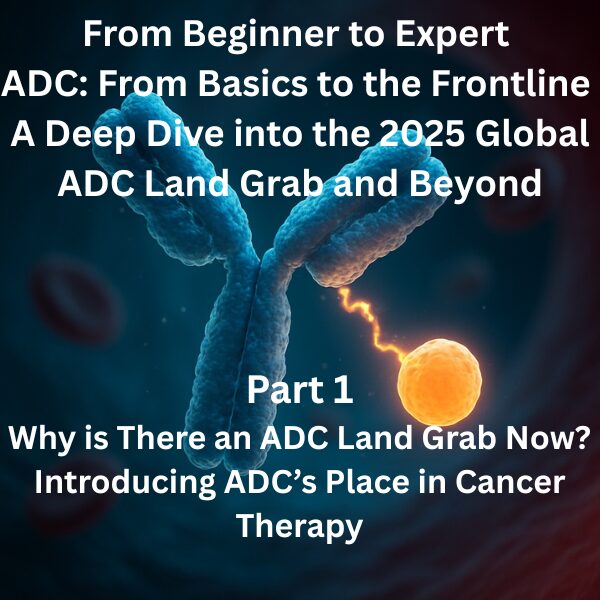
The basic structure of an ADC is straightforward. It consists of three key components:
- Antibody: the “delivery guide” that recognizes a specific antigen on the surface of cancer cells (e.g., HER2, TROP2).
- Payload: a highly potent cytotoxic agent, the “execution unit.”
- Linker: the “rule of delivery,” connecting the antibody and payload and defining where and how the payload is released.
While circulating in the body, the antibody shields the payload, limiting nonspecific systemic exposure. Once the ADC binds to a target cell and is internalized, the linker is cleaved and the payload is released, causing lethal damage from within the cancer cell. This is, at an intuitive level, how ADCs are supposed to work.
In practice, many design variables come into play: which antigen to target, what drug-to-antibody ratio (DAR) to aim for, how stable the linker should be in circulation and under what conditions it should be cleaved, and so on. Still, the core concept—combining the targeting capability of antibodies with a powerful cytotoxic payload—is relatively intuitive and can be seen as a natural extension of the evolution of cancer therapy.
From First-generation ADCs to the Pre-Enhertu Era: On the Edge of the Mainstream
Early ADCs mainly focused on hematologic malignancies. They were effective for certain patient populations but remained limited in scope, and safety issues related to linker stability and payload selection made their broader adoption challenging. As a result, ADCs were often perceived as “valuable options for some patients” but not yet as a central pillar of oncology.
Solid-tumor ADCs gradually emerged, but indications tended to be narrow and markets relatively small. Even though many players were interested in ADCs, there was still skepticism: “Can they really become a mainstream modality?” This was essentially the mood in the industry on the eve of Enhertu.
What Changed After Enhertu?
From HER2-high to HER2-low and Beyond: The Impact of Broadening Indications
Trastuzumab deruxtecan (Enhertu) fundamentally altered this perception. It not only demonstrated strong efficacy in HER2-high breast cancer but also showed clinical benefit in a patient group known as HER2-low— individuals who had previously been considered outside the scope of HER2-targeted therapy. Enhertu is also expanding into other solid tumors, progressively breaking the old intuition of “HER2 = a niche subset of breast cancer.”
The significance of this goes well beyond merely increasing the number of eligible patients. By broadening the biomarker-positive population, several things happen:
- The clinical footprint of ADCs expands rapidly.
- Regulators, physicians, and payers gain firsthand familiarity with ADCs as a modality.
- Subsequent ADCs are no longer seen as “completely unfamiliar” therapies.
In other words, Enhertu did not just succeed as a standalone product. It raised the overall recognition and trust level of the ADC category, making it easier for the entire modality to gain acceptance.
By-stander Effect and Topo-I Payloads: A Glimpse of New Possibilities
A frequently discussed feature of Enhertu is its Topo-I inhibitor payload and the associated by-stander effect. After the ADC is internalized and the linker is cleaved inside the cancer cell, a fraction of the released payload can diffuse out of the cell and damage neighboring tumor cells. This is the essence of the by-stander effect.
Traditional ADC design focused mainly on killing only those cells that express the target antigen. However, tumors are heterogeneous; expression levels vary within the same tumor mass. An ADC with a by-stander effect can, in principle, use the “strongly expressing cells” as an entry point and propagate its effect to neighboring cells that express the antigen weakly or intermittently.
Of course, this raises safety concerns and must be balanced against systemic toxicity. Yet the data from Enhertu and similar ADCs indicate that, with careful design, it is possible to deliver clinically meaningful benefits to a broader patient base. This has substantially widened the “expectation range” for what ADCs might be able to achieve.
What Happens When Regulators, Clinicians, and Payers “Learn” ADCs?
For any new modality to be widely adopted, it is not enough for the drug itself to be effective. Regulators, clinicians, and payers must collectively learn how to evaluate, use, and reimburse it.
The approvals, label expansions, and guideline updates around Enhertu and other ADCs have accelerated this process:
- Regulators are building reference points for what constitutes sufficient evidence and how to evaluate safety profiles for ADCs.
- Oncologists are accumulating experience regarding which patients to treat, at which line of therapy, and how to manage ADC-specific toxicities.
- Payers are gathering real-world data to assess cost-effectiveness and define reimbursement criteria.
This “learning cost” has largely been paid already. As a result, new ADC programs no longer face an entirely blank slate. They can run on the tracks laid down in the post-Enhertu era, which fundamentally changes the risk–reward calculation for companies and investors.
Why Are Companies Rushing to “Lock In” ADCs Now?
Patent Cliffs and the Pressure to Fill Revenue Gaps
From the perspective of large pharma, investing in ADCs is not merely about diversifying into a promising new class. Behind this lies the looming challenge of patent cliffs—sharp declines in revenue when blockbuster products lose exclusivity.
When a major product’s sales fall rapidly due to generics or biosimilars, companies are forced to look for new assets that satisfy several conditions:
- Sufficient market potential (eligible population × price per patient).
- Reasonably fast time to market and ramp-up.
- Acceptable risk–return balance at the portfolio level.
ADCs can, in principle, span multiple tumor types and indications, depending on how they are developed. With success stories like Enhertu already on the market, it is easier to craft a credible business case. This is why ADCs tend to be treated as candidates for the next decade’s growth engines, rather than just one-off products.
Targeting the Gaps Left by IO and Small-Molecule Therapies
Importantly, ADCs are not replacing IOs or small-molecule targeted therapies. Rather, the progress made by these modalities has clarified the remaining unmet needs:
- Indications and patient subsets where IO response rates remain modest.
- Cases in which small molecules face resistance, off-target toxicities, or insufficient selectivity.
These are areas where “the target is known, but existing pharmacological approaches are not sufficient.” ADCs, combining antibody-based selectivity with potent cytotoxic payloads, provide a way to attack these residual gaps. With an appropriate target antigen, ADCs can be designed to directly hit tumor subsets that other modalities struggle to reach effectively.
ADCs as “1→n” Rather than “0→1”: The Value of Accumulated Learning
From an investment and corporate strategy standpoint, ADCs have become attractive partly because they no longer represent a pure “zero-to-one” bet. With the accumulated experience from both successful and unsuccessful programs, the industry now has a much clearer view of:
- Which combinations of target, payload, and linker are more likely to work.
- What toxicity profiles are particularly concerning and how to monitor them.
- How regulators, clinicians, and payers are likely to respond.
In that sense, ADC investment is shifting from a completely uncharted frontier to a more structured “one-to-many expansion”. Individual projects remain risky, but the modality as a whole has established a recognizable framework and regulatory pathway. This makes ADCs much easier to integrate into corporate and investment portfolios than they were a decade ago.
The Player Landscape: Big Pharma, Biotech, and Investors
Big Pharma: Choosing Among M&A, Licensing, and Co-development
Big pharma companies have three main ways to access ADCs:
- M&A: acquiring companies that own ADC pipelines and platforms.
- Large-scale licensing: obtaining regional or indication-based rights to specific ADCs (or baskets of ADCs).
- Co-development: sharing development costs and risks with biotech partners.
Companies facing massive patent cliffs and urgent revenue gaps may lean toward M&A to bring late-stage or marketed ADCs in-house quickly. Those prioritizing capital efficiency and risk diversification may focus more on licensing and co-development deals. In the ADC land grab, all three approaches are being actively used, and the mix chosen by each company reflects its strategy, risk tolerance, and internal culture.
Biotech: What Makes an ADC “Buyable”?
For ADC-focused biotechs, the key question is: “What makes our program attractive enough for large pharma or global investors to take seriously?” While the answer differs case by case, some general factors include:
- A clearly differentiated target (few direct competitors, strong biological rationale).
- A compelling value proposition versus existing standard-of-care or approved ADCs.
- Credible manufacturability and CDMO strategy, not just elegant preclinical biology.
It is increasingly common for development plans to be designed with future deals in mind. Target selection, endpoint choices, and trial design are crafted to maximize the visibility and attractiveness of the program at specific inflection points, such as first-in-human data or early proof-of-concept in a well-defined patient population.
VCs and Consultants: How to Evaluate and Advise on ADCs
For VCs, ADCs are a tricky theme where science, clinical practice, deal markets, and geopolitics all intersect. It is not enough to check off “oncology,” “ADC,” and “active deal flow” on a slide. A serious assessment must look at:
- Target selection: which tumor types and lines of therapy the ADC is truly positioned to address.
- Payload and linker: safety, efficacy, and differentiation versus existing ADCs.
- Manufacturing and supply chain: technical risk, capacity constraints, and cost of goods.
- Competitive and partnering landscape, including China- and Asia-born ADCs.
Consulting firms, in turn, are often asked by pharma and investors to structure these questions and provide recommendations such as “which areas to prioritize,” “which partners to pursue,” and “how ADCs fit into the broader corporate growth story.” In the later parts of this series, we will explore these evaluation frameworks and deal-reading skills in more depth.
What This Series Will Cover
Roadmap for the Series: Technology, Deals, China/Asia, and Next-generation Themes
In this first article, we provided a high-level map of the ADC land grab: where ADCs sit among cancer modalities, what changed after Enhertu, and who the main players are. From Part 2 onward, we will zoom into specific areas on this map.
- Part 2: ADC structure and generational shift – what “second- and third-generation” ADCs really mean after Enhertu.
- Part 3: Patent cliffs and ADCs – why big pharma is betting on ADCs as engines for the next decade.
- Part 4: Reading ADC deals – what M&A, licensing, and CDMO contracts really tell us.
- Part 5: China- and Asia-born ADCs – new players driving a large share of global ADC deal flow.
- Part 6: Next-generation ADCs – emerging targets, payloads, and combination strategies.
- Part 7: Strategic lessons from the ADC land grab for pharma, VCs, and startups.
- Column A: Safety and toxicity profiles of ADCs – from ILD to bone marrow suppression.
- Column B: ADC manufacturing and CDMOs – how supply chains shape deals and strategy.
Each article is labeled as “intro,” but the goal is not to stop at basic definitions. Rather, we aim to connect foundational explanations with current trends and forward-looking questions, so that readers can use ADCs as a lens to think about the future of oncology and biopharma.
A Promise to the Reader: A “Measuring Stick” for Everyone from Beginner to Expert
The overarching objective of this series is to give you more than just accumulated facts about ADCs. We want to provide a “measuring stick” you can use to interpret ADC news, data, and deals on your own.
- For readers new to oncology or the pharma industry:
A basic map that helps you place any ADC-related headline: “Where does this fit?”, “What is new here?”, “Why does it matter?” - For practitioners in pharma, VC, or consulting:
A set of frameworks and checkpoints to evaluate ADC programs and deals and to position them within a broader portfolio or corporate strategy.
Using the overview from Part 1 as our starting point, we will move back and forth between technology, business, and geopolitics in the upcoming parts, to explore both the current status and possible futures of the ADC land grab.
My Reflections
In this first part, we looked at the ADC land grab through three lenses: the evolution of cancer treatment modalities, the paradigm shift triggered by Enhertu, and the emerging player landscape. From my perspective, this is not simply a story about a new drug class gaining momentum. It is a sign that the center of gravity of the pharmaceutical industry is quietly but steadily shifting.
ADCs sit at the intersection of antibodies and small molecules. They are technologically demanding in terms of discovery, development, manufacturing, regulation, and market access. Yet the fact that so much capital and talent is converging on this modality suggests that the industry now sees clear and important segments that existing modalities alone cannot serve sufficiently. In particular, patient populations that IO has not been able to rescue, and tumor subsets where targets are known but traditional pharmacology falls short, are increasingly viewed as areas where ADCs might offer a way forward.
At the same time, the ADC land grab comes with risks. The sheer size of the deals amplifies both the upside and the downside. Not only the success or failure of individual ADC programs but also manufacturing capacity, supply chains, and geopolitical constraints now play critical roles in determining outcomes. Factors that used to be considered “peripheral” to drug discovery have moved to the foreground.
Throughout this series, I would like to look beyond the binary question of whether “ADCs are good or bad” and instead use ADCs as a mirror to examine how pharma, biotech, investors, and policymakers interact across multiple layers. In Part 2, we will take a more technical look at ADC design and generational change. That discussion—how Enhertu-like ADCs were made possible and what the next generations may look like—will offer clues to where the next waves of innovation and competition are likely to emerge.
This article has been edited by the Morningglorysciences team.
Related Articles











Comments