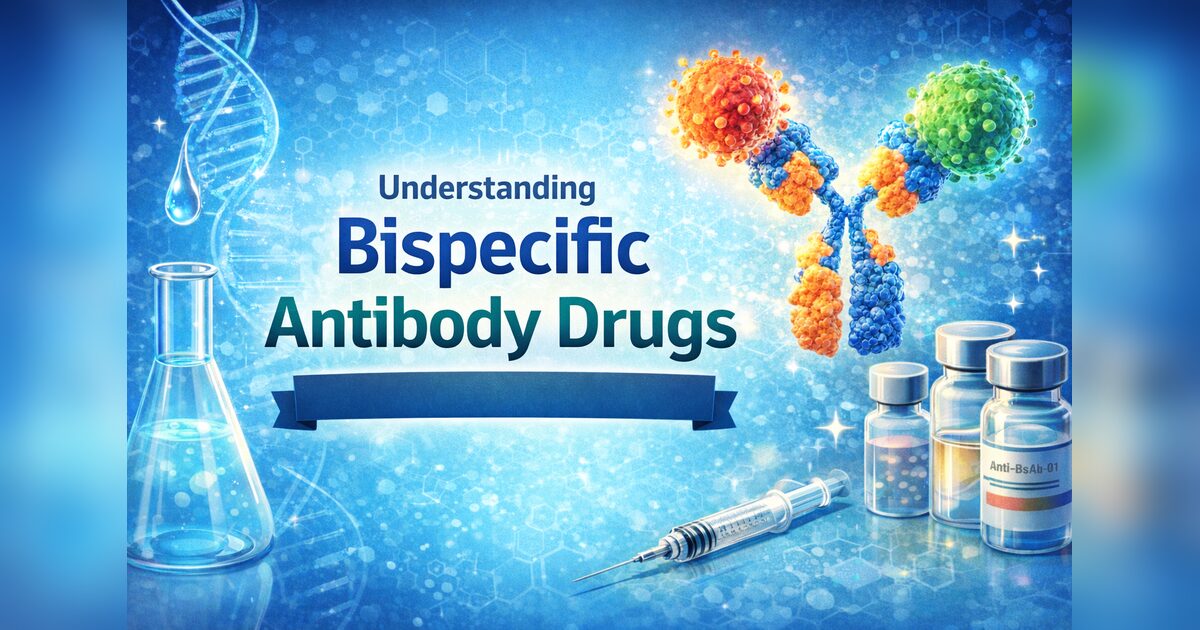
Bispecific antibody drugs have become one of the most prominent areas in cancer therapy over the past several years. If we only follow headlines, we often see striking phrases such as “a new antibody that brings T cells to cancer,” “a next-generation immunotherapy after CAR-T,” or “a technology expected to expand into solid tumors.” In reality, however, it is not easy to grasp what bispecific antibody drugs truly are, why they have attracted so much attention, where their real difficulties lie, and where their essential value comes from if we rely only on fragmented explanations.
This field is difficult because bispecific antibody drugs are not simply “another class of drugs.” They are built at the intersection of antibody engineering, tumor immunology, clinical development, manufacturing technology, and business strategy. In other words, a single structural choice can determine efficacy and toxicity, a single target-selection decision can change the probability of clinical success, and dosing design or patient-selection strategy can directly affect commercial value. Seen from another angle, bispecific antibody drugs are also a theme that vividly condenses where modern drug discovery succeeds and where it struggles.
The goal of this series is to organize the full picture of bispecific antibody drugs in a way that is understandable for beginners while still maintaining enough depth that experts will not find it superficial. Rather than simply listing “what kinds exist,” we will look structurally at why certain designs are needed, why hematologic malignancies have advanced faster than solid tumors, and why some technologies are growing rapidly while others stall despite early enthusiasm.
This A0 article serves as the introduction to the entire series. Here, we will first provide a broad view of what kind of technology bispecific antibody drugs are, explain what this series will help readers understand, show the order in which the articles are easiest to read, and clarify why it is worth organizing this field again right now. In the articles that follow, we will move step by step through fundamentals, structural design, pharmacology, safety, clinical development, company strategies, and technological evolution, so that the whole area can ultimately be understood as an integrated framework.
Why it is necessary to study bispecific antibody drugs systematically now
The main reason bispecific antibody drugs have drawn so much attention is that they may enable functions that conventional antibody therapeutics could not easily reach, while remaining within a relatively compact molecular design. A standard monoclonal antibody basically binds to a single target and exerts its effect by blocking that target or by helping the immune system recognize it. In contrast, a bispecific antibody drug can engage two different targets, or two different sites, at the same time within a single molecule. As a result, it becomes possible to go beyond simple inhibition and create functions such as physically bringing cells together, controlling multiple signaling pathways simultaneously, or increasing tumor selectivity.
The format that became widely recognized first was the T cell engager type, which pulls T cells toward cancer cells and prompts them to attack. This is highly intuitive because it represents a new form of immunotherapy in which immune cells are guided by the drug itself. However, that is not the whole essence of bispecific antibody drugs. Their design concepts extend much further, including simultaneous receptor control, signal optimization, localized activation, and reduction of effects on normal tissues. In fact, their significance as a platform technology for future drug discovery may lie even more in these broader design possibilities.
At the same time, this is a field where large expectations often produce large misunderstandings. If we only look at a few clinically successful drugs, it can appear as though “making something bispecific makes it work” or “all you need is to connect T cells.” The reality is far more complicated. Increasing potency often raises toxicity issues, reducing molecular size can create half-life and dosing challenges, and expanding into solid tumors brings the barriers of the tumor microenvironment and normal tissue expression to the forefront. In other words, bispecific antibody drugs are a technology with great potential, but also one that requires extremely careful optimization at the levels of design, evaluation, and clinical implementation.
That is exactly why it is not enough to know this field only because it is currently popular. Researchers need to understand which molecular formats are suited to which mechanisms of action. Clinicians need to determine in which patient populations and treatment settings real value can be created. From investment and business perspectives, it is necessary to distinguish between simple novelty and the deeper structure of sustainable differentiation and repeated failure patterns. This series is designed so that these different perspectives can be connected naturally without losing coherence.
First, grasp the big picture of what bispecific antibody drugs are
Bispecific antibody drugs are a class of medicines in which a single antibody molecule, or an antibody-derived molecule, is engineered to possess two distinct binding specificities. Put simply, they are antibodies designed so that one molecule can recognize two different targets at the same time. What matters here, however, is not merely the fact that they can bind two things, but what kind of function can be created by doing so.
One of the most representative designs is a format in which one arm recognizes an antigen on the cancer cell while the other recognizes CD3 or another molecule on the T cell. This makes it possible to artificially bring T cells and cancer cells into close proximity, promote formation of an immune synapse, and induce tumor cell killing. In that sense, these agents may be closer in reality to drugs that pharmacologically “make immune attack happen” than to drugs that directly strike the tumor on their own.
However, the role of bispecific antibody drugs is not limited to bridging immune cells. They can also be designed to regulate two receptors simultaneously, fine-tune signaling, act selectively based on two highly expressed tumor molecules, or locally control checkpoint and co-stimulatory pathways. In other words, bispecific antibody drugs are not best understood as “one key that turns two keyholes,” but rather as a technology for creating new pharmacological functions by combining two biological conditions.
This viewpoint is extremely important. The value of bispecific antibody drugs does not come from the simple convenience of being “2 in 1.” Their real strength lies in enabling spatial control, conditional activation, and simultaneous optimization of multiple pathways, which are difficult to achieve with conventional single-target antibodies. At the same time, this is also where the difficulty comes from. The overall character of the drug can change dramatically depending on which targets are combined, how strong each interaction is, and which molecular format carries the design.
The central themes covered in this series
In this series, we will not treat bispecific antibody drugs as a mere technical introduction. Instead, we will organize the field around several central themes. This will allow readers not only to learn individual topics but also to build a mental map of the entire area.
1. Core concepts and the overall landscape
The first essential step is to understand what bispecific antibody drugs are, the minimum necessary definition, and what kinds currently exist. If this part remains vague, later discussions on structure and clinical development will appear fragmented. In the first half of the series, we will clarify how bispecific antibodies differ from conventional antibodies, outline the major categories, and explain the representative mechanisms of action so that the overall landscape becomes visible.
2. The link between structural design and pharmacology
The pharmacology of a bispecific antibody drug changes greatly depending on which format is chosen. Whether it is an IgG-like format, a non-IgG format, a fusion-protein format, or a design with different valencies and arm arrangements will affect stability, half-life, tissue penetration, immune activation, and manufacturability. This series will emphasize that structure is not just a difference in appearance but something directly tied to efficacy and safety.
3. Safety and the barriers to implementation
Bispecific antibody drugs can generate powerful effects, but precisely because of that strength, they also tend to carry toxicity and implementation challenges. In particular, with formats that directly activate immune cells, safety issues such as cytokine release syndrome cannot be ignored. Moreover, even if the target is biologically sound, success is not guaranteed; normal tissue expression, dosing schedule, first-dose strategy, and patient-monitoring systems all strongly influence clinical adoption. In the later parts of the series, we will carefully organize these issues that cannot be explained by “the drug molecule itself” alone.
4. The difference between hematologic malignancies and solid tumors
The difference between blood cancers and solid tumors is unavoidable when trying to understand bispecific antibody drugs. The fact that successful examples emerged earlier in hematologic malignancies was not accidental. It reflects multiple factors, including the relative uniformity of target antigens, easier cellular access, and favorable conditions for contact with immune cells. By contrast, solid tumors present complicated barriers such as the tumor microenvironment, difficulty of infiltration, antigen heterogeneity, and normal tissue toxicity. This series will examine structurally where that difference comes from.
5. Clinical strategy, business, and the competitive landscape
Even if a drug is scientifically elegant, its real value cannot be understood without asking how it will be used clinically, how it will differentiate itself from existing treatments, and where companies can build competitive advantage. Bispecific antibody drugs are closely tied not only to science but also to development strategy, indication selection, combination strategy, commercialization, access, and manufacturing cost. In this series, we will look at the field from both scientific and business perspectives.
How to read this series
This series is designed so that beginners can enter from the starting point and continue reading, while readers who go through the whole series can gradually build a more systematic understanding. For that reason, each article will retain a certain degree of independence, but the order is designed so that reading sequentially increases the density of understanding.
In A0, the goal is to place an overall map of the series in the reader’s mind. A1 will then establish the definition and basic concepts of bispecific antibody drugs themselves. B1 will go one step further and examine, in a more technical way, how structural design relates to therapeutic effect. After that, the A-side articles will organize the broader picture in an accessible way, while the B-side articles will dig into the design logic, pharmacology, and implementation issues that sit behind it.
If a reader is a complete beginner, simply reading the A-side articles in order should already provide a strong foundation. On the other hand, readers who want to look more deeply from the viewpoints of research and development, clinical development, investment evaluation, or business development will find it useful to move back and forth between the A-side and B-side. Doing so makes it easier to see where individual issues sit within the larger structure. This is not simply a matter of dividing articles by difficulty, but rather a way of observing the same field at different levels of resolution.
The essential questions that will become visible through the whole series
The single most important thing when studying bispecific antibody drugs is to keep asking, all the way through, “Why should this be made bispecific in the first place?” What is technically possible is not the same as what is meaningful as a medicine. Is there a real biological necessity for combining two targets? Does that combination truly create value that is difficult to achieve with a single-target antibody? And does that value outweigh the burdens imposed on safety, manufacturability, and commercial viability? These are the central axes for evaluating the field.
Another important point is that bispecific antibody drugs are not a “universal solution.” Some successful examples certainly demonstrate major clinical value, but that does not mean every target combination has a future. In fact, recurring failure structures are fairly clear: excessive immune activation, weak target selection logic, access barriers in solid tumors, half-life and dosing convenience problems, and insufficient differentiation from competing therapies. What matters throughout this series is not the glamour of success stories, but the conditions that enable success and the conditions that repeatedly lead to failure.
It is also important for the future of drug discovery as a whole to recognize that bispecific antibody drugs are not a self-contained technology. They connect continuously to ADCs, CAR-T, radiopharmaceuticals, immune checkpoint inhibitors, and next-generation technologies such as multispecific antibodies and conditionally activated antibodies. In that sense, understanding bispecific antibody drugs is also an entry point into the future of antibody engineering, immunotherapy, and combined-modality strategies.
What we will examine in the upcoming articles
In this series, after A1 organizes the basics of what bispecific antibody drugs are, B1 will move into a comparison of structural designs. A2 will then break down the mechanisms of action in a straightforward way, while B2 will dive deeper into the logic of target design and optimization. A3 will organize the classifications and the broader landscape, and B3 will focus on how different modalities produce different pharmacological properties. A4 will examine adverse effects and safety, while B4 will discuss PK/PD and major development bottlenecks. A5 will place bispecific antibody drugs within the broader landscape of cancer therapy, and B5 will analyze clinical development strategy and indication expansion. A6 will provide a broader view of future directions, and B6 will conclude with the historical evolution of the technology and its connection to the next generation.
By reading along this flow, readers should gain not only “more knowledge about bispecific antibody drugs,” but also a framework for judging how this field should be viewed. For researchers, it should clarify how to think about design. For clinicians, it should clarify how to think about value. For the business side, it should clarify how to think about competitive advantage. That is the central aim of this series.
Conclusion
Bispecific antibody drugs are one of the areas in modern cancer therapy where science, clinical medicine, and business intersect most intensely. A superficial explanation that they are simply molecules capable of handling two targets at once does not reveal either the true value of this technology or its real difficulty. The essential issue is how to combine two biological conditions so that a new pharmacological function becomes possible, and how that design can actually be implemented.
This series will begin with the core concepts and then move step by step through structural design, pharmacology, safety, clinical development, the competitive environment, and technological evolution. By the end, readers should be able to do more than recognize individual drug names; they should be able to understand more three-dimensionally why a given design is needed, where it is likely to fail, and in which directions the field is evolving.
In the next article, A1, we will build the foundation carefully by starting with the definition and basic structure of bispecific antibody drugs themselves. As the entry point to the full series, I hope this article serves as a practical map for learning this field.
Related Articles

Comments