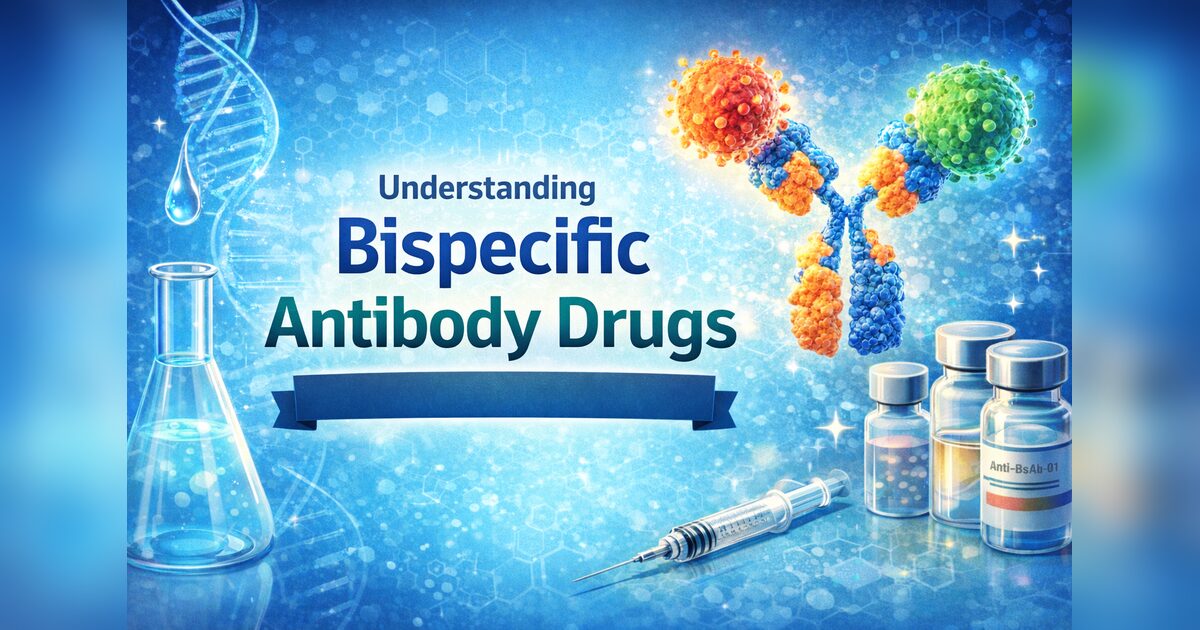
Bispecific antibody drugs are now one of the most important themes in the evolution of cancer therapy and antibody therapeutics. Over the past several years, they have rapidly increased in prominence. In hematologic malignancies, they are already becoming established as real treatment options, and they are also strongly expected to expand into solid tumors, autoimmune diseases, and beyond. However, when people first hear the term, their understanding often stops at something like “they are antibodies that can bind two targets.” What is actually new, what is difficult, and why this field is attracting so much attention are often not well organized.
As the foundation of the entire series, this A1 article first organizes what bispecific antibody drugs are from the basics. We will look structurally at how they differ from conventional monoclonal antibodies, what this bispecific design makes possible, what the major representative types are, and why they have become so important in the current context of drug discovery, clinical medicine, and business.
The key is not to see bispecific antibody drugs as simply an “extended version” of antibodies, but to understand them as a design technology for achieving pharmacological functions that single-target antibodies could not easily reach. The essence of bispecific antibody drugs is not the mere fact that they bind two things, but that by combining those two interactions they can create new biological conditions and new spatial conditions. Once this perspective is established at the beginning, the later discussions on structural design, pharmacology, safety, and clinical development will connect much more naturally.
What are bispecific antibody drugs?
Bispecific antibody drugs are medicines in which a single antibody molecule, or an antibody-derived molecule, is engineered to possess two distinct binding specificities. In other words, they are antibody drugs designed so that one molecule can recognize two different target molecules, or two different epitopes, at the same time. While conventional antibody therapeutics basically bind to a single target and exert therapeutic effects by blocking, neutralizing, or promoting immune-mediated elimination of that target, bispecific antibody drugs can assign two roles to one molecule.
What matters here is not to understand the word “bispecific” only in a literal way. On the surface, these are “antibodies that can bind two things,” but that is not where their value in drug discovery truly lies. What is really important is that those two binding events can be used to create new pharmacological functions such as bringing cells into proximity, controlling two receptors at once, or making the drug act strongly only where two conditions are simultaneously present. In that sense, bispecific antibody drugs are better understood not as “antibodies with two binding destinations,” but as “a design platform that connects two biological conditions within one molecule.”
The best-known example is the type in which one arm recognizes an antigen on the cancer cell and the other recognizes CD3 on the T cell. In this format, T cells that would normally circulate freely in the body are drawn close to tumor cells, and this physical proximity enables T-cell-mediated killing activity. This means that the antibody is not simply blocking a target, but is pharmacologically “connecting” different cells.
However, the design logic of bispecific antibody drugs is not limited to T-cell redirection. There are also designs that simultaneously adjust two signaling pathways, increase activity in tumors while suppressing effects on normal tissues, or combine checkpoint modulation with co-stimulation. This breadth is exactly why bispecific antibody drugs are not just a temporary trend, but a central theme in next-generation antibody engineering.
How are they different from conventional monoclonal antibodies?
To understand bispecific antibody drugs, it is first necessary to clarify how they differ from conventional monoclonal antibodies. A conventional monoclonal antibody, in principle, recognizes one target. For example, it may bind a specific molecule such as HER2, PD-1, or VEGF, and produce a therapeutic effect by suppressing that molecule’s function or by making it visible to the immune system. This format is highly refined and has already produced many successful drugs.
However, the biology of cancer and immunity is not simple enough to be determined by a single molecule alone. Cell-to-cell contact, the balance of multiple receptors, suppression by the tumor microenvironment, and expression differences from normal tissues all contribute to the actual disease state. For that reason, there are inevitably situations in which a single-target antibody cannot provide sufficient control.
This is where bispecific antibody drugs enter the picture. By dealing with two targets simultaneously, they can manipulate “relationships themselves” that conventional antibodies cannot easily control. The most representative example is bridging T cells and cancer cells, but other possibilities include simultaneously blocking two signaling pathways, acting more selectively on cells that satisfy two conditions, or using one target to determine localization and the other to generate activity.
So the difference is not simply that the number of targets has increased. If a conventional antibody is “a drug that directly controls one molecule,” then a bispecific antibody drug is better described as “a drug that uses the combination of two conditions to create a higher-order pharmacological effect.” This is a major difference. That is exactly why bispecific antibody drugs carry both high potential and a greater level of design freedom and difficulty.
What can bispecific antibody drugs do?
The main reason bispecific antibody drugs attract so much attention is that they can provide pharmacological functions that are difficult to achieve with conventional antibodies. These functions can be broadly organized into several directions: bridging cells, simultaneous signal control, improved conditional selectivity, and localized activation.
1. They can bridge cells
The most representative function is bridging T cells and cancer cells. One side recognizes a tumor antigen and the other recognizes CD3 on the T cell, bringing the two into proximity and triggering T-cell killing activity. This is the symbolic use of bispecific antibody drugs and one major reason why clinical success came first in hematologic malignancies.
2. They can control two signals at the same time
By simultaneously controlling two receptors, ligands, or signaling pathways, bispecific antibody drugs can aim for effects that are not obtained by blocking a single pathway alone. This may involve handling both a tumor growth signal and an immunosuppressive signal at once, or modulating multiple immune checkpoints within one molecule. In that sense, this is also an attempt to build into one molecular design the kind of effect that combination therapies try to achieve with multiple drugs.
3. They may increase tumor selectivity
By using a combination of two targets, bispecific antibody drugs may be able to create a more conditional form of selectivity. For example, even if target A is somewhat risky because it is also expressed on normal cells, the simultaneous recognition of target B, which is more characteristically combined in tumors, may relatively increase activity in tumor tissue. This idea is especially important in solid tumors.
4. They can narrow where and when activation occurs
Using a bispecific design, it becomes possible to aim for drugs that do not act strongly everywhere in the body, but instead act strongly only where a certain cell contact or a certain expression condition is present. This is extremely important not only for increasing efficacy but also for reducing toxicity. In future next-generation designs, this idea of “conditional activation” is likely to become even more important.
Major types of bispecific antibody drugs
Not all bispecific antibody drugs are the same. They are highly diverse in terms of mechanism of action, target combination, and molecular format. At the beginner stage, it is most useful to first understand them by dividing them into several broad categories.
1. T cell engager type
This is the best-known category. One side recognizes a tumor antigen and the other recognizes CD3 on the T cell. It works by drawing T cells close to cancer cells and promoting killing, and it has achieved major success in hematologic malignancies. It is the first type that should be understood as a representative example of bispecific antibody drugs.
2. Dual signaling control type
This category simultaneously controls two receptors, ligands, or signaling pathways. In some cases, it suppresses two growth pathways in the tumor cell. In other cases, it combines inhibition and activation on the immune side. The main purpose is not simple bridging, but more precise control of signaling.
3. Tumor-selective activation type
This category uses two target conditions to improve selectivity in tumors. It includes designs in which one target determines localization while the other generates activity. This is likely to become even more important in the future as a strategy to balance safety and efficacy in solid tumors.
4. Immune modulation type
This category simultaneously adjusts multiple elements of the immune system, such as immune checkpoints and co-stimulatory molecules. It also includes designs that aim to move beyond what can be achieved by PD-1 or CTLA-4 blockade alone, in a more localized or more selective way. It occupies an important place in the next generation of immunotherapy.
As these examples show, bispecific antibody drugs are not simply “drugs that pull in T cells.” Their character differs substantially depending on the purpose of the design, and those differences directly lead to differences in pharmacology, safety, indication, and development strategy. That is why it is important not merely to know the names, but to understand what each design is trying to achieve.
Why are they attracting so much attention now?
Bispecific antibody drugs are attracting so much attention not simply because they are new. They are gaining momentum because unmet needs in drug discovery and technical progress are now meeting in this field.
First, in cancer therapy it is becoming increasingly clear that single-target approaches are often not sufficient. Tumors are highly heterogeneous, and signaling escape as well as resistance acquisition occur frequently. Even in immunotherapy, simply releasing the brakes is often not enough. There is a need to actively draw immune cells into tumors or locally change suppressive environments. Against this complexity, bispecific antibody drugs offer a relatively rational design answer.
Second, advances in antibody engineering and manufacturing technology have made a major difference. In the past, it was difficult even to build stable bispecific antibodies. There were many technical barriers, including correct chain pairing, uniform manufacturing, and maintaining sufficient half-life. In recent years, however, the development of IgG-like formats and multiple engineering technologies has greatly expanded the range of molecular designs that are practically usable as real drugs. This means the field is moving from a theoretical stage toward an implementation stage.
Third, real clinical success has begun to emerge. In hematologic malignancies, bispecific antibody drugs have shown that they are not merely concepts but can contribute meaningfully to patient treatment. Of course, it would be dangerous to become overly optimistic by looking only at successful examples, but at least the question of “can this concept truly become a drug?” has already been answered. The discussion today has entered a more concrete stage of optimization: where these drugs are strong, where they are difficult, and which formats fit which indications.
Fourth, they are also highly attractive from business and investment perspectives. Bispecific antibody drugs offer room for differentiation from single-target antibodies, can often be expanded as platforms, and may have the potential to spread across multiple indications. At the same time, success requires both design capability and development capability, and there is a meaningful barrier to entry. In other words, they are seen as a field where scientific difficulty and business value are relatively tightly linked.
The strengths and difficulties of bispecific antibody drugs
The strengths of bispecific antibody drugs are clear. They can target higher-order pharmacological effects that are difficult for single-target antibodies to reach. They are easier to differentiate through combinations. They can be designed around cell–cell interactions and multi-signal control, which are closer to real disease biology. In particular, the fact that they can directly manipulate the relationship between tumors and immunity is highly meaningful within current cancer therapy.
However, those strengths are also the source of their difficulty. There are many design variables: which targets to combine, how strong each binding interaction should be, what molecular size to use, whether to use an IgG-like format or a non-IgG format, and more. Changing even one of these elements can greatly alter the character of the drug. Furthermore, when one tries to make the drug more potent, toxicity becomes more likely; when one tries to improve selectivity, efficacy or tissue accessibility may be sacrificed.
Also, bispecific antibody drugs are not an area where “if you can make it, you win.” Even if a concept looks exciting in preclinical work, there are many barriers to clinical implementation, including manufacturing uniformity, stability, half-life, route and schedule of administration, immunogenicity, first-dose safety management, and differentiation from competing therapies. That is why this field is not merely a theme of clever ideas. It is a field that tests whether one can see the full continuum from molecular design to clinical use.
How should this series be read going forward?
The most important point to keep in mind from A1 is that bispecific antibody drugs are not simply “antibodies that bind two things,” but rather “an antibody design technology that combines two conditions to create new pharmacological functions.” Once this is understood, the differences in structure, pharmacology, and safety that appear in later articles will no longer feel like isolated details. They will all appear as expressions of the same central logic.
In the next article, B1, we will move into a comparison of structural designs. We will examine why the differences among IgG-like formats, non-IgG formats, and fusion-protein formats are not just matters of appearance, but are directly connected to half-life, stability, activity, manufacturability, and safety. A1 builds the conceptual foundation, and B1 then translates that foundation into the level of molecular design. That should raise the resolution of the entire series by one level.
Conclusion
Bispecific antibody drugs are antibody therapeutics designed so that one molecule can simultaneously handle two different targets, or two different biological conditions. Their value does not lie simply in the ability to bind two things, but in the ability to achieve pharmacological functions that conventional antibodies could not easily reach, such as bridging cells, simultaneously controlling multiple signals, improving tumor selectivity, and enabling conditional activation.
At the same time, their high level of design freedom is also the source of their difficulty, requiring integrated optimization that includes target selection, molecular format, toxicity, manufacturing, dosing, and real clinical positioning. That is exactly why bispecific antibody drugs also reflect the current frontier of drug discovery so clearly.
For now, it is enough if this article helps you grasp the basic way of thinking and the overall picture of bispecific antibody drugs. In the next article, we will move into structural design and examine how much diversity of molecular design thinking is contained within the single term “bispecific antibody drugs.”
Related Articles

Comments