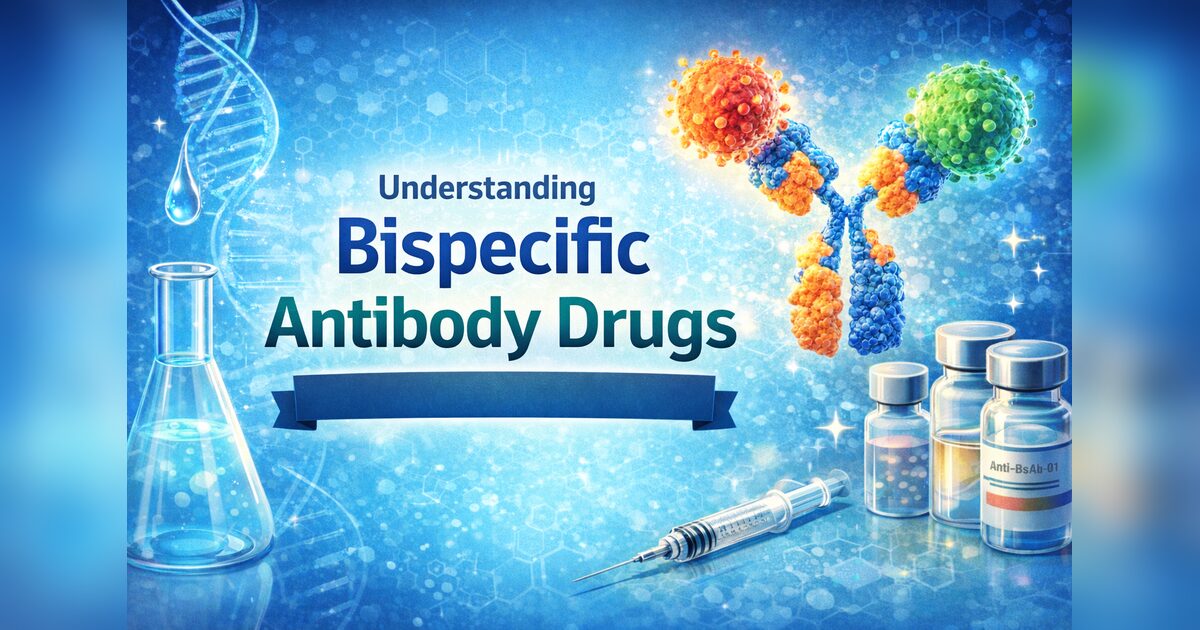
One of the reasons bispecific antibody drugs attract so much attention is that they can bind two targets within a single molecule. However, as we saw in A1 and B1, what truly matters is not simply the fact that they can bind two things. What matters is what kind of pharmacological effect can be created by using those two binding events. In other words, the central point in understanding bispecific antibody drugs is not memorizing the names of structures, but understanding what the molecule actually causes to happen in the body.
In conventional monoclonal antibodies, the basic mode of action is to bind a target molecule and block it, neutralize it, or make it easier for the immune system to recognize it. By contrast, bispecific antibody drugs can handle two targets at once, which makes it possible to manipulate “relationships” that are difficult to control with single-target antibodies. Typical examples include bringing cells closer together, controlling two signaling pathways at the same time, or making the drug act strongly only in places where certain conditions are simultaneously met.
In this A2 article, we will organize the major mechanisms of action of bispecific antibody drugs in as clear a way as possible. We will first show the broad overall picture that their modes of action can be grouped into a few major types, and then look in order at the representative categories of T-cell redirection, dual signal control, conditional selectivity enhancement, and localized activation. The key point is that these are not just different categories in name. They correspond to different pharmacological goals that the drug is designed to achieve.
The mechanisms of action of bispecific antibody drugs are easiest to understand in four broad types
The mechanisms of action of bispecific antibody drugs are highly diverse, but to understand the overall field, it is useful to organize them into four broad types. The first is the “cell-bridging type,” which brings immune cells and cancer cells into proximity. The second is the “dual signal control type,” which simultaneously regulates two receptors or ligands. The third is the “conditional selectivity type,” which uses two target conditions to increase selectivity in tumors. The fourth is the “localized activation type,” which is designed to act strongly only in certain places or environments.
Of course, actual molecules do not always fit neatly into only one of these categories. For example, one design may both redirect T cells and increase selectivity, while another may combine local activation with signal control. Still, as a first framework for understanding, these four types make it much easier to see what a bispecific antibody drug is trying to do.
This framework is important because bispecific antibody drugs are not simply “drugs that connect two things.” Even within the same bispecific concept, the desirable structure, required half-life, acceptable toxicity, and suitable indications can differ greatly depending on the pharmacological effect being pursued. Understanding mechanism of action therefore directly helps us understand development logic as well.
1. Cell-bridging type: bringing immune cells and cancer cells closer together
The best-known mechanism among bispecific antibody drugs is the cell-bridging type, which physically brings immune cells and cancer cells into proximity. The representative example is the T-cell engager format, in which one side recognizes a tumor antigen and the other recognizes CD3 on the T cell. In this format, the drug positions itself between the T cell and the cancer cell, bringing them close enough together to trigger T-cell-mediated killing of the tumor cell.
A major feature of this mechanism is that the antibody does not directly kill the cancer cell by itself. Instead, it pharmacologically creates a situation in which immune cells can attack more effectively. Normally, efficient recognition and killing of cancer cells by T cells requires several conditions, including antigen presentation and co-stimulation. In T-cell engager formats, part of that process is effectively forced into place, narrowing the distance between T cells and tumor cells, promoting immune synapse formation, and inducing cytotoxic activity.
This mechanism is highly powerful. In hematologic malignancies in particular, tumor cells are more accessible and target antigens tend to be relatively uniform, which helps explain why T-cell engager formats have achieved clinical success there. On the other hand, strong efficacy also means a greater risk of toxicity. Excessive stimulation of T cells can lead to adverse events such as cytokine release syndrome, making optimization of CD3 binding strength, valency, and dosing strategy extremely important.
In solid tumors, however, this bridging concept does not always work as directly as it does in blood cancers. There are additional barriers such as an immunosuppressive tumor microenvironment, insufficient T-cell infiltration, antigen heterogeneity, and potential effects on normal tissues. In other words, the cell-bridging type is the most symbolic mechanism of action in bispecific antibody drugs, but the conditions required for success depend greatly on the indication and the target.
2. Dual signal control type: regulating two pathways at the same time
Another major mechanism of action in bispecific antibody drugs is the dual signal control type, in which two receptors, ligands, or signaling pathways are regulated simultaneously. In this type, the drug does not necessarily have to bridge two cells. Instead, it aims to achieve effects that are difficult to obtain with a single-target antibody by intervening in two distinct biological pathways at once.
For example, a drug might suppress two receptor pathways that support tumor growth, or simultaneously affect an immunosuppressive signal and an activating signal. This can also be understood as an attempt to integrate into a single molecule the kind of pharmacology that has traditionally been sought through combination therapy using multiple drugs.
The strength of this type is that it can address complex biology in a form that is closer to reality. Cancer and immune regulation are rarely determined by a single pathway alone, and escape pathways or compensatory pathways often exist. For that reason, inhibiting only one pathway may not produce sufficient effect. The dual signal control type may offer a rational way to address this dependence on multiple pathways.
At the same time, this type comes with a different kind of difficulty. Touching two pathways at once means that one must consider not only the biology of each pathway separately, but also the unexpected effects that may arise from their combination. Simply combining two mechanisms into one molecule does not automatically make the drug better. Depending on binding balance, localization, and strength of activity, the expected synergy may fail to appear. In this type, the central question is whether there is real biological and therapeutic meaning in controlling both pathways together.
3. Conditional selectivity type: making the drug work more selectively in tumors
One of the major reasons bispecific antibody drugs attract interest is that they may improve tumor selectivity. With a single-target antibody, if the target is also expressed in normal tissues, the risk of adverse effects rises accordingly. In contrast, bispecific antibody drugs may allow a more conditional form of selectivity to be designed by using a combination of two targets. This is the basic idea behind the conditional selectivity type.
For example, even if target A alone is risky because it is also present on normal cells, if the combination of target A with target B is more characteristic of the tumor, a design may be possible in which strong activity occurs only where both conditions are met. Alternatively, one target may be used to enhance localization near the tumor, while the other provides the activating function. In this way, bispecific antibody drugs may allow molecular-level design not only of “what the drug acts on,” but also of “where the drug acts.”
This concept is particularly important in solid tumors. In solid tumors, there are relatively few perfectly tumor-specific antigens, and a central challenge is how to make use of expression differences from normal tissues. As a result, even when a single-target approach would have too narrow a safety margin, a dual-condition approach may relatively improve safety.
However, this type is not simple either. It requires careful validation of whether the two targets truly provide sufficient tumor selectivity, how problematic low-level expression in normal tissues may be, and whether intratumoral heterogeneity might reduce efficacy. Increasing selectivity may also reduce efficacy. Here too, optimization of design is essential.
4. Localized activation type: making the drug act where it is needed, not everywhere
A concept that has become increasingly important in recent years is the localized activation type. This refers to a design in which the drug does not act equally strongly throughout the body, but instead acts more strongly only in limited places such as the tumor site or a specific cellular environment. Because bispecific antibody drugs can handle two conditions at once, they are one of the formats well suited for designing this kind of place-dependent or condition-dependent activity.
For example, one might design a molecule so that full activity of one side is achieved only after the other side has bound, or so that activity becomes stronger only under conditions characteristic of the tumor microenvironment, or so that immune activation is much more likely to occur only after accumulation in the tumor site. This represents a step beyond the traditional idea of “a drug that works the same way everywhere in the body,” toward “a drug that works where it is needed.”
The attraction of this type is that it may make it easier to balance efficacy and safety. Strong immune activation is not inherently good; what matters is where it occurs and to what degree. If strong immune activation occurs throughout the body, toxicity is more likely. If the effect can be concentrated locally in the tumor, a more desirable therapeutic outcome may become possible.
However, the localized activation type is a high-difficulty area both in design and in evaluation. Major challenges include whether the intended conditional behavior truly occurs in the body, how well preclinical models can predict that behavior, and how much it varies across different tumors. Even so, this concept is becoming highly important as a next-generation strategy for solid tumors and for targets associated with significant toxicity risk.
Why can the same class of bispecific antibody drugs work in such different ways?
As we have seen, bispecific antibody drugs can work through several different mechanisms of action. Why, then, can molecules that are all grouped under the same term “bispecific antibody drugs” behave so differently? The reason is that bispecific antibody drugs are not merely a product category. They are a design principle for connecting two conditions.
In other words, one first decides what pharmacological effect is actually desired, and then builds around that goal by selecting the target combination, binding strength, valency, molecular size, Fc presence or absence, and mechanism of localization. As a result, one molecule becomes a cell-bridging type, another becomes a signal-control type, and yet another becomes a selectivity-enhancing or localized-activation type. These differences are not accidental. They arise from different design intentions.
This viewpoint is extremely important. In evaluating bispecific antibody drugs, it is not very meaningful to ask only whether a drug is “bispecific.” What really matters is what the molecule is trying to make happen, whether that mechanism is rational for the disease and target, and whether it can be implemented safely.
Once mechanism of action is understood, the development difficulty also becomes visible
Once we understand the mechanisms of action of bispecific antibody drugs, it becomes easier to see why this field is so difficult. In the cell-bridging type, stronger activity can make toxicity more problematic. In the dual signal control type, one must ask whether controlling both pathways together truly makes sense. In the conditional selectivity type, the concern is whether increasing selectivity may reduce efficacy. In the localized activation type, the central issue is whether the intended local behavior truly occurs in the body.
In other words, the difficulty of bispecific antibody drugs is not only the challenge of making the molecule itself. It lies in having to design what kind of effect is desired, where that effect should occur, and what trade-offs are acceptable. Understanding mechanism of action therefore means understanding not just how the drug works, but also how development decisions are made.
For that reason, it is not enough to say that bispecific antibody drugs are interesting simply because they have two targets. More fundamentally, they must be viewed through the question: what kind of pharmacological function is this particular combination of two targets intended to create? Once that question is kept in mind, the way one reads individual development programs and papers changes substantially.
How this connects to the rest of the series
The central message to take away from A2 is that the value of bispecific antibody drugs does not lie in the simple fact that they bind two things, but in their ability to use those two binding events to create new mechanisms of action. A1 introduced the concept, B1 examined structural design, and A2 has now organized how that structure finally appears as function. At this point, the foundation of the first half of the series should be becoming much more three-dimensional.
In the next article, B2, we will go one level deeper by asking how the targets themselves should be chosen in order to make these mechanisms of action possible. We will organize questions such as which targets should be combined, which targets offer the best balance between efficacy and safety, and why some targets that appear attractive are still difficult in development. This will deepen the design logic of bispecific antibody drugs even further.
Conclusion
The mechanisms of action of bispecific antibody drugs become easier to understand when they are broadly organized into four types: the cell-bridging type, the dual signal control type, the conditional selectivity type, and the localized activation type. Actual molecules may combine elements of these categories, but in principle the way a drug works is determined by what it is designed to achieve pharmacologically.
The important point is that bispecific antibody drugs are not simply “antibodies that bind two things.” Their essence lies in using two targets or two conditions to create new mechanisms of action that are difficult to realize with single-target antibodies. And depending on the mechanism of action, the required structure, safety challenges, suitable indications, and development bottlenecks all change.
In the next article, B2, we will examine target design itself, which is the prerequisite for making these mechanisms of action possible. By moving to the question of what the drug binds to and why that combination is chosen, our understanding of bispecific antibody drugs will deepen even further.
Related Articles

Comments