New here?
→ A0: What is CAR-T therapy? The big picture + index
→ A1: Where CAR-T is used today (blood cancers first)
Deep dive next (B3): next-gen CAR engineering to overcome these barriers (multi-target, logic-gated, armored, local delivery, etc.). (Coming soon)
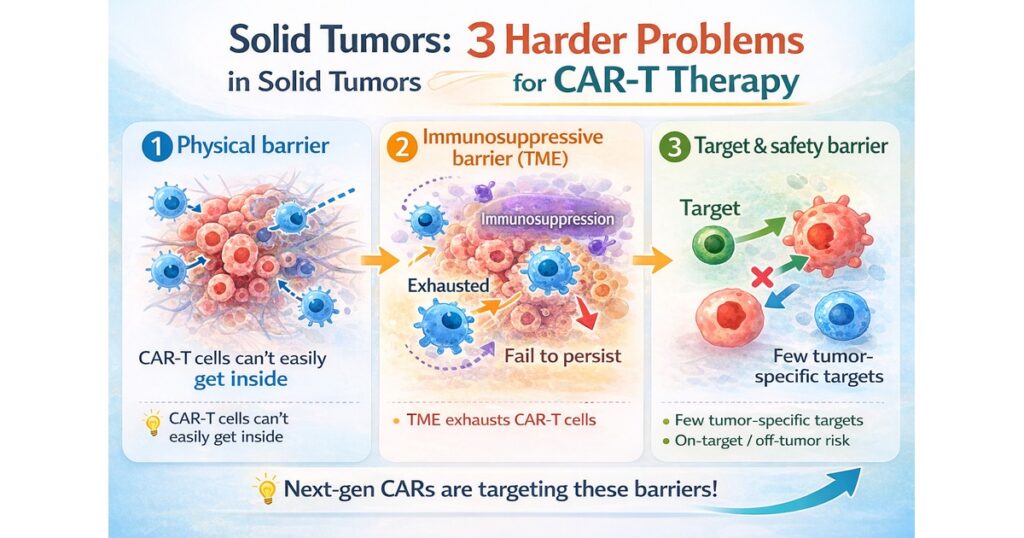
“Solid tumors: 3 harder problems” (Physical barrier / Immunosuppressive environment / Target & safety)
The short answer: solid-tumor CAR-T isn’t “impossible”—it’s hard for clear reasons
CAR-T development in solid tumors is extremely active. The reason outcomes have lagged behind blood cancers is not lack of effort—it’s that solid tumors impose multiple “immune-unfriendly” conditions at once.
In this beginner post, we group the challenges into three barriers:
- Physical barrier: CAR-T cells have trouble reaching and penetrating tumor tissue
- Immunosuppressive barrier (TME): the tumor microenvironment weakens immune function
- Target & safety barrier: it’s hard to find targets that are truly tumor-specific and uniform
Why blood cancers are different (the key premise)
In many blood cancers, malignant cells circulate in blood/lymph, making them easier for CAR-T cells to encounter.
Solid tumors form dense masses and build defensive “layers,” so CAR-T cells may struggle to enter, persist, and function.
That difference explains the three barriers below.
Barrier 1: the physical barrier (tumor penetration)
What it means
Solid tumors can be dense, poorly perfused, and structurally complex. Even if CAR-T cells reach the tumor vicinity, they may not penetrate deeply enough.
Why it matters
If CAR-T activity stays near the surface, resistant or shielded tumor regions can persist and drive regrowth.
How to read headlines
Two quick checks:
- Do investigators show evidence that CAR-T cells reach the tumor?
- What is the delivery route (systemic vs local)?
Barrier 2: the immunosuppressive tumor microenvironment (TME)
What is the TME?
The tumor microenvironment includes cells and signals around the tumor that can suppress immunity. In plain terms, tumors can create “conditions” that make immune cells less effective.
What happens in practice
- CAR-T cells can become exhausted (reduced function)
- CAR-T cells may fail to expand or persist
- Suppressive signals can dominate, shortening durability
One sentence to remember
Solid-tumor CAR-T success depends not only on targets, but on how the design deals with the TME.
Barrier 3: targets and safety (tumor-specificity and heterogeneity)
Targets in plain language
CAR-T needs a recognizable “marker” (target) to attack.
Why solid tumors are tougher
Ideal targets—high on tumor, absent on healthy tissues—are harder to find in solid tumors. If healthy organs share the target, on-target/off-tumor toxicity becomes a core concern.
In addition, solid tumors often show target heterogeneity: not every tumor cell displays the marker equally, allowing escape.
How to read headlines
- Is the target truly tumor-restricted? What about normal tissue expression?
- Are there safety strategies (dual targeting, safety switches, logic gates)?
So is there hope? Yes—and that’s why next-gen designs are exploding
The key point is: the challenges are clearly defined. That clarity drives concrete engineering solutions.
In B3, we will organize the major design strategies that aim to overcome Barriers 1–3 (multi-target, logic gating, armored CARs, local delivery, alternative cell types, etc.).
FAQ (search-aligned)
Q1. Does CAR-T “not work” in solid tumors?
Not a fair conclusion. Solid tumors are harder, but results depend on tumor type, target choice, delivery, and CAR design.
Q2. Why is CAR-T more successful in blood cancers?
Access is easier (circulation) and immune suppression is often less structurally entrenched than in solid tumors.
Q3. What is the “tumor microenvironment (TME)” again?
The local ecosystem around a tumor that can suppress or exhaust immune responses—often a major barrier in solid tumors.
Mini glossary
- Solid tumor: a mass-forming cancer in tissues/organs
- Target (antigen): a marker the CAR recognizes
- Target heterogeneity: uneven target expression across tumor cells
- TME: tumor microenvironment; suppressive conditions around tumors

Comments