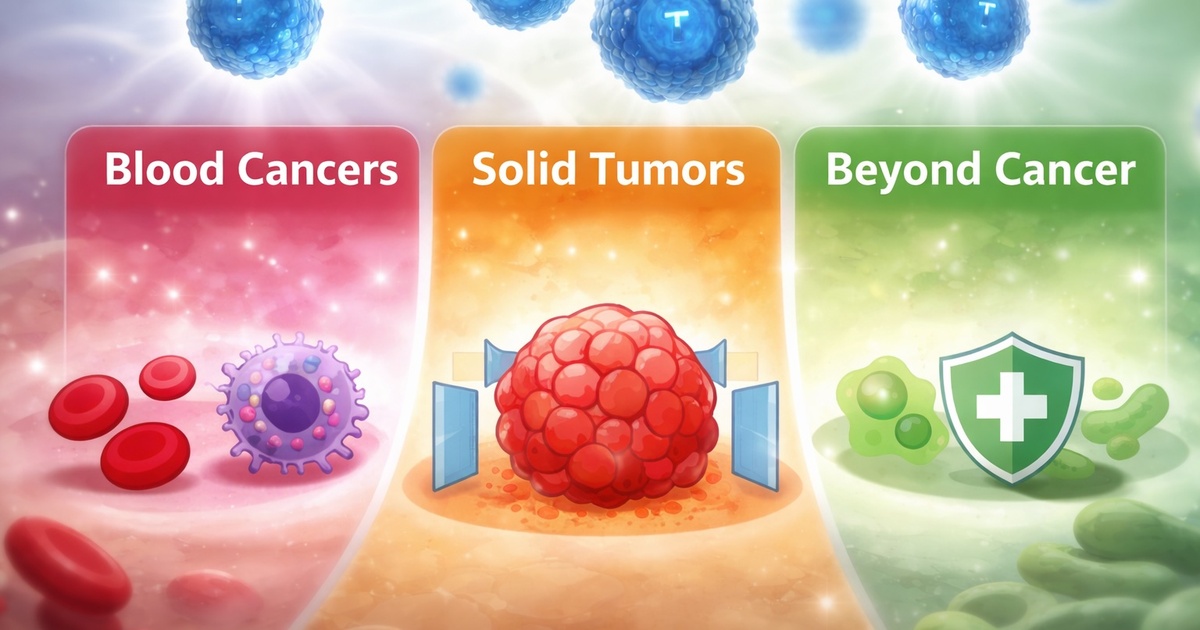
Prefer the beginner overview first?
→ A0: What is CAR-T therapy? The big picture + index
→ A1: Where CAR-T is used today (blood cancers first)
Executive summary
- FDA-approved oncology CAR-T products cluster around two core targets: CD19 (B-cell malignancies) and BCMA (multiple myeloma). A practical “approved CAR-T” frame is 7 products.
- Within CD19, major labeled arenas include B-ALL, LBCL (DLBCL/PMBCL/high-grade), FL, and CLL/SLL, with meaningful differences in line-of-therapy criteria and accelerated approval language.
- Within BCMA, multiple myeloma is central; both Abecma and Carvykti include explicit prior-therapy criteria.
- Regulatory posture is “access + discipline”: FDA eliminated REMS for approved BCMA/CD19 autologous CAR-T immunotherapies while emphasizing class labeling updates on T-cell malignancy risk.
- From a development and scale perspective, CMC, analytical comparability, and potency are major value drivers (explicit in FDA guidance).
1) The coordinate system: Target × Disease × Line-of-therapy
Targets
- CD19: B-cell malignancies (ALL, LBCL, FL, CLL/SLL)
- BCMA: plasma cell malignancy (multiple myeloma)
Representative disease names (minimum expert set)
- B-ALL: B-cell precursor acute lymphoblastic leukemia
- LBCL: large B-cell lymphoma, including DLBCL, PMBCL, high-grade B-cell lymphoma, etc.
- FL: follicular lymphoma
- CLL/SLL: chronic lymphocytic leukemia / small lymphocytic lymphoma
- MM: multiple myeloma
Why label logic matters
Most confusion comes from qualifiers: number of prior lines, required exposure to certain drug classes, accelerated approval language, and transplant eligibility clauses.
2) FDA-approved CAR-T products (oncology): the seven-product frame
| Brand (generic) | Target | Manufacturer (FDA page) | Key labeled arenas | Label logic (ultra-short) |
|---|---|---|---|---|
| AUCATZYL (obecabtagene autoleucel) | CD19 | Autolus Limited | Adults with r/r B-cell precursor ALL | Adult r/r ALL |
| KYMRIAH (tisagenlecleucel) | CD19 | Novartis | ≤25y B-ALL; adult r/r LBCL; adult r/r FL | Age-gated ALL; LBCL ≥2 lines; FL accelerated |
| YESCARTA (axicabtagene ciloleucel) | CD19 | Kite (Gilead) | Adult LBCL; adult r/r FL | LBCL: 1L refractory/early relapse or ≥2 lines; FL ≥2 lines |
| TECARTUS (brexucabtagene autoleucel) | CD19 | Kite | Adult r/r B-ALL; adult r/r MCL | Adult r/r |
| BREYANZI (lisocabtagene maraleucel) | CD19 | Juno (BMS) | Adult LBCL; adult r/r CLL/SLL (accelerated) | Multiple LBCL entry criteria; CLL/SLL after BTK + BCL-2 |
| ABECMA (idecabtagene vicleucel) | BCMA | Celgene (BMS) | Adult r/r MM | ≥2 lines incl. IMiD + PI + anti-CD38 |
| CARVYKTI (ciltacabtagene autoleucel) | BCMA | Janssen | Adult r/r MM | ≥1 line incl. PI+IMiD; lenalidomide-refractory |
Important: “Label logic” above is an ultra-short paraphrase. Use the exact FDA indication language for final decisions.
3) Product-by-product label highlights (what to notice)
- AUCATZYL (CD19): Adults with relapsed or refractory B-cell precursor ALL.
- KYMRIAH (CD19): ≤25 years ALL (refractory or ≥2nd relapse); adult r/r LBCL after ≥2 lines; adult r/r FL after ≥2 lines with accelerated approval language.
- YESCARTA (CD19): LBCL includes 1L refractory/relapse within 12 months and/or r/r after ≥2 lines; FL after ≥2 lines.
- TECARTUS (CD19): Adult r/r B-ALL and adult r/r mantle cell lymphoma (MCL).
- BREYANZI (CD19): LBCL has multiple label entry pathways (1L refractory/early relapse; HSCT-ineligible; or ≥2 lines); CLL/SLL after ≥2 lines including BTK inhibitor and BCL-2 inhibitor, with accelerated approval language.
- ABECMA (BCMA): MM after ≥2 lines including IMiD, PI, and anti-CD38.
- CARVYKTI (BCMA): MM after ≥1 line including PI + IMiD; lenalidomide-refractory.
4) Regulatory posture: REMS eliminated, boxed warning logic tightened
- REMS elimination (Jun 2025): FDA eliminated REMS for approved BCMA- and CD19-directed autologous CAR-T immunotherapies.
- Class labeling / T-cell malignancy risk (Apr 2024): FDA determined the risk is applicable to all currently approved BCMA- and CD19-directed genetically modified autologous CAR-T products and required boxed warning changes.
5) Development/scale implications: CMC & comparability as value drivers
CAR-T scale is constrained not only by efficacy, but by manufacturing consistency, analytical comparability, and potency strategy. FDA’s CAR-T development guidance is the right “map” for what sponsors must prove.
Next in the series
- A3 [Beginner]: Why solid tumors are hard (the big picture)
- B3 [Expert]: Next-gen CAR engineering (multi-target, logic-gated, armored, local delivery)
Primary sources (FDA)
Approved list: https://www.fda.gov/vaccines-blood-biologics/cellular-gene-therapy-products/approved-cellular-and-gene-therapy-products
AUCATZYL: https://www.fda.gov/vaccines-blood-biologics/aucatzyl
KYMRIAH: https://www.fda.gov/vaccines-blood-biologics/cellular-gene-therapy-products/kymriah
YESCARTA: https://www.fda.gov/vaccines-blood-biologics/cellular-gene-therapy-products/yescarta
TECARTUS: https://www.fda.gov/vaccines-blood-biologics/cellular-gene-therapy-products/tecartus
BREYANZI: https://www.fda.gov/vaccines-blood-biologics/cellular-gene-therapy-products/breyanzi
ABECMA: https://www.fda.gov/vaccines-blood-biologics/abecma
CARVYKTI: https://www.fda.gov/vaccines-blood-biologics/cellular-gene-therapy-products/carvykti
REMS press release: https://www.fda.gov/news-events/press-announcements/fda-eliminates-risk-evaluation-and-mitigation-strategies-rems-autologous-chimeric-antigen-receptor
Boxed warning: https://www.fda.gov/vaccines-blood-biologics/safety-availability-biologics/fda-requires-boxed-warning-t-cell-malignancies-following-treatment-bcma-directed-or-cd19-directed
CAR-T guidance: https://www.fda.gov/regulatory-information/search-fda-guidance-documents/considerations-development-chimeric-antigen-receptor-car-t-cell-products


Comments