This article serves as the complete index page for the CAR-T series now that the series has been completed.
It is designed as a single entry point that allows readers to see the full picture, from the basics to expert-level implementation and commercialization topics.
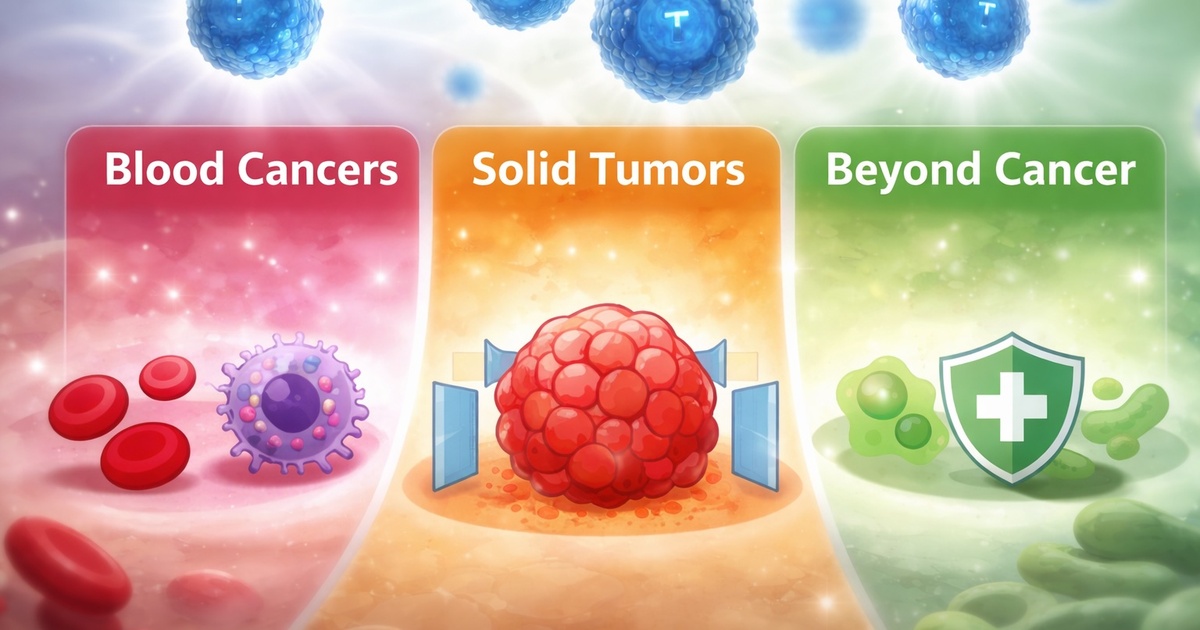
Over the past several years, CAR-T therapy has evolved from being seen as an advanced treatment option for a limited subset of patients with relapsed or refractory cancers into one of the defining modalities of an era in which immunity itself is being engineered as treatment. The field now spans high-impact results in hematologic malignancies, growing efforts in solid tumors, expanding applications in autoimmune disease, and next-generation approaches such as in vivo CAR-T.
At the same time, CAR-T is also a field in which fragmented information often makes the overall picture difficult to grasp. Who is eligible for treatment? Why do these toxicities occur? Why has CAR-T been so difficult in solid tumors? Why is the therapy so expensive? What exactly are next-generation platforms trying to change? These questions are often discussed separately across different articles and technical contexts, making the field difficult for beginners to enter and surprisingly hard to view as a connected whole even for experienced readers.
That is why this series was designed as an alternating structure of general-reader A articles and expert-oriented B articles, allowing readers to understand CAR-T continuously from the fundamentals all the way to implementation and commercialization. The A articles explain essential concepts in accessible language for patients, families, and non-specialist readers. The B articles go deeper into approvals, toxicity management, engineering strategy, CMC, regulation, and commercialization.
This page brings the full structure together into a single hub. Whether you are completely new to CAR-T or already follow the field closely, this overview is designed to help you understand how the whole series fits together and where you may want to begin.
What You Will Learn in This Series
- What CAR-T is and in which cancers it is currently used
- The major toxicities of CAR-T and how they are managed
- Why CAR-T has been much harder in solid tumors, and what strategies are being developed to overcome that
- Why CAR-T is attracting attention beyond cancer, especially in autoimmune disease
- What in vivo CAR-T means and how it differs from conventional CAR-T
- Why CAR-T is expensive and why it is often difficult for patients to access in time
- What defines a winning commercialization strategy
- How next-generation CAR-T platforms may change manufacturing, supply, and access
Reading Guide
- If you want the big picture first
Start with A0 and continue through A1 to A6 in order. - If you want deeper technical insight on each topic
Read the corresponding B article after each A article. - If you are especially interested in research, implementation, or business strategy
B2, B3, B5, and B6 are particularly strong entry points.
Complete Series Index
A0: Introduction and Series Map
This is the entry point to the entire series. It explains what CAR-T is, what the series covers, and how the general-reader A articles and expert-oriented B articles are positioned. It is designed to be read first.
Pair 1: Indications and Approvals
A1: In Which Cancers Is CAR-T Used?
This article provides an accessible overview of the patient groups in which CAR-T is used today, especially in hematologic malignancies. It serves as the basic starting point for understanding the current indication landscape.
B1: The Landscape of FDA-Approved CAR-T Therapies
This expert-oriented article reviews approved CAR-T products, targets, indications, and regulatory updates. It is designed as an overview of the current approval landscape.
Pair 2: Toxicities and Operational Reality
A2: What Are the Main Side Effects of CAR-T?
This article explains CRS, ICANS, and key precautions after discharge in accessible language, helping general readers understand why CAR-T toxicities occur and how they are recognized.
B2: Toxicity Management, Site Operations, and Long-Term Safety
This expert article discusses CAR-T toxicity management in the context of treatment-center systems, regulation, and long-term follow-up. It makes clear why CAR-T is not only a product, but also an operational system.
Pair 3: The Challenge of Solid Tumors
A3: Why Has CAR-T Been So Difficult in Solid Tumors?
This general-reader article organizes the problem around “three major barriers,” explaining why CAR-T succeeded in blood cancers but has struggled in solid tumors.
B3: Strategies to Break Through in Solid Tumors
This expert article examines the main engineering strategies for solid-tumor CAR-T, including multi-targeting, logic gating, armored designs, and local delivery approaches.
Pair 4: Beyond Cancer
A4: Can CAR-T Be Used Beyond Cancer?
This article introduces the idea of CAR-T as a form of immune reset, especially in autoimmune disease, in language that remains accessible to general readers.
B4: The Front Line of Autoimmune CAR-T
This expert article reviews the design logic, disease categories, and company landscape in autoimmune CAR-T, showing how the field is expanding beyond oncology.
Pair 5: The Next Generation Called In Vivo CAR-T
A5: What Does It Mean to Make CAR-T Inside the Body?
This general-reader article explains the concept of in vivo CAR-T and how it differs from conventional ex vivo approaches. It serves as an introduction to where the field may be heading next.
B5: Implementation Challenges in In Vivo CAR-T
This expert article examines the key technical and regulatory issues in in vivo CAR-T, including delivery, control, safety, and CMC/regulatory considerations.
Pair 6: Manufacturing, Cost, Access, and Commercialization
A6: Why Is CAR-T So Expensive?
This general-reader article explains the practical realities behind CAR-T pricing, manufacturing, logistics, site requirements, and patient access. It also touches on recent major in vivo CAR-T deals and what next-generation technologies may change.
B6: What Defines a Winning Commercialization Strategy?
This expert article examines the true commercialization challenge in CAR-T, including COGS, TAT, capacity, quality/regulation, site burden, long-term follow-up, and payment models. It serves as a capstone to the series by connecting science, implementation, and business.
What This Series Ultimately Tries to Show
By reading the series from beginning to end, readers should be able to understand CAR-T not simply as “an exciting new therapy,” but as a broader system spanning immune engineering, toxicity management, solid-tumor barriers, autoimmune applications, in vivo approaches, and commercialization.
The future of CAR-T will not be decided only by whether stronger cells can be made. It will also depend on which patients can receive them, in which centers, how quickly, at what cost, and with what degree of safety and system support. This series was built to organize that full picture across two layers: one for general readers and one for expert readers.
Who This Series Is For
- Readers who want to learn CAR-T from the basics in a structured way
- Readers following new directions in cancer therapy
- Readers interested in autoimmune CAR-T and in vivo CAR-T
- Researchers, clinicians, investors, and business professionals interested in implementation, regulation, and commercialization of cell therapy
- Anyone who wants to understand the broader structure of the field rather than only following isolated news
Preview of the Next Series
The next series will focus on Bispecific Antibody Drug, covering the field systematically from the fundamentals to clinical development, design logic, pharmacologic behavior, and competitive landscape.
Read together with the CAR-T series, it should also help clarify both the differences and the points of connection between engineered immune-cell therapies and next-generation antibody therapeutics.
Conclusion
CAR-T is no longer only a story about blood cancers. It now extends into solid tumors, autoimmune disease, in vivo engineering, manufacturing, access, supply, and commercialization. This series was designed to bring all of those threads together into one map.
For readers who want to understand CAR-T not as scattered points of information but as a connected whole, this overview page is intended to serve as the entry point.

Comments