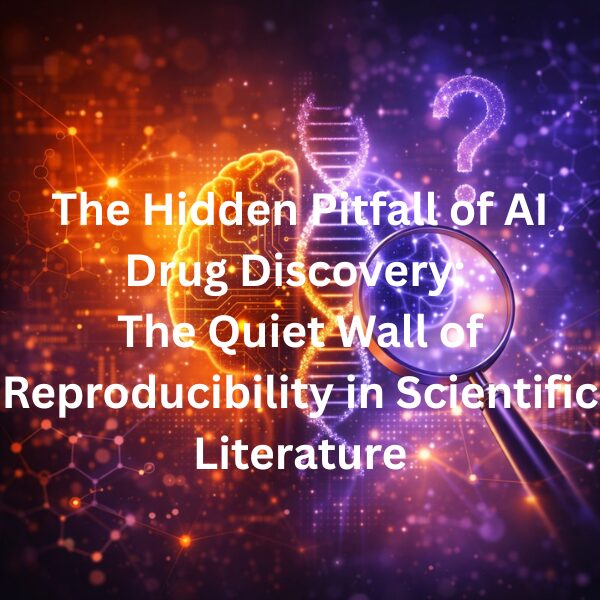
Introduction: Past Knowledge Is Now the Starting Point of Future Drug Discovery
AI-driven drug discovery has become an increasingly central part of modern pharmaceutical R&D. The speed at which novel drug candidates can be identified, the precision of structure prediction, and the scalability of search space have all advanced dramatically in recent years. In this environment, AI systems read and learn from vast volumes of published biomedical knowledge and use that data to propose new hypotheses and drug candidates.
But beneath this technological promise lies a subtle yet critical assumption—can we truly trust all of the past knowledge that fuels AI models?
Are the publications and datasets it learns from accurate, robust, and reproducible?
This article sheds light on an often-overlooked issue in AI drug discovery: the reproducibility of past scientific knowledge, and why human judgment remains indispensable—even in an era of accelerating automation.
AI Drug Discovery Starts with “Past Knowledge”
AI drug discovery pipelines are typically powered by data derived from previously published academic research, curated databases, and structural biology sources. These include:
- PubMed / PMC: abstracts and full-text articles (for natural language processing)
- ChEMBL / BindingDB: compound–target relationships
- GEO / TCGA: gene expression profiles, omics data, patient-derived datasets
- PDB / AlphaFold: protein structure data
To an AI model, these are its training materials. It learns patterns from past data and generates new hypotheses based on that learned structure. This works—so long as the source data is accurate.
But that is exactly where the critical issue lies: is all past scientific data as trustworthy as we assume?
The Amgen and Bayer Studies: High-Profile Research with Low Reproducibility
Two industry-led investigations into the reproducibility of academic biomedical research have become iconic references in this discussion. These are the internal reviews by Amgen and Bayer, both large pharmaceutical companies.
Amgen’s Internal Review (2012)
- Target: 53 landmark studies in oncology and related fields
- Result: Only 6 out of 53 could be independently reproduced (~11%)
- Source: Begley & Ellis, Nature (2012)
Bayer’s Validation Study (2011)
- Target: 67 high-priority published targets relevant to Bayer’s drug programs
- Result: Reproducibility confirmed in only 20–25% of cases
- Source: Prinz et al., Nature Reviews Drug Discovery (2011)
These results sent shockwaves through the drug development community. They clearly indicated that even peer-reviewed, high-profile papers could fail to hold up when re-tested in industrial labs using rigorous protocols.
Why Are Scientific Results Often Not Reproducible?
It is important to note that a lack of reproducibility is not the same as fraud. In most cases, it reflects systemic, technical, and methodological issues, including:
● Differences in statistical analysis
Even with the same raw data, results can differ based on normalization techniques, inclusion criteria, or interpretation of significance.
● Variability in materials and ambiguous protocols
Cell line lots, culture conditions, or seemingly minor differences in reagent prep can significantly affect results.
● Lack of methodological transparency
Academic papers often omit detailed steps due to space limits or assumptions about “standard” protocols, creating a barrier to reproducibility.
These problems are deeply embedded in how preclinical research is conducted—and are essentially invisible to AI models, which cannot judge quality or context.
What AI Cannot See: The Challenge of Scientific “Provenance”
AI systems are unable to distinguish between “high-trust” and “low-trust” knowledge. They cannot evaluate:
| What AI is good at | What AI cannot do |
|---|---|
| Learning patterns from published text | Understanding who conducted the research |
| Predicting chemical structures and target interactions | Assessing whether the data was reproducible |
| Generating statistically optimized outputs | Evaluating biological plausibility and context |
In short, AI cannot ask:
- Who published this?
- Has this been reproduced?
- Is this lab considered reliable by its peers?
The Invisible Filtering Mechanism in Science Communities
When a published paper turns out to be non-reproducible, it is rarely retracted. Instead, the scientific community handles it via silent exclusion mechanisms, such as:
- The work is no longer cited
- The authors are not invited to collaborative projects
- They lose credibility in their field over time
This is not public punishment, but a form of unspoken community filtering. The researchers may not even know that their work is being quietly disregarded—but insiders do.
This quiet filtering plays a critical role in shaping which knowledge gets used and trusted, especially in drug development.
Why This Matters for AI-Driven Drug Discovery
Modern AI models can process thousands of papers and datasets in minutes, but they cannot distinguish between:
- A landmark study that has been independently validated
- A flashy result that has never been reproduced
- A paper written by a trusted expert
- A one-off report from an unknown source with ambiguous methods
This means that AI-generated hypotheses may look promising—but rest on unstable scientific foundations if the training data includes low-reproducibility studies.
What Can We Do About It?
This does not mean we should abandon AI in drug discovery—far from it. But it does require a shift in mindset from blind automation to strategic, human-in-the-loop decision making.
The following principles are essential:
- Don’t trust every AI-generated hypothesis at face value
- Evaluate the sources behind each prediction
- Understand which labs, authors, or networks are known for reliable work
- Integrate human experience and domain expertise in all critical decisions
The future of AI in pharma lies not in replacing scientists—but in supporting experienced professionals with better tools. The final judgment must always remain human.
My Perspective and Reflections
In my own career, I’ve encountered researchers—both young and senior—who have admitted in private that their own published work was not reproducible under real-world conditions. I have also heard respected experts quietly share which studies “don’t work” despite appearing in prestigious journals.
These conversations are rarely recorded. They are passed through trusted networks, within closed circles. But they shape how projects move forward, how funds are allocated, and ultimately which drugs are brought to patients.
In this reality, reproducibility is not just a technical issue—it is a social one. And it is not AI, but human relationships, integrity, and accumulated experience that help us navigate it.
AI may analyze knowledge. But it cannot judge truth.
※ Edited and reviewed by the Morningglorysciences editorial team
(Based on scientific and analytical insights as of December 2025)
Related Articles



Comments