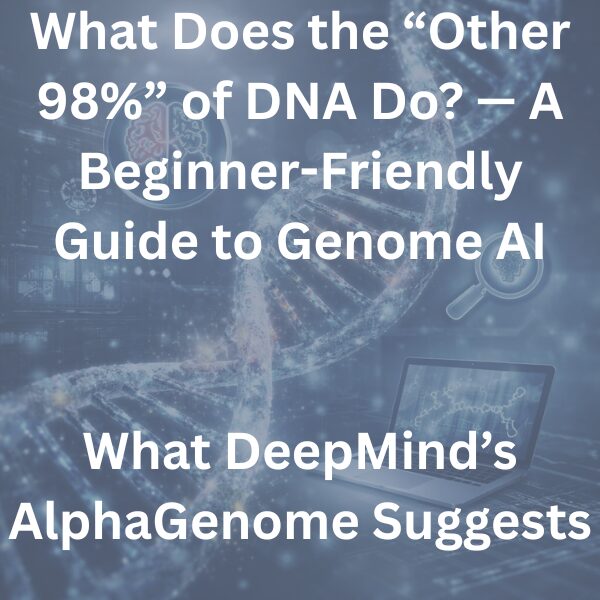
When people hear “genome analysis,” they often imagine a simple story: read DNA, find a mutation, and explain a disease. In reality, the deeper we read, the more often we hit a frustrating wall: we can detect many variants, but we can’t tell which ones matter. The hardest part is the vast portion of the genome that does not directly encode proteins—so-called non-coding regions.
Only a few percent of the human genome is protein-coding. The rest contains a scattered landscape of regulatory elements—think switches, dials, and timing circuits—that control when, where, and how much genes are expressed. For decades, this space has been treated like “dark matter”: clearly important, but notoriously difficult to interpret.
That is now changing, not because biology suddenly became simple, but because the data and modeling approaches have matured. A major trend in the last few years is using AI to predict genome function directly from DNA sequence—often called sequence-to-function modeling. One of the most discussed recent reports in this area is Google DeepMind’s Nature paper introducing AlphaGenome.
This article is a beginner-friendly introduction. Using AlphaGenome as the anchor example, we’ll focus on three practical questions:
- Why is genome interpretation so hard—especially in non-coding regions?
- What can genome AI actually do in real workflows?
- What should you trust—and what should you not overinterpret?
Chapter 1: The Bottom Line — What Does Genome AI Do for You?
If we strip away the hype, the most useful summary is this:
Genome AI helps turn a long list of DNA variants into ranked hypotheses about which variants might affect which genes, and how.
Modern sequencing (especially whole-genome sequencing, WGS) generates enormous variant lists. But experiments to validate each candidate are slow and expensive. In practice, the key bottleneck is not “finding variants” but triage—deciding what to test first.
Genome AI aims to output hypotheses in a form that is actionable. For example:
- This variant may reduce gene A’s expression in a relevant cell type.
- This variant may disrupt splicing (how RNA is stitched together) for gene B.
- This variant may change chromatin accessibility, affecting how easily the DNA is read.
The crucial mindset is this: AI is not a diagnosis machine. It is a way to produce a prioritized list of mechanistic hypotheses, so humans can design the fastest validation path.
Chapter 2: Protein-Coding vs Non-Coding DNA — What’s the Difference?
2-1. Protein-coding DNA is like the “engine blueprint”
Protein-coding regions specify the amino acid sequence of proteins. When variants occur in coding regions, they can change the protein’s structure or truncate it. That makes coding variants relatively straightforward to interpret in many cases—at least conceptually.
2-2. Non-coding DNA is like switches and control systems
Non-coding DNA does not directly encode proteins, but it contains regulatory logic: promoters, enhancers, silencers, insulators, and more. These elements control when a gene turns on, in which tissues, and at what intensity.
A simple analogy:
- Genes (coding regions) = the engine
- Regulatory non-coding DNA = ignition, throttle, brakes, sensors, and timing circuits
The engine can be intact, yet the system fails if the control circuits malfunction. This is why non-coding variants can cause disease even without changing the protein sequence.
2-3. Why are non-coding variants so hard to interpret?
Three reasons dominate:
- Context dependence: an enhancer can be active in one cell type and inactive in another.
- Long-range regulation: enhancers can influence genes tens to hundreds of thousands of bases away.
- Subtle effects: regulation often changes expression by “some percent,” not all-or-none.
In short, non-coding interpretation is not just about sequence; it’s about cell state, 3D genome structure, and multi-layer molecular readouts.
Chapter 3: Why Non-Coding Variants Have Often Been “Set Aside”
If non-coding regulation matters so much, why hasn’t it been standard practice to interpret it thoroughly? Because the workflow is constrained by reality.
3-1. WGS multiplies candidates; experiments can’t keep up
Whole-genome sequencing yields a flood of variants. Even with filters (allele frequency, conservation, predicted impact), the candidate list is typically too large for exhaustive experimental testing.
3-2. Tissue and cell-type specificity is a major trap
A regulatory variant can matter strongly in heart cells but not neurons, or in immune cells but not liver cells. This specificity is biologically normal—but it complicates diagnosis and research. Often, the most relevant tissue is hard to sample, and the relevant cell state may be transient.
3-3. The system naturally biases toward “easier” interpretations
Because coding variants are easier to explain and validate, analyses often focus on coding regions first. Non-coding candidates can become “dark matter” in practice: important in theory, deprioritized in workflows.
Genome AI—AlphaGenome included—tries to reduce this gap by turning non-coding variants into testable hypotheses.
Chapter 4: What’s New About AlphaGenome?
AlphaGenome attracted attention because it pushes toward a specific direction: using long DNA context and predicting multiple functional readouts at once.
4-1. Input: reading longer DNA context
Regulation is often not local. A causal enhancer can be far from the gene it regulates, and 3D folding can bring distant segments into contact. Models that only look at short windows may miss these relationships.
AlphaGenome is presented as a long-context model (up to a large genomic span) designed to better capture long-range regulatory signals. That makes it more aligned with how gene control works in real genomes.
4-2. Output: predicting multiple layers of genome function
Regulatory variants can influence different molecular layers:
- Gene expression (how much RNA is produced)
- Chromatin accessibility (how “open” DNA is for reading)
- Transcription initiation (where transcription starts)
- Splicing (how RNA is assembled)
- 3D contacts (which regions physically interact)
AlphaGenome aims to predict a broad set of these “functional tracks” from sequence. For beginners, the key point is not the full list of outputs but the idea that AI can help answer: “What kind of biological effect might this variant have?”
4-3. The real value: translating “a letter change” into a ranked mechanistic story
In practical terms, the promise is a translation pipeline:
Variant (DNA letter change) → predicted molecular consequence → candidate target gene(s)
Once you have that translation, you can design smarter validation experiments and more focused clinical interpretation.
Chapter 5: Where Does It Help in Practice?
5-1. Rare disease: prioritizing causal candidates
In rare disease settings, exome sequencing sometimes fails to find a convincing coding variant. Whole-genome data may contain the answer—but non-coding candidates are overwhelming. Genome AI can help by prioritizing variants with predicted functional impact in relevant tissues or cell types.
In other words, it helps clinicians and researchers decide: which non-coding variants are worth spending validation effort on?
5-2. Research: identifying regulatory elements to test
In research, a phenotype may suggest that gene expression is misregulated, but the upstream regulatory element is unknown. AI-based predictions can narrow down candidate enhancers or promoter-proximal regions, making experimental design more efficient (e.g., reporter assays, CRISPRi/a perturbations).
5-3. Drug discovery: shifting from “the gene” to “gene control”
Drug discovery increasingly includes approaches that modulate gene expression and RNA processing: epigenetic drugs, splicing modulators, ASOs, CRISPR-based regulation, and more. Better interpretation of non-coding variation can surface new hypotheses about disease mechanisms rooted in gene control rather than protein sequence changes.
Chapter 6: Common Misunderstandings — AI Does Not “Give the Answer”
This chapter is essential for beginners. The more impressive a model sounds, the easier it is to over-trust it.
6-1. Prediction ≠ diagnosis
AI prediction is a statistical inference based on training data. Whether a variant actually causes a patient’s disease depends on clinical context, family segregation, other variants, environment, and confirmation in relevant biological systems.
The right framing is: AI helps you form hypotheses and prioritize validation, not replace validation.
6-2. Cell-type specificity remains a hard problem
Even strong models can struggle when the relevant tissue or cell state is rare or underrepresented in training datasets. A model can appear highly accurate in well-studied cell types yet be unreliable in under-sampled conditions.
6-3. Three safety checks to avoid being fooled by “plausible stories”
- (1) Which molecular layer? Expression, splicing, chromatin, 3D contacts?
- (2) Which cell type? Does it match the disease-relevant biology?
- (3) What is the fastest falsification test? Which experiment can disprove the hypothesis quickly?
If you can’t answer these three, the prediction is not yet an actionable hypothesis.
Chapter 7: What Happens Next?
AlphaGenome’s report is not the end of the story—it’s a signal that the field is entering a new phase. For beginners, three trends matter most.
7-1. Non-coding variants will be “less ignored” in real workflows
Historically, non-coding variants have been deprioritized because they are hard to interpret. AI makes them easier to discuss and test. That shifts non-coding regions from “too hard” to “hypothesis-ready.”
7-2. The competitive edge moves from “finding variants” to “assigning meaning”
Sequencing is increasingly commoditized. Interpretation is the bottleneck. Teams that integrate AI prediction with efficient experimental design will move faster and produce higher-confidence conclusions.
7-3. The real payoff is shorter loops: hypothesis → test → refine
The value is not the prediction itself; it is the speed and quality of the validation loop. If AI helps you reach the decisive experiment sooner, it is creating real scientific and clinical value.
My Thoughts and Future Outlook
I think the real promise of genome AI is not a dramatic “universal diagnosis AI,” but a quieter and more powerful shift: making hypothesis generation more systematic. For decades, non-coding regions have been acknowledged as critical, yet often sidelined in practice because candidate lists are too large, validation is too heavy, and tissue/cell-state specificity is hard. Models like AlphaGenome point toward a workflow where non-coding variants are translated into mechanistic hypotheses—expression, splicing, chromatin, and potentially 3D effects—so that we can design the shortest validation route.
At the same time, the risk of overconfidence is real. AI can produce explanations that sound convincing, and humans are naturally tempted to treat them as “truth.” The healthiest way to think about genome AI is as an engineering tool for experimental design: break down predicted effects by molecular layer, ensure the tissue and cell-type assumptions match the disease biology, and plan the smallest experiment that can falsify the hypothesis. In the next article (Expert Edition), I will go deeper into how to read the benchmarks, what generalization really means, where bias enters, and how to implement a robust “predict → validate” pipeline in practice.
Summary
- Most of DNA is non-coding, and it contains regulatory logic that controls when and where genes work.
- Interpreting non-coding variants has been a major bottleneck because effects are context-dependent and hard to validate.
- Genome AI models like AlphaGenome aim to translate variants into ranked mechanistic hypotheses (not definitive diagnoses).
- The real value appears when predictions shorten the hypothesis → validation loop.
References / Sources
- Nature (AlphaGenome paper): https://www.nature.com/articles/s41586-025-10014-0
- Google DeepMind (AlphaGenome announcement): https://deepmind.google/blog/alphagenome-ai-for-better-understanding-the-genome/
- Nature news and analysis articles
Note: This is a beginner-focused overview emphasizing concepts and practical framing. Technical details—benchmarks, evaluation pitfalls, dataset bias, and implementation workflows—will be covered in the upcoming Expert Edition.


Comments