

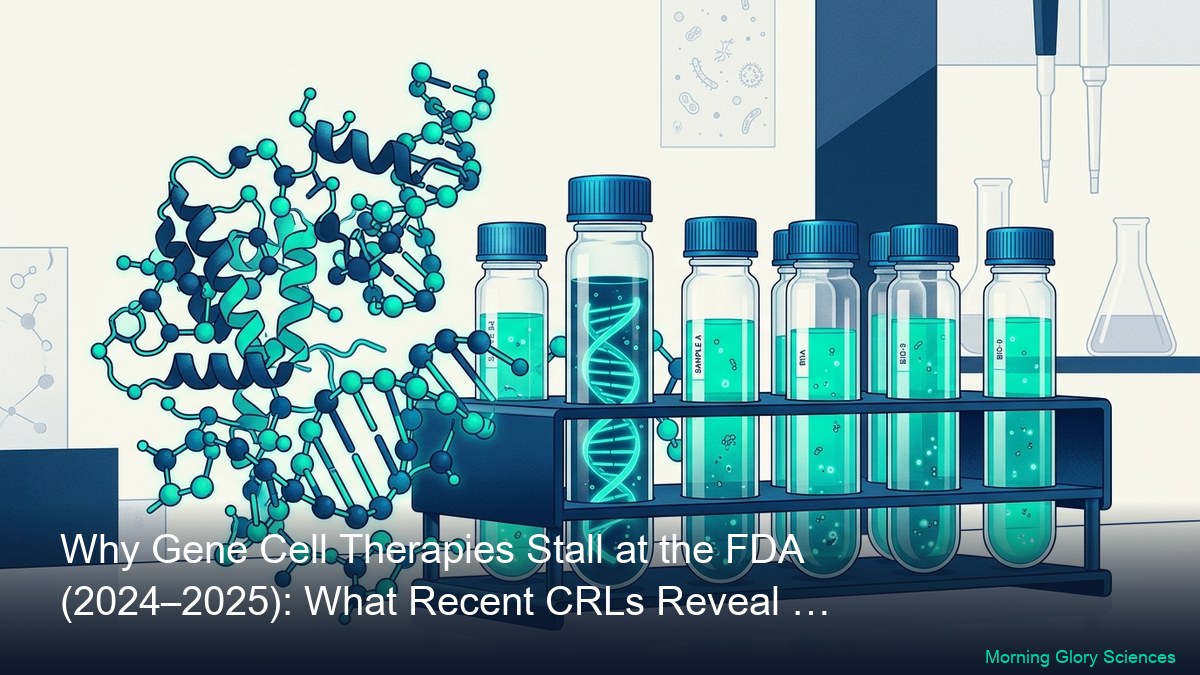
In July 2025, the FDA began publishing past Complete Response Letters (CRLs).
In July 2025, the FDA began publishing past Complete Response Letters (CRLs). Triangulating those releases with company disclosures and primary reporting shows two dominant themes: CMC (quality/manufacturing/testing) & Pre-License Inspections (PLI), and the strength of efficacy evidence / trial adequacy. This article synthesizes six prominent 2024–2025 cases and turns them into a practical, submission-ready checklist.
What you will learn
- 1. Terminology (Aligned with JP)
- 2. 2024–2025 Case Summary (Non-Approvals / Delays)
- 3. Why They Stalled: Three Bottlenecks
- 4. Pre-Submission “Red Pen” Checklist
- 5. Wrap-Up
Key Takeaways
- The most frequent blockers: CMC / facilities & PLIs.
- Several CRLs hinged on substantial evidence and trial adequacy/control.
- Build comparability, potency, and change control “backward from approval.”
- Use Type A/B meetings to document agreements and lock the submission staging.
1. Terminology (Aligned with JP)
- CRL (Complete Response Letter): non-approval notice
- CMC (Chemistry, Manufacturing and Controls): quality/manufacturing/testing
- PLI (Pre-License Inspection)
- AA (Accelerated Approval)
- Substantial Evidence: statutory bar for efficacy
- Comparability: demonstrating sameness across process/scale/site changes
- Potency Assay: MOA-aligned, validated, reproducible potency testing
- CAPA: Corrective and Preventive Action
- Data Integrity: ALCOA+ principles
- Autologous / Allogeneic: donor equals / differs from recipient
- RDEB, LAD-I, EBV+ PTLD, DMD, MPS IIIA: indications referenced in the text
2. 2024–2025 Case Summary (Non-Approvals / Delays)
On mobile, swipe the table horizontally
| Date | Product | Sponsor | Modality | Indication | FDA Outcome | Stated Reason (public) |
|---|---|---|---|---|---|---|
| 22-Apr-2024 | pz-cel → Zevaskyn | Abeona | Autologous gene-corrected cell sheet | RDEB | CRL → Approved 29-Apr-2025 | CMC information requested; no major efficacy/safety objections reported |
| 28-Jun-2024 | KRESLADI | Rocket | Autologous HSC (LVV/ex vivo) | LAD-I | CRL → Ongoing CMC review in 2025 | Limited additional CMC data request (extended timelines) |
| 16-Jan-2025 | tabelecleucel (tab-cel) | Atara | Allogeneic T-cell therapy | EBV+ PTLD | CRL → Resubmission accepted Jul-2025 | Third-party PLI findings; no new efficacy/safety objections |
| 11-Jul-2025 | deramiocel (CAP-1002) | Capricor | Allogeneic cell therapy | DMD cardiomyopathy | CRL | Insufficient substantial evidence + outstanding CMC items |
| 11-Jul-2025 | UX111 | Ultragenyx | AAV (in vivo) | MPS IIIA | CRL | Manufacturing data gaps and facility readiness concerns |
| 22-Jul-2025 | RP1 + nivolumab | Replimune | Oncolytic HSV (engineered) | Advanced melanoma | CRL | Trial not considered “adequate and well-controlled” (design concerns) |
3. Why They Stalled: Three Bottlenecks
(A) CMC / Facilities & PLIs (most frequent)
- PLI findings, weak control strategies, unvalidated potency, and thin comparability/stability packages.
- For process/scale/site changes, codify the equivalence bridge.
(B) Strength of Efficacy Evidence
- deramiocel: insufficient substantial evidence.
- RP1: adequacy/control challenged; even under AA, robust design & statistics are required.
(C) Design for Manufacturability from Day One
- Vector/cell source/process choices drive commercial viability.
- Co-design CDMO alignment, tech-transfer, and a defensible comparability package early.
4. Pre-Submission “Red Pen” Checklist
- PLI: CAPA closure evidence, data integrity, consistent deviation/change control
- Comparability: bridge across process/scale/site (CQA/potency continuity)
- Potency: MOA-aligned validity & reproducibility
- Trial design: adequate & well-controlled where feasible; rigorous selection/adjustment for external controls
- Meetings: document agreements in Type A/B minutes; lock submission staging
Note: Some figures (e.g., “~40% of INDs halted for CMC”) reflect expert opinion in media reports. Treat numbers without official backing as opinion, not statistics.
5. Wrap-Up
CMC/PLI is the final gate, but substantial evidence and adequate trial design are equally decisive. Reverse-engineer approval by embedding comparability, potency, and change control, and by locking agreements in minutes—the fastest way to avoid a CRL and to resubmit effectively.
🔗 Related Articles / Series Links



This article was produced by the Morningglorysciences Editorial Team.
Editors Note
This article covered the following key points:
- 1. Terminology (Aligned with JP)
- 2. 2024–2025 Case Summary (Non-Approvals / Delays)
- 3. Why They Stalled: Three Bottlenecks
- 4. Pre-Submission “Red Pen” Checklist
Rather than fragmented news or definitions, the aim was to present these as a single connected flow. For one step deeper on the same theme, see the related articles below.





Comments