

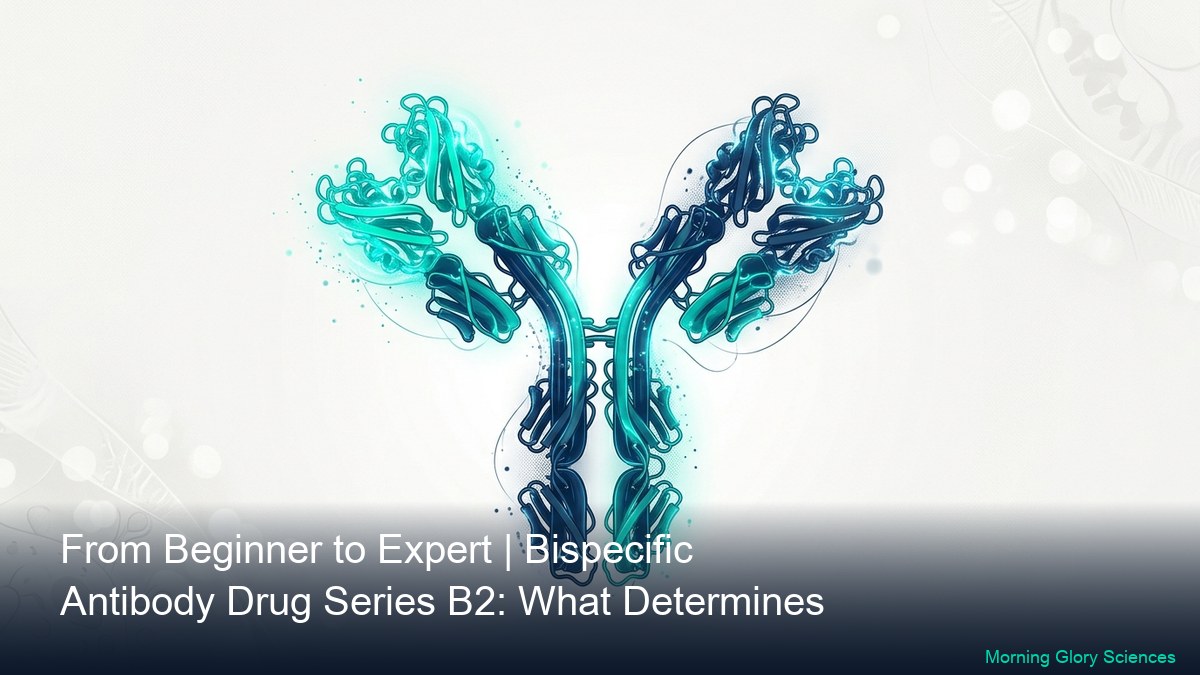
When people think about the design of bispecific antibody drugs, they often focus first on which targets should be combined.
When people think about the design of bispecific antibody drugs, they often focus first on which targets should be combined. That is natural, because the value of bispecific antibody drugs arises from handling two targets at the same time. In practice, however, target design is not a simple matter of addition. A highly attractive target A plus a highly attractive target B does not automatically produce a highly attractive drug.
What you will learn
- Why is target design in bispecific antibody drugs so difficult?
- The starting point of target design is the question: what pharmacological effect do we want to create?
- 1. A tumor antigen needs to be more than simply “high in cancer”
- 2. On the immune-cell side, “stronger activation” is not automatically better
- 3. In dual signal control, the real question is whether there is meaning in touching both at the same time
This is because, in bispecific antibody drugs, one must design not only around the biology of each target itself, but also around the meaning of connecting those two targets within the same molecule, where the effect should occur, when it should occur, how strong it should be, and how much effect on normal tissues can be tolerated. In other words, target selection is not an exercise in listing what seems important. It is an exercise in determining which combination can realistically and safely make the intended mechanism of action work.
In this B2 article, we will organize the logic of target design in bispecific antibody drugs. We will first examine why target selection is even more difficult here than in single-target antibodies, and then consider the problem from the perspectives of tumor antigens, immune-cell-side targets, signaling pathway targets, and targets used for localization or conditional control. From there, we will look at how target combinations are optimized and why even highly attractive targets often run into development barriers. The key is to judge a target not by whether it looks good on its own, but by what kind of pharmacology it creates when paired with another target.
Why is target design in bispecific antibody drugs so difficult?
Target selection is important even in conventional monoclonal antibodies, but in bispecific antibody drugs the difficulty rises by another level. In a single-target antibody, the central questions are typically whether the target is important in the disease, whether the effect on normal tissues is tolerable, and whether the target can be controlled by an antibody. In a bispecific antibody drug, however, one must additionally ask whether there is real meaning in touching the two targets at the same time, whether one target increases the value of acting on the other, and whether combining the two in one molecule creates new problems.
For example, even if there is an attractive tumor antigen and an effective immune-activating target, linking the two does not automatically guarantee that the desired activity will occur only in the tumor. If similar conditions are partially met in normal tissues, toxicity can result. If target expression is heterogeneous within the tumor, sufficient efficacy may not emerge. In other words, the quality of a target is not determined in isolation. It is determined by combination and context.
In addition, in bispecific antibody drugs, target selection is directly tied to structural design and dosing strategy. Which side should have higher affinity, which side should have multivalency, whether one target is mainly for localization and the other for activation—these questions all influence the optimal molecular architecture. Target design is not an independent upstream step. It is the central design layer that simultaneously constrains mechanism of action, structure, safety, and clinical strategy.
The starting point of target design is the question: what pharmacological effect do we want to create?
When thinking about targets in bispecific antibody drugs, the first question should not be which target is famous. The true starting point should be what kind of pharmacological effect one wants to create. Whether the goal is to bring T cells to the tumor, suppress two growth signals at once, improve tumor selectivity, or activate immunity only locally will change the properties required of the targets.
This order matters because the same target is judged differently depending on the intended mechanism of action. In a T-cell bridging format, what matters includes antigen expression level, stability on the cell surface, normal tissue expression, and spatial suitability for immune synapse formation. In a dual signal control format, what matters more is whether the two pathways are functionally connected, whether blocking one causes escape through the other, and whether simultaneous control has real value.
So target design is not a matter of selecting two items from a list of targets. It is the process of first defining the mechanism of action that should be achieved, and then working backward to identify targets that satisfy the conditions needed for that mechanism. Without this way of thinking, design easily becomes an exercise in linking fashionable or visually attractive targets, which raises the risk that the resulting drug will fail in the clinic.
1. A tumor antigen needs to be more than simply “high in cancer”
When selecting the tumor-side target in a bispecific antibody drug, the most obvious condition is that it should be highly expressed in cancer. Of course that matters, but it is not enough. In bispecific antibody drugs, especially those that recruit immune cells, the target antigen is not just a marker. It is the trigger point of pharmacological activity, meaning that even low-level expression in normal tissues can create major safety problems.
For this reason, tumor antigens must be evaluated not only by expression level, but also by the expression gap between tumor and normal tissues, the uniformity of expression, whether the antigen is sufficiently present on the cell surface, whether it internalizes too rapidly, and whether a soluble form exists in the circulation. The relative success of certain hematologic malignancy targets is strongly related to the fact that they are comparatively uniform, accessible, and stably displayed on the cell surface.
In solid tumors, the situation becomes more difficult. There are relatively few ideal, completely tumor-specific antigens, and many targets are expressed to some extent in normal tissues as well. In this setting, the key is often not to search for a perfectly specific target, but to design around relative expression differences and tumor-local conditions. Target design in bispecific antibody drugs therefore requires a design philosophy that starts from this imperfection rather than pretending it does not exist.
2. On the immune-cell side, “stronger activation” is not automatically better
A common misunderstanding in the selection of immune-cell-side targets is the idea that the best target is simply the one that can activate immunity most strongly. In reality, that is not the case. Strong activation is often inseparable from toxicity, and may lead to systemic immune activation or damage to normal tissues.
CD3 is the classic example. It is a very powerful target because it can directly activate T cells and sits at the center of T-cell engager design, but if the balance is even slightly off, toxicities such as cytokine release syndrome can become a major problem. That is why, in CD3-based design, it is not enough to simply bind CD3. One must carefully optimize affinity, valency, and the balance relative to the tumor-side target.
Also, the immune-cell-side target does not have to be limited to T cells. Possible candidates include NK cells, macrophages, co-stimulatory molecules, and immune checkpoint-related molecules. But in every case, it is not enough that the target “can move the immune system.” One must think about which cells should be moved, to what extent, in what location, and at what timing. Immune-cell-side targets should therefore be judged not by the sheer strength of activation they can produce, but by how controllably they can create the desired immune response.
3. In dual signal control, the real question is whether there is meaning in touching both at the same time
In dual signal control bispecific antibody drugs, two receptors, ligands, or pathways are targeted simultaneously. What matters here is not merely that both are involved in disease biology. What truly matters is whether touching them together creates meaningful pharmacology that cannot be obtained by acting on only one.
For example, bispecificity makes sense when blocking one pathway causes escape through the other, when a pathological phenotype becomes particularly strong only when both signals are present together, or when simultaneous control increases selectivity toward a specific cellular population. By contrast, if both are important individually but interact only weakly, and the added value of simultaneous control is small, then there may be little reason to combine them in one molecule.
In this type of design, “both are important” and “both should be targeted simultaneously” are not the same claim. Confusing the two can lead to a molecule that looks sophisticated but is functionally little more than two targets listed side by side. What is truly needed in dual signal control is a deep understanding of the functional relationship between the two pathways and a clear explanation of what simultaneous control will change in the disease state.
4. Targets used for conditioning or localization are becoming a key part of next-generation design
In recent bispecific antibody drug design, it has become increasingly important to use one target not as the direct therapeutic driver, but as a means of conditioning or localization. This may involve using one arm to concentrate the molecule near the tumor and the other to drive immune activation or signal control. It may also involve designing the molecule so that stronger activity appears only when conditions characteristic of the tumor microenvironment are present.
This way of thinking matters because bispecific antibody drug development is moving beyond the simple question of what the drug acts on, toward the questions of where it should act and where it should not act. This is particularly important in solid tumors, where ideal, completely tumor-specific antigens are rare. In such settings, safety margins may need to be created not through target perfection, but through combinations of conditions and local restriction.
In that sense, targets used for conditioning or localization may look less prominent, but they are often critically important in design. They may be less visually striking than direct killing targets, yet in practice they can determine whether the drug is viable at all. In next-generation bispecific antibody drugs, the combination of a “target that causes the pharmacology” and a “target that determines where the pharmacology happens” is likely to become increasingly important.
Why are even attractive targets often difficult in development?
When one looks at bispecific antibody drug development, it is common to find target combinations that look extremely attractive in theory but do not necessarily succeed in the clinic. The reason is that target attractiveness and drug viability are different questions. A target may be deeply involved in the disease, but if its expression is heterogeneous, if it is also present in normal tissues, or if it does not satisfy the spatial conditions needed for the intended mechanism of action, then the expected pharmacology may never emerge.
There are also problems that cannot be seen by looking at either target alone. Combining two targets can introduce constraints of molecular size and geometry, make binding balance more difficult, and produce unexpected toxicity or loss of activity. In other words, even if two attractive targets are chosen, separate optimization is still required to make them work as one actual drug.
For this reason, target selection cannot stop at biological plausibility in papers. It has to include expression distribution, behavior on the cell surface, consistency with the intended mechanism of action, compatibility with structural design, and safety in real dosing conditions. The real difficulty in bispecific antibody drug development lies not in discovering targets, but in translating combinations of targets into workable pharmacology.
What should be examined when optimizing target design?
To optimize target design in bispecific antibody drugs, at least several perspectives must be evaluated at the same time. First, does the combination actually create the intended mechanism of action? Second, could similar conditions also occur in normal tissues? Third, how much will target-expression heterogeneity limit efficacy? Fourth, can the combination be implemented naturally as a molecular structure?
In actual clinical use, route of administration, dosing frequency, patient selection, and compatibility with biomarkers also become important. In other words, a good target design is not just biologically interesting. It is a design with a credible path from preclinical logic to clinical reality. That is a very demanding standard, but it is also why target combinations that truly pass this bar can have such high value.
Ultimately, optimizing target design does not mean choosing the targets that seem strongest. It means choosing the combination that can most rationally become a drug. Simply keeping that distinction in mind changes how one sees bispecific antibody drugs quite substantially.
How this connects to the rest of the series
The central message to take from B2 is that target design in bispecific antibody drugs is not a popularity contest among targets, but a condition-design problem for making a mechanism of action work. As we saw in A2, bispecific antibody drugs can operate through multiple mechanisms of action, but each of those mechanisms only becomes possible when the right target combination is chosen. In that sense, target design is both the prerequisite for structural and mechanistic design, and at the same time one of their major constraints.
In the next article, A3, we will step back and reorganize the classifications and overall map of bispecific antibody drugs in light of the structure, mechanism, and target-design logic we have examined so far. Because we have already built up the individual components, A3 should allow the full landscape of this field to appear in a much more three-dimensional way. We will look broadly at what kinds exist, what differentiates them, and where the main axes of future development lie.
Conclusion
Target design in bispecific antibody drugs is not the process of simply selecting two targets that seem important. Its essence lies in identifying which combination of targets is most rational for achieving the intended mechanism of action. A tumor antigen must be more than simply “high in cancer,” and an immune-cell-side target must be more than simply “strongly activatable.” In dual signal control, there must be a real reason to control both simultaneously, and targets used for conditioning or localization are becoming key elements of next-generation design.
Also, even highly attractive targets can become difficult in development because of expression distribution, heterogeneity, safety, compatibility with structure, and practical dosing considerations. That is why target design in bispecific antibody drugs must be carried out while simultaneously keeping biology, engineering, and clinical medicine in view.
In the next article, A3, we will reorganize the classification and overall landscape of bispecific antibody drugs while taking into account all of the elements we have discussed so far. By stepping back and looking again at the field as a whole, its map should become even clearer.
Related Articles
Editors Note
This article covered the following key points:
- Why is target design in bispecific antibody drugs so difficult?
- The starting point of target design is the question: what pharmacological effect do we want to create?
- 1. A tumor antigen needs to be more than simply “high in cancer”
- 2. On the immune-cell side, “stronger activation” is not automatically better
Rather than fragmented news or definitions, the aim was to present these as a single connected flow. For one step deeper on the same theme, see the related articles below.









Comments