

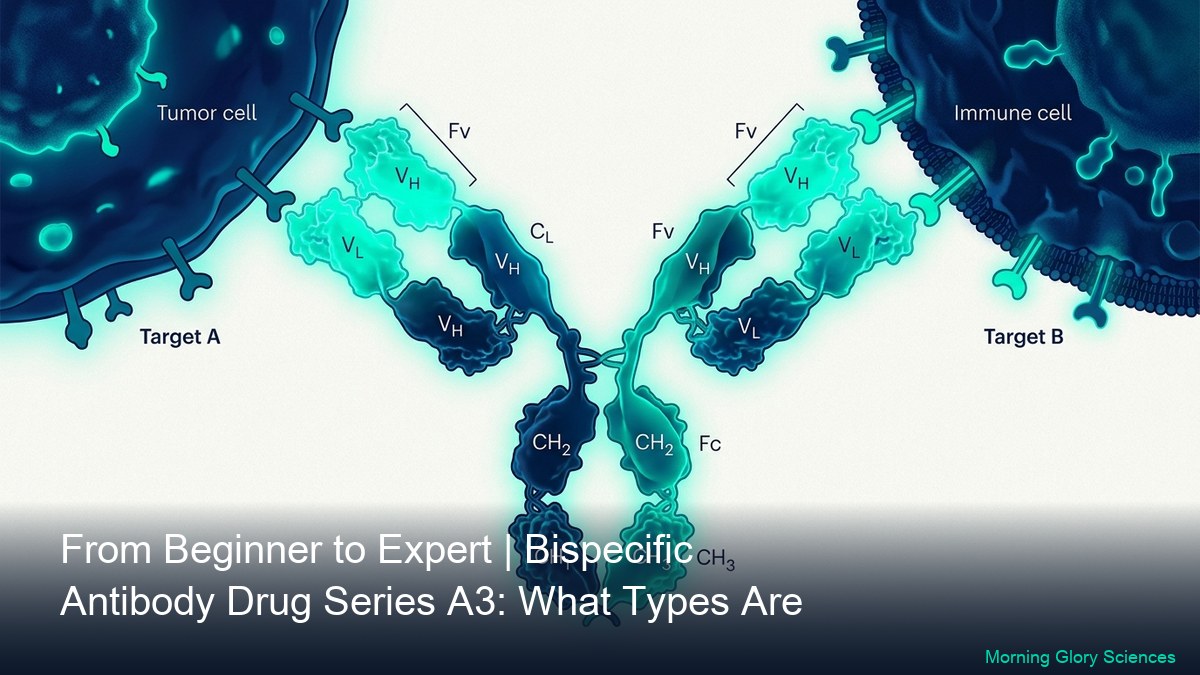
Bispecific antibody drugs are often discussed as if they were a single technological field.
Bispecific antibody drugs are often discussed as if they were a single technological field. In reality, however, their internal diversity is substantial. As we saw in A1, the essence of bispecific antibody drugs is to connect two targets or conditions within one molecule in order to create a new pharmacological function. And as we saw in B1, A2, and B2, the ways of achieving that goal differ greatly depending on structure, mechanism of action, and target design. In that sense, bispecific antibody drugs are better understood not as one simple category, but as a large family built from multiple overlapping design concepts.
What you will learn
- Bispecific antibody drugs cannot be fully understood through only one axis
- 1. Classification by mechanism of action: what is the drug trying to make happen?
- 2. Classification by structure: through what molecular architecture is the function achieved?
- 3. Classification by target combination: what is being connected to what?
- 4. Classification by indication: what is different between hematologic malignancies and solid tumors?
For this reason, in order to understand bispecific antibody drugs correctly, it is not enough to ask only what they are. It is equally important to ask what kinds of classification make the overall landscape easiest to grasp. If the classification framework remains vague, it becomes difficult to see why one drug is powerful, why another is difficult, or where future potential lies. Once the classification axes become clear, however, the position and intent of an individual drug or development program become much easier to understand.
In this A3 article, we will organize the major classification axes for understanding bispecific antibody drugs. We will first confirm the basic point that this field cannot be fully classified along only one axis, and then examine four perspectives in order: classification by mechanism of action, by structure, by target combination, and by therapeutic indication. The important point is that no single classification is sufficient on its own. Only by layering multiple axes do we begin to see the full picture of a given drug.
Bispecific antibody drugs cannot be fully understood through only one axis
When people first start looking at bispecific antibody drugs, they often try to understand them through one characteristic—for example, whether the drug is designed to recruit T cells, or whether it uses an IgG-like format. Each of those viewpoints is certainly important. But in practice, bispecific antibody drugs are a field in which relying on only one axis easily leads to misunderstanding.
For example, even within the same T-cell redirection category, a small non-IgG molecule and a long-half-life IgG-like molecule can differ greatly in clinical use and toxicity management. Conversely, even within the same IgG-like structural class, the pharmacological meaning changes completely depending on whether the mechanism of action is cell bridging or dual signal control. And even if the same tumor antigen is involved, the overall character of the drug changes drastically depending on whether the other side binds CD3, a co-stimulatory molecule, or a localization-related target.
In other words, bispecific antibody drugs must be understood through multiple overlapping axes: structure, mechanism of action, target combination, and indication. This may seem complicated at first, but it also means that once those axes are organized, individual drugs can be interpreted in a highly logical way. The role of A3 is to build that overall map.
1. Classification by mechanism of action: what is the drug trying to make happen?
One of the most intuitive and important classification axes is mechanism of action. As we saw in A2, bispecific antibody drugs can broadly be organized into four directions: cell-bridging types, dual signal control types, conditional selectivity types, and localized activation types. This classification asks what final pharmacological effect the drug is trying to achieve.
The cell-bridging type brings T cells or other immune cells close to cancer cells and enables immune-mediated attack. It is the most symbolic form of bispecific antibody drugs and includes many of the best-known clinical successes. The dual signal control type regulates two receptors or pathways at the same time and aims for effects that cannot easily be achieved through inhibition of only one pathway. The conditional selectivity type uses two target conditions to make activity more tumor-selective. The localized activation type is designed to avoid creating the same pharmacological effect throughout the body, and instead bias activity toward places where it is most needed, such as the tumor site.
The strength of this classification is that it makes it easier to see why the molecule is bispecific in the first place. When trying to understand a bispecific antibody drug, the first thing to examine is not the structural label, but the mechanism of action it is trying to produce. That is because the meaning of both structure and target choice is ultimately judged in relation to this intended pharmacological effect.
2. Classification by structure: through what molecular architecture is the function achieved?
The second major classification axis is structure. As we saw in B1, bispecific antibody drugs can broadly be grouped into IgG-like formats, non-IgG formats, and fusion-protein formats. This matters because even when the same mechanism of action is pursued, the overall character of the drug can change dramatically depending on which molecular architecture is chosen.
IgG-like formats often offer advantages in half-life, stability, and manufacturability, making them relatively strong from the perspective of implementability as real antibody therapeutics. Non-IgG formats are smaller and more flexible, which can be advantageous in settings such as cell bridging where close proximity matters, but they often face challenges in half-life and dosing design. Fusion-protein formats allow relatively flexible combination of the functional units needed for pharmacology, but they often come with higher design and evaluation difficulty.
This classification axis is important not only for understanding how a drug works, but also for understanding how it becomes a practical medicine. Even when the same pharmacology is being pursued, differences in structure can change dosing route, safety, patient convenience, and manufacturing cost. That is why classification by mechanism of action and classification by structure must always be considered together.
3. Classification by target combination: what is being connected to what?
The third classification axis is the combination of targets. As we saw in B2, which two targets are combined is extremely important in bispecific antibody drugs, and the combination itself largely determines the nature of the final molecule. Broadly speaking, one can think in terms of tumor antigen × immune-cell target, tumor antigen × tumor antigen, immune target × immune target, or localization target × functional target.
Tumor antigen × immune-cell target is the most classical type of bispecific antibody drug combination, with the T-cell engager format as the best-known example. Tumor antigen × tumor antigen connects naturally to strategies that either control two growth-related conditions on the cancer cell side or improve selectivity through dual conditions. Immune target × immune target moves in the direction of redesigning the immune response itself, for example by treating suppression and activation together. Localization target × functional target becomes especially important in next-generation design that emphasizes where pharmacology should occur.
The value of this classification axis is that it makes visible the biological relationship through which the pharmacological effect is being produced. Even within the same cell-bridging concept, the expected immune response changes depending on whether the partner is a T cell or an NK cell. Even when the same tumor antigen is used, the intent changes completely depending on whether the other side is about signal control or localization. Looking at the target combination is therefore another way of asking which biology the drug is actually trying to exploit.
4. Classification by indication: what is different between hematologic malignancies and solid tumors?
The fourth major classification axis is indication. In particular, the difference between hematologic malignancies and solid tumors is critically important for understanding bispecific antibody drugs. This is because even when the same mechanism of action, the same structure, and the same target logic are involved, the conditions for success can change greatly depending on the disease setting.
In hematologic malignancies, tumor cells are relatively accessible and target antigens are often more uniform, which helps explain why cell-bridging formats such as T-cell engagers have achieved success there. In contrast, solid tumors bring additional problems such as the tumor microenvironment, insufficient T-cell infiltration, antigen heterogeneity, and smaller expression gaps between tumor and normal tissue. As a result, it is not enough simply to transfer a successful blood-cancer format into solid tumors. Greater selectivity and more localized activity are often required.
This classification axis helps explain why a given design may succeed in one indication and struggle in another. It is not enough to judge bispecific antibody drugs by asking whether they are “good technology” in the abstract. The better question is under which indication-specific conditions they are most likely to work. Classification by indication is therefore also an axis for understanding the realistic path to success.
When the classification axes are layered, the position of a drug becomes much clearer
Each of the four classification axes discussed so far is meaningful on its own, but what matters most is using them together. For example, once we describe a molecule as “an IgG-like bispecific antibody drug for solid tumors, designed for localized activation, using a localization target × immune activation target combination,” its intended value and likely challenges become much clearer.
By contrast, if only one axis is considered, misunderstanding becomes more likely. Statements such as “it uses CD3, so it must be promising” or “it is IgG-like, so it must be superior” ignore what the drug is trying to achieve and in which indication it is meant to work. In bispecific antibody drugs, it is dangerous to judge quality based on a single label alone.
Once one becomes used to layering the classification axes, this also becomes very useful in reading papers and company pipelines. What mechanism is the drug aiming for, what structure has it chosen, what target relationship is it using, and in which indication is it trying to win? Once those questions can be answered, a development program stops looking like isolated news and starts looking like strategy.
Which classification axes will become especially important in future development?
Looking ahead to the future evolution of bispecific antibody drugs, the especially important trends are likely to be the expansion of conditional selectivity and localized activation, as well as the increased use of designs that include localization-related targets. So far, the clearest symbol of success in this field has been the cell-bridging type, especially T-cell engager approaches in hematologic malignancies. But that alone will not be enough to address the major future challenges of solid tumors and high-toxicity targets.
For that reason, future progress is likely to depend not only on making drugs act more strongly, but also on designing where they should act and where they should not. This is simultaneously a matter of mechanism-of-action classification, target classification, and indication strategy. In other words, the next wave of progress will not occur along only one axis, but across several axes at once.
In that sense, the classification map organized in A3 is useful not only for understanding the present landscape, but also for reading where future innovation is most likely to happen. Classification is not merely a way of organizing information. It is also a tool for thinking about where the next path to success may lie.
How this connects to the rest of the series
The central message to take from A3 is that bispecific antibody drugs are not a single simple category, but a field that must be understood by layering multiple classification axes. From A1 through B2, we built up the key individual elements. In A3, we stepped back and rearranged them as an overall map. That should make it easier to see the material so far not as isolated pieces of knowledge, but as an interconnected structure.
In the next article, A4, we will build on this overall picture and turn to the issue of adverse effects and safety in bispecific antibody drugs. By examining why strong activity so often leads directly to toxicity, what narrows the therapeutic window, and how design choices are linked to safety management, the practical difficulty of implementing these drugs should become even clearer.
Conclusion
Bispecific antibody drugs are a field that cannot be fully understood through only one axis. Only by layering four axes—classification by mechanism of action, by structure, by target combination, and by indication—do we begin to see the position, intent, difficulty, and future potential of a given drug.
The important point is not to judge a drug based on only one classification label. Even with the same mechanism of action, different structures create different therapeutic characters. Even with the same structure, different target combinations create different intentions. And even with the same design, different indications can radically change the conditions for success. The essence of bispecific antibody drugs lies in the overlap among these multiple axes.
In the next article, A4, we will focus on adverse effects and safety. Once the overall landscape is clear through this classification map, adding the real-world constraint of safety should make it even easier to understand why bispecific antibody drugs are both highly promising and deeply challenging.
Related Articles
Editors Note
This article covered the following key points:
- Bispecific antibody drugs cannot be fully understood through only one axis
- 1. Classification by mechanism of action: what is the drug trying to make happen?
- 2. Classification by structure: through what molecular architecture is the function achieved?
- 3. Classification by target combination: what is being connected to what?
Rather than fragmented news or definitions, the aim was to present these as a single connected flow. For one step deeper on the same theme, see the related articles below.



Comments