

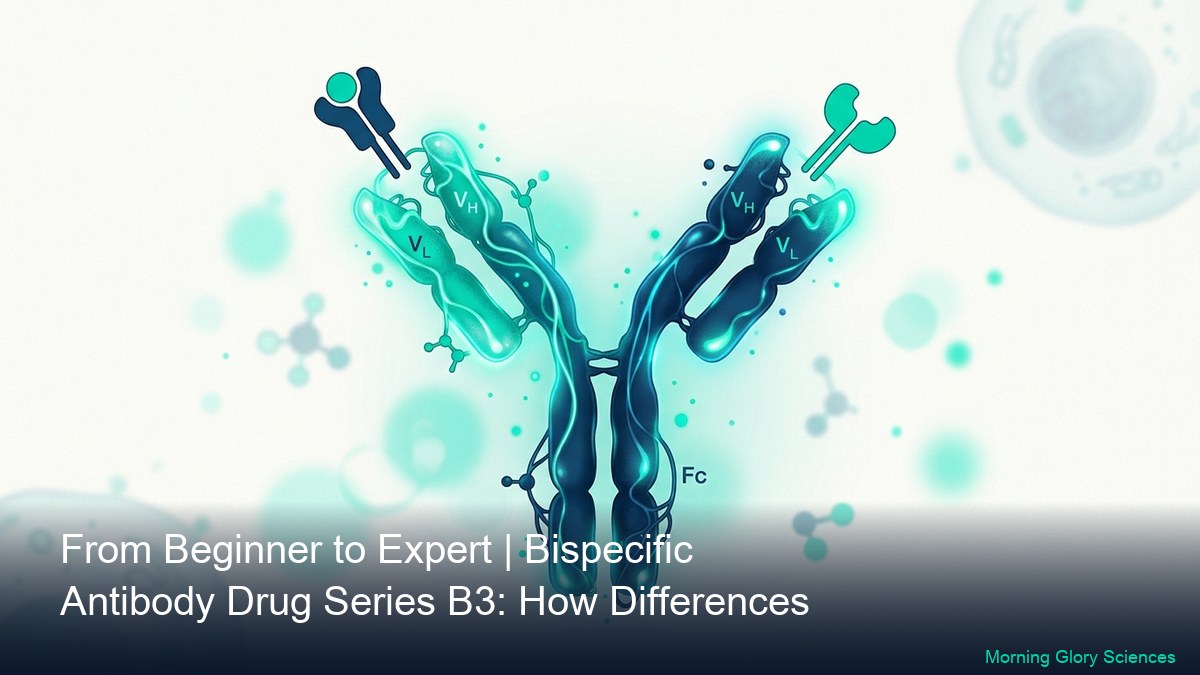
When we look at bispecific antibody drugs, it becomes clear that even though they are grouped under the same label, they can behave very differently as actual medicines.
When we look at bispecific antibody drugs, it becomes clear that even though they are grouped under the same label, they can behave very differently as actual medicines. One molecule may show very strong cell-bridging activity while struggling with durability of exposure. Another may offer advantages in half-life and dosing convenience while showing different characteristics in local peak activity density. Behind these differences lies the difference in modality.
Editors Note
This article covered the following key points:
- Why do differences in modality so strongly shape pharmacological properties?
- 2. Non-IgG formats: often capable of strong functional activity, but prone to shorter half-life
- 3. Fusion-protein formats: high design freedom, but behavior can be harder to predict
- Differences in distribution: where does the drug reach more easily?
Rather than fragmented news or definitions, the aim was to present these as a single connected flow. For one step deeper on the same theme, see the related articles below.
What you will learn
- Why do differences in modality so strongly shape pharmacological properties?
- 1. IgG-like formats: strong in stability and half-life, but with size-related constraints
- 2. Non-IgG formats: often capable of strong functional activity, but prone to shorter half-life
- 3. Fusion-protein formats: high design freedom, but behavior can be harder to predict
- Differences in distribution: where does the drug reach more easily?
Here, modality does not simply mean the rough distinction of whether something is an antibody or not. It means the specific molecular format through which the function is implemented. As we have seen from A1 through B2, even when bispecific antibody drugs aim at the same mechanism of action, they may be designed in different molecular forms such as IgG-like formats, non-IgG formats, or fusion-protein formats. These differences are not cosmetic. They directly shape pharmacokinetics, tissue distribution, strength of activity, safety, and dosing strategy.
In this B3 article, we will organize how differences in modality create differences in pharmacological properties. We will first confirm the basic point of why modality so strongly affects pharmacology, and then compare the characteristics of IgG-like formats, non-IgG formats, and fusion-protein formats. We will then examine their differences from the perspectives of distribution, half-life, tissue penetration, immune activity, and dosing strategy. The important point is not to decide which modality is generally superior, but to understand which pharmacological properties are suited to which indications and mechanisms of action.
Why do differences in modality so strongly shape pharmacological properties?
In bispecific antibody drugs, mechanism of action and target combination are of course important, but they do not fully determine the nature of the drug. Even when the same target pair A × B is being pursued, the way it is implemented through a modality can change how long the molecule stays in the body, how well it reaches tumors, how it interacts with immune cells, and even what kind of toxicity emerges. In other words, modality is not just a container. It is one of the elements that defines the pharmacology itself.
This is because different modalities differ in molecular size, three-dimensional structure, Fc presence or absence, flexibility, binding geometry, and stability. For example, a smaller molecule may enter tissues more easily, but it is also more likely to be cleared rapidly. A molecule with an Fc region may achieve longer half-life, but can also become larger, and may face issues related to local physical bridging efficiency or unwanted effector functions.
For that reason, choosing a modality is an extension of structural design, but in practice it is also pharmacological design itself. The optimal modality changes depending on how long the drug should remain in the body, where it should be delivered, how strongly the immune system should be activated, and what dosing schedule is realistically feasible. In B3, we will focus on this central idea that differences in modality become differences in pharmacology.
1. IgG-like formats: strong in stability and half-life, but with size-related constraints
IgG-like formats are among the most antibody-like modalities in bispecific antibody drugs. They retain a framework close to a conventional IgG antibody while incorporating bispecificity, often contain an Fc region, and tend to benefit from the mature development foundation already established for antibody therapeutics.
From the perspective of pharmacological properties, the major advantage of IgG-like formats is longer half-life. Through FcRn-mediated recycling, they can remain in the body for longer periods and often make it easier to avoid very frequent dosing. This directly affects compatibility with outpatient treatment, patient convenience, and the feasibility of chronic administration. In addition, they often show relatively high molecular stability and reproducibility in manufacturing, which contributes to practical implementability in the clinic.
At the same time, IgG-like formats tend to be larger molecules, which can become a disadvantage in deep tissue penetration or uniform local distribution. This is particularly relevant in solid tumors, where stromal barriers and physical constraints often matter, meaning that simply staying longer in circulation does not automatically translate into better performance. Also, in T-cell redirection formats, Fc-dependent effector functions may be unnecessary or even harmful, which can require additional engineering such as Fc silencing.
2. Non-IgG formats: often capable of strong functional activity, but prone to shorter half-life
Non-IgG formats do not have the full IgG structure, and instead are built from compact modules such as antibody fragments or related components. These formats are often seen in T-cell engager designs and enable small and flexible molecular architectures.
A major feature of this modality is that it can produce very strong functional activity. Because the molecule is small and can bridge cells at short distances, it may promote highly efficient immune synapse formation in settings such as T-cell–tumor-cell bridging. In that sense, non-IgG formats may have an advantage in local “burst power.”
However, that same small size also tends to create the problem of short half-life. When an Fc region is absent, renal clearance is often faster, and continuous infusion or frequent dosing may be required to maintain sustained exposure. This can become a challenge in terms of patient burden and practical clinical implementation, making it important to consider not only how strongly a drug can act, but also how realistically it can be used.
3. Fusion-protein formats: high design freedom, but behavior can be harder to predict
Fusion-protein formats are modalities built by combining antibody fragments, receptor-binding domains, linkers, and other functional domains. Rather than staying within the framework of a conventional antibody, this approach is closer to assembling the desired pharmacological function through molecular engineering.
The appeal of this modality lies in its high degree of design freedom. It can be relatively well suited to incorporating localization functions, conditional activation, and multifunctionality—features that are often needed in next-generation bispecific antibody drugs. Especially when the goal goes beyond simple T-cell engagement or dual pathway inhibition and moves toward more complex pharmacological functions, fusion-protein formats can become a powerful option.
At the same time, the very freedom of fusion-protein formats can make pharmacokinetics, stability, immunogenicity, and manufacturability harder to predict. Small design differences may lead to unexpected behavior, and even when a molecule looks attractive in preclinical work, careful optimization is often needed to make it function as a real drug. In that sense, fusion-protein formats have great potential, but they are not always the easiest modalities in which to read pharmacological behavior clearly.
Differences in distribution: where does the drug reach more easily?
Differences in modality first appear as differences in distribution. In general, smaller molecules tend to diffuse more easily into tissues and access intercellular spaces more readily, while larger molecules tend to have better persistence in circulation. For that reason, non-IgG formats may have advantages in tissue and intercellular access, whereas IgG-like formats tend to have advantages in persistence in the bloodstream.
However, this is not a simple matter of size alone. In solid tumors, distribution is affected by abnormal vasculature, interstitial pressure, and cell density, so it is not automatically true that a smaller molecule will always distribute evenly. Conversely, even a larger molecule may achieve sufficient exposure by circulating for longer periods. In other words, distribution is a relative property influenced not only by modality size, but also by indication and tumor environment.
Still, the question of where a drug reaches most easily is an important starting point in modality selection. The desired distribution properties differ between indications such as hematologic malignancies, where access is relatively easy, and solid tumors, where physical barriers are substantial. Differences in modality directly shape this first condition of reaching the target.
Differences in half-life: how long does the drug remain in the body?
Half-life is one of the key determinants of how usable a bispecific antibody drug will be in practice. IgG-like formats often achieve longer half-life through FcRn-mediated recycling, making it possible in some cases to design dosing intervals measured in weeks or longer. By contrast, non-IgG formats and some fusion-protein formats are more likely to have shorter half-lives, which can require continuous infusion or frequent dosing.
Long half-life has obvious advantages. It reduces patient burden, often makes clinical operation easier, and may support more sustained pharmacological effect. However, remaining in the body longer is not always an advantage. In drugs with strong immune activation, prolonged exposure can make toxicity management more difficult. On the other hand, a shorter half-life can be beneficial in cases where the effect needs to be turned off more quickly if a problem occurs.
For that reason, half-life is not a simple metric in which longer is always better. It must be evaluated in light of whether the duration is appropriate for the intended mechanism of action, and whether it is compatible with toxicity control and dosing design. Differences in modality strongly influence where this optimal duration point lies.
Differences in tissue penetration: especially important in solid tumors
Tissue penetration is one of the most important pharmacological properties of bispecific antibody drugs, particularly in solid tumors. It is not enough for the drug merely to circulate in the blood. It must enter tumor tissue and function at the appropriate intercellular distances. In this respect, smaller non-IgG formats and some fusion-protein formats may appear advantageous.
However, higher tissue penetration does not automatically mean higher efficacy. Even if a molecule enters tissue easily, it may fail to maintain sufficient action if its residence time is too short, and uneven intratumoral distribution may still prevent the expected pharmacology from emerging. Conversely, larger molecules such as IgG-like formats may be able to achieve effective cumulative exposure through prolonged circulation.
For that reason, tissue penetration must not be evaluated in isolation. It must be considered together with half-life, binding properties, and localization strategy. When thinking about which modality is suitable for solid tumors, one has to look at both how easily the molecule can enter and how long it can remain.
Differences in immune activity: how strong is the effect, and how controllable is it?
Differences in modality also have a major influence on the strength of immune activity and how controllable that activity is. Non-IgG formats can sometimes activate T cells very strongly because they allow close intercellular spacing. This is especially important in T-cell engager designs, where it can translate into powerful cytotoxic activity but also increase the risk of toxicities such as cytokine release syndrome.
In IgG-like formats, by contrast, the quality of immune activation may differ depending on how the activity rises, what local molecular density is achieved, and how the Fc region is handled. This does not mean that they are necessarily weaker, but rather that even with the same target combination, differences in physical arrangement and persistence can change how immune activity appears. Fusion-protein formats may allow even more complex forms of activity control through design, but this also makes prediction and optimization more difficult.
The important point here is that immune activity is not simply a matter of stronger being better. What is desirable is to move the immune system in a controllable way, at the right place, and to the right extent. Differences in modality directly affect not only the strength of activity, but also how controllable that activity is.
The relationship to dosing design: pharmacological properties become real in the clinic
Differences in modality ultimately appear in dosing design. Modalities with shorter half-life may require continuous infusion or frequent dosing, while those with longer half-life may allow more widely spaced administration. This affects not only patient convenience, but also outpatient feasibility, first-dose safety management, and the practicality of step-up dosing strategies.
For example, in drugs with strong immune activity, a short half-life may actually provide a safety advantage, because the effect can be shut down more quickly if problems occur. On the other hand, for mechanisms that need chronic control, a longer half-life may be more realistic. In that sense, dosing design is both the result of pharmacological properties and one of the key criteria by which the practical value of a modality is judged.
In this way, understanding differences in modality is not merely a matter of molecular theory. It also means understanding how the drug will ultimately be delivered to patients and handled in real medical settings. Pharmacological properties gain their full meaning only when they are translated into actual dosing practice.
Which modality is the best?
The natural question that follows is which modality is ultimately the best. But the honest answer is that there is no universal best solution. Which modality is superior depends on the intended mechanism of action, the target combination, the disease indication, the desired half-life, toxicity management, and the realities of dosing implementation.
For example, if the goal is to produce a rapid and powerful burst of T-cell-bridging activity in hematologic malignancies, a non-IgG format may be rational. If, on the other hand, the goal is easier outpatient use and longer dosing intervals, an IgG-like format may be advantageous. If localized activity or conditional activation in solid tumors is the priority, fusion-protein formats or more complex next-generation designs may become meaningful choices.
In other words, superiority of modality cannot be judged in isolation. It is determined by which pharmacological properties are most rational for the intended purpose of the drug. Without this perspective, there is a risk of seeing the success of one modality and generalizing it to all settings. What matters in B3 is to understand modality not as a trend, but as a choice among pharmacological property profiles.
How this connects to the rest of the series
The central message to take from B3 is that differences in modality are not merely differences in structure. They appear as differences in distribution, half-life, tissue penetration, immune activity, and dosing design. After A3 organized the overall map of the field, B3 has now shown how deeply the axis of modality shapes actual pharmacological behavior.
In the next article, A4, we will examine how these differences in pharmacological properties ultimately connect to adverse effects and safety. By looking at why strongly active drugs so often run into toxicity problems, and which pharmacological properties narrow the therapeutic window, the practical difficulty of implementing bispecific antibody drugs should become even more concrete.
Conclusion
The differences in modality among bispecific antibody drugs are not simply differences in molecular format. IgG-like formats, non-IgG formats, and fusion-protein formats each have distinct characteristics in distribution, half-life, tissue penetration, immune activity, and dosing strategy. As a result, even with the same mechanism of action or the same target combination, changing the modality can substantially change the overall character of the drug.
The important point is not to decide which modality is generally superior, but to determine which pharmacological property profile best fits the intended purpose of the drug. Modality is both part of structural design and a choice among pharmacological behaviors.
In the next article, A4, we will turn to adverse effects and safety. By organizing how differences in modality and mechanism of action translate into the balance between efficacy and toxicity, the practical reality of bispecific antibody drug implementation should become even clearer.
Related Articles



Comments