

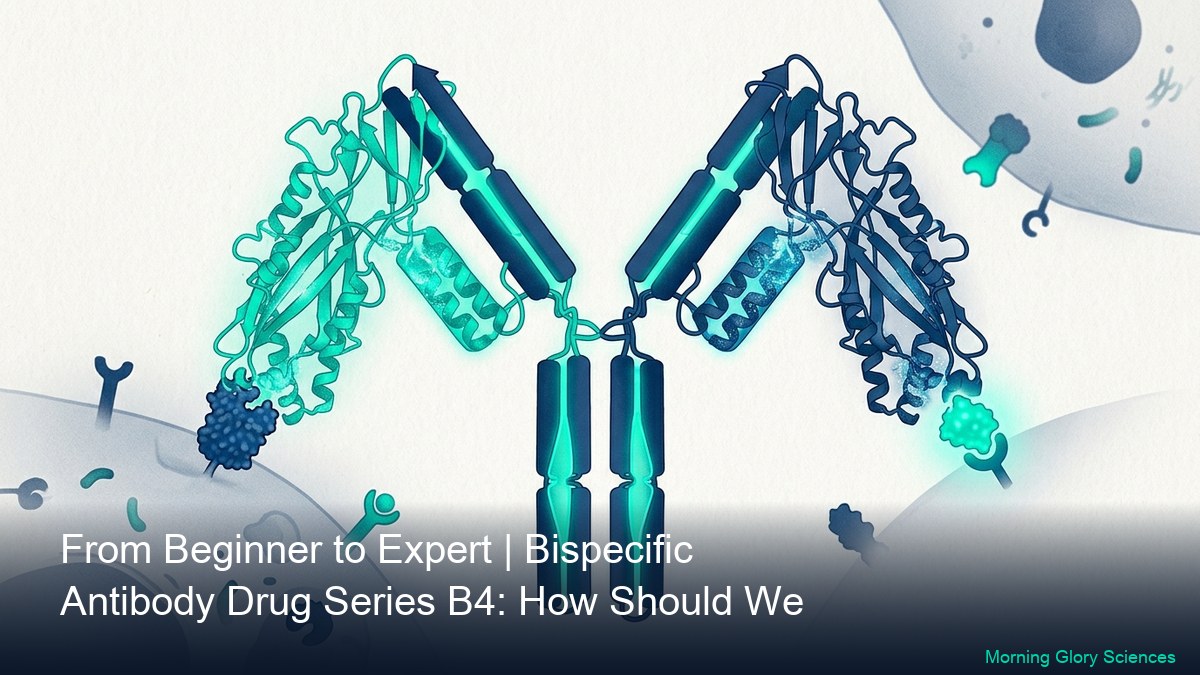
Bispecific antibody drugs are a modality that often looks highly attractive in theory.
Bispecific antibody drugs are a modality that often looks highly attractive in theory. Because they can handle two targets within a single molecule, they can aim for pharmacological effects that are difficult to achieve with single-target antibodies. In actual development, however, it is not uncommon to see a gap between concept and clinical reality: a molecule may look excellent as a concept but struggle in the clinic, or may show strong activity in preclinical studies but fail to deliver the expected efficacy or safety in humans. To understand this gap, toxicity alone is not enough. We have to look at PK/PD and the practical realities of development together.
What you will learn
- Why is PK/PD especially important in bispecific antibody drugs?
- From the PK perspective: what do exposure, distribution, and duration actually mean?
- From the PD perspective: what counts as “the drug is working”?
- How should toxicity be interpreted: how do we distinguish strong activity from dangerous activity?
- Why is translation from preclinical studies to humans so difficult?
As we saw in A4, the adverse effects of bispecific antibody drugs are extensions of their pharmacological action. A design that works strongly is often also a design that produces toxicity. In B4, we now add another layer to this picture: the PK/PD perspective of how much exposure occurs, when it occurs, in which tissues it occurs, and what degree of biological response follows. This matters because in bispecific antibody drugs, it is not enough to ask whether the drug binds the target. Exposure level, duration, local concentration, and the contact conditions with immune cells all directly shape both efficacy and toxicity.
In this B4 article, we will first organize the basic way of thinking about PK/PD in bispecific antibody drugs, and then examine how toxicity should be interpreted, why translation from preclinical studies to humans is so difficult, why dosing design matters so much, and where the major development bottlenecks actually lie. The important point is to understand why these drugs are difficult not as a generic development challenge, but as a challenge that is specific to the nature of bispecific antibody drugs.
Why is PK/PD especially important in bispecific antibody drugs?
PK/PD is important for all medicines, but in bispecific antibody drugs its importance becomes even greater. PK describes how the drug distributes in the body and how long it remains there, while PD describes what kind of biological response occurs as a result. In bispecific antibody drugs, these two are tightly intertwined. That is because it is not enough for the drug simply to be present. What matters is at what concentration, in what location, for how long, and under what cell-contact conditions it is present, and what signaling changes or immune-cell interactions result from that exposure.
For example, in a T-cell engager format, occupancy on the CD3 side, occupancy on the tumor-antigen side, the physical distance between T cells and tumor cells, and the local concentration all contribute to activity. If exposure is insufficient, efficacy will be weak. But if exposure rises too rapidly or reaches excessively high levels, toxicities such as cytokine release syndrome may become more likely. In other words, “how much the drug works” is determined not only by target binding itself, but also by how exposure rises and how it is sustained.
The same is true in dual signal control types and localized activation types. What matters is not just total systemic exposure, but where, for how long, and to what extent activity is actually created. For that reason, PK/PD in bispecific antibody drugs should not be viewed as background data. It is part of the core pharmacology.
From the PK perspective: what do exposure, distribution, and duration actually mean?
From the PK perspective, the first important question is how exposure rises and how long it is maintained. In bispecific antibody drugs, the stronger the intended pharmacology, the more the shape of the initial exposure profile matters for safety. If high concentrations are reached too quickly, unwanted immune activation or systemic inflammatory responses may occur. On the other hand, if exposure is insufficient, the intended efficacy may never be achieved.
The next important issue is distribution. Even at the same blood concentration, the meaning changes depending on whether the drug actually reaches the tumor site, whether it is present at appropriate distances relative to immune cells, and whether similar conditions are being created in normal tissues. This is especially relevant in solid tumors, where tissue penetration and nonuniform local distribution often become limiting factors for efficacy.
Duration adds yet another layer. If the molecule remains in the body for a long time, efficacy may be easier to sustain, but toxicity may also last longer. If the effect can be turned off quickly, safety management may be easier, but a shorter half-life may require more frequent dosing to achieve sufficient activity. So optimization of PK is not simply about making exposure higher or longer. It is about creating the most rational exposure profile for the intended mechanism of action.
From the PD perspective: what counts as “the drug is working”?
From the PD perspective, the key question is what biological changes occur after the drug is given. But in bispecific antibody drugs, PD is not simple to interpret. In a T-cell engager format, for example, T-cell activation, cytokine release, tumor-cell killing, and changes in T-cell infiltration may all occur in sequence. It is not straightforward to decide which of these changes should count as sufficient PD.
The difficulty here is that some PD markers are signs of efficacy and signs of toxicity at the same time. Cytokine elevation, for example, indicates that the immune system is being activated, but it is also linked to the risk of CRS. In other words, in bispecific antibody drugs, the mere fact that a response is occurring does not automatically mean that the response is favorable. What matters is how much response occurs, when it occurs, and where it occurs.
Another development challenge is deciding which intermediate PD markers are truly reliable before final outcomes such as tumor shrinkage can be observed. Strong cytotoxic activity in preclinical experiments does not necessarily translate into the same behavior in patients, because the tumor microenvironment and immune context are different. For this reason, the key in bispecific antibody drug PD is not simply whether there is activity, but whether there are translationally meaningful markers of activity.
How should toxicity be interpreted: how do we distinguish strong activity from dangerous activity?
When thinking about toxicity in bispecific antibody drugs, it is not enough to say that an adverse effect occurred or did not occur. The more important task is to understand from which part of the pharmacology the toxicity is arising. The interpretation changes greatly depending on whether the toxicity is coming from the same activity that is driving desirable therapeutic effect, or from unwanted activity in the wrong place.
For example, there may be cases in which strong T-cell activation is also driving tumor shrinkage, but the same activation occurring systemically produces CRS. In that situation, the problem is not immune activation itself, but where, how strongly, and when that activation is occurring. By contrast, when toxicity arises because the target is present in normal tissues, producing on-target / off-tumor effects, that points more directly to a problem of target selectivity or localization control.
In other words, when looking at toxicity, one has to distinguish whether it is primarily a PK problem, a PD problem, a target problem, or a structural-design problem. In bispecific antibody drugs, toxicity often arises from multiple overlapping causes rather than from a single one, so this kind of decomposition becomes critically important for development strategy.
Why is translation from preclinical studies to humans so difficult?
One of the major difficulties in bispecific antibody drug development is knowing how far preclinical data can really be translated into humans. Strong activity seen in cell-based systems may not appear the same way in the human body. Conversely, toxicities that are not clearly visible in preclinical work may emerge strongly in patients.
One reason is that the action of bispecific antibody drugs depends on complex conditions such as immune cells, the tumor microenvironment, target expression, and local concentration. In simple coculture systems, T cells and tumor cells are often placed in near-ideal proximity, so highly favorable results can emerge. In real tumors, however, those same conditions may not exist. On the other hand, low-level normal-tissue expression or patient-to-patient variation in immune state can be difficult to reproduce adequately in preclinical models.
Animal models also have major limitations. Species differences in targets and immune systems, differences in tumor microenvironments, and difficulty reproducing human-specific responses all mean that even when a drug appears safe preclinically, the same conclusion may not hold in humans. For that reason, in bispecific antibody drugs, preclinical results that look “too clean” may actually require especially cautious reinterpretation before moving into the clinic.
Why is dosing design so central to development success?
In bispecific antibody drugs, it is not enough to have a good molecule. How that molecule is dosed can strongly influence both efficacy and safety. The exposure profile during early dosing is especially important, and even with the same molecule, the perceived safety profile can change significantly depending on the dosing strategy.
A representative example is step-up dosing. This is an approach in which treatment begins at a low dose and then gradually increases, allowing necessary exposure to be reached while reducing the risk of abrupt immune activation. For molecules with meaningful CRS risk, this kind of dosing strategy is effectively part of the viability of the drug itself. In other words, dosing design is not a downstream development detail. It is part of the same integrated strategy as molecular design.
Dosing interval, premedication, how to initiate treatment in patients with high tumor burden, and whether a drug can realistically be used in the outpatient setting also directly affect development success. No matter how promising the pharmacology is, a drug will not be widely used if dosing is impractical. In bispecific antibody drugs, not only the performance of the molecule but also the way that performance can be turned into something workable in real clinical settings becomes decisive.
Where are the real development bottlenecks?
The development bottlenecks in bispecific antibody drugs do not come from a single problem. First, a target combination may look attractive but still offer too narrow a safety window. Second, a molecule may look highly active preclinically but fail to generate enough functional activity in the tumor site in patients. Third, the classic trade-off often appears: trying to suppress toxicity may reduce efficacy at the same time.
In addition, manufacturability and stability cannot be ignored. In structurally complex bispecific antibody drugs, uniform production, long-term stability, and quality control can all become challenges. And even if those issues are solved, there are still practical questions of clinical use and market implementation. Does the drug require inpatient monitoring? Can it be used in the outpatient setting? Is it easy to combine with other therapies? These considerations also affect the overall probability of development success.
So the bottleneck in bispecific antibody drugs is not simply that “the molecule is difficult.” The real issue is that target biology, PK/PD, toxicity, manufacturability, dosing strategy, and clinical implementation are all linked. If any one of these links is weak, the overall drug is much less likely to become viable.
What should count as a “good bispecific antibody drug”?
By this point, it should be clear that a good bispecific antibody drug is not simply the molecule with the strongest activity. What really matters is whether it can produce enough of the desired pharmacological effect while staying within a manageable safety window and remaining compatible with realistic dosing and clinical implementation. In other words, what is needed is not only strength, but also controllability and implementability.
This perspective is important because many molecules that look highly attractive at the research stage run into difficulties during development. Strong activity, an interesting target combination, or a novel structure alone is not enough. What is required is an overall design that can truly function as a drug in humans. Only when PK/PD, toxicity, and clinical use are included can we meaningfully call it a “good molecule.”
For that reason, when evaluating bispecific antibody drugs, the right question is not simply whether the molecule looks powerful. The more important question is what kind of exposure profile it creates, what kind of PD response follows, and how toxicity is managed under those conditions. The central point of B4 is to understand this development reality as an extension of pharmacology.
How this connects to the rest of the series
The central message to take from B4 is that the difficulty of bispecific antibody drugs lies in the fact that toxicity, PK/PD, dosing design, and translation from preclinical studies to humans are all connected. In A4, we examined safety problems more broadly. In B4, we have now revisited them at a more implementation-focused level. This should make it much clearer why bispecific antibody drugs are so promising and yet so difficult to develop.
In the next article, A5, we will build on the understanding of structure, mechanism of action, safety, and PK/PD accumulated so far and place bispecific antibody drugs within the broader landscape of cancer therapy. By comparing them with chemotherapy, ADCs, CAR-T, immune checkpoint inhibitors, and other modalities, we should be able to see more clearly where their strengths truly lie and where their limits remain.
Conclusion
In bispecific antibody drugs, toxicity, safety, and efficacy cannot be considered separately. We must look at what kind of exposure creates what kind of PD response, and how that then produces both therapeutic benefit and adverse effects. That is why PK/PD is especially important in bispecific antibody drugs, and why translation from preclinical studies to humans is so difficult.
Development bottlenecks are also not just problems of the molecule alone. They arise because target biology, structure, PK/PD, toxicity, dosing design, and clinical implementation are all connected. A good bispecific antibody drug is therefore not simply a strong molecule, but one that can implement the required pharmacology safely and realistically.
In the next article, A5, we will place bispecific antibody drugs within the full landscape of cancer treatment. By clarifying what they do well and where they remain difficult relative to other modalities, the true value and limits of this field should become even clearer.
Related Articles
Editors Note
This article covered the following key points:
- Why is PK/PD especially important in bispecific antibody drugs?
- From the PK perspective: what do exposure, distribution, and duration actually mean?
- From the PD perspective: what counts as “the drug is working”?
- How should toxicity be interpreted: how do we distinguish strong activity from dangerous activity?
Rather than fragmented news or definitions, the aim was to present these as a single connected flow. For one step deeper on the same theme, see the related articles below.


Comments