

Key Points
- In 2025-26, KRAS drug discovery rapidly expanded from G12C (NSCLC-focused) to G12D (PDAC-focused) and pan-KRAS (multi-mutation). The central player is Revolution Medicines, whose RAS(ON) inhibitor platform yielded two clinically transformative drugs.
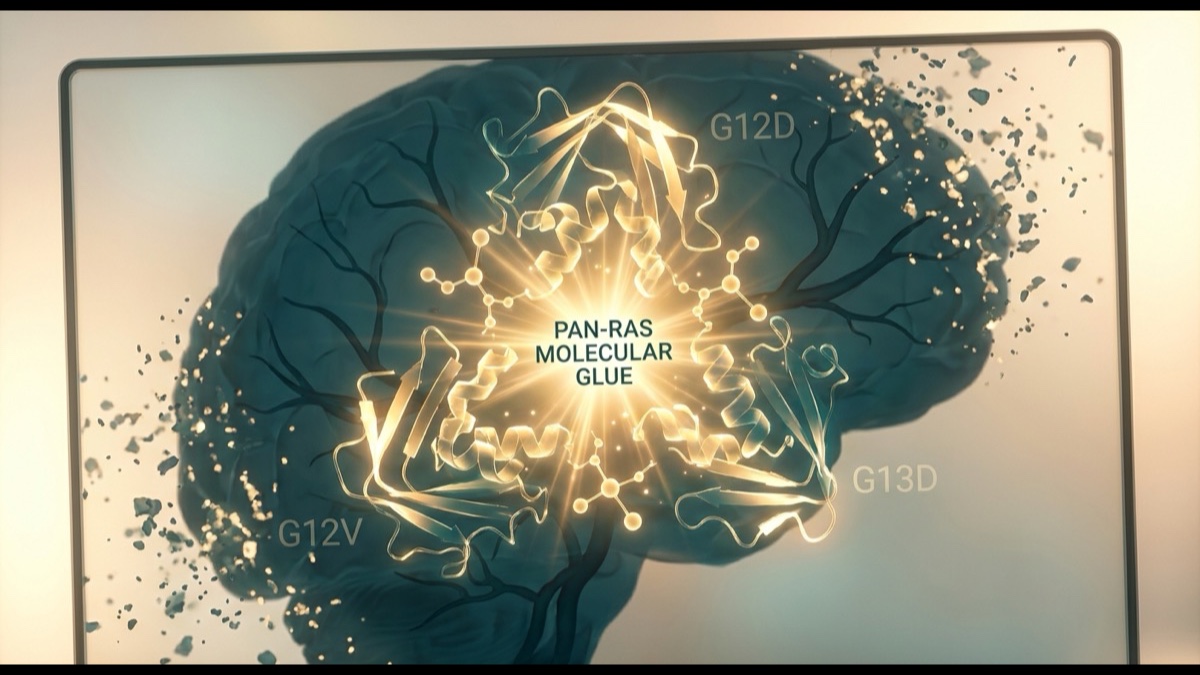
- Daraxonrasib (RMC-6236) is a pan-RAS (multi-selective) inhibitor targeting GTP-bound (active) KRAS / NRAS / HRAS at G12 / G13 / Q61 (and WT) via a tri-complex molecular-glue mechanism using cyclophilin A. Phase 3 RASolute 302 (previously treated PDAC) hit OS 13.2 vs 6.7 months (HR 0.40, P<0.0001) and earned FDA Breakthrough Therapy designation.
- Zoldonrasib (RMC-9805) is a G12D-selective covalent inhibitor. ORR 30% with 80% DCR in heavily pretreated G12D PDAC; 1L combination ORR 63%. FDA Breakthrough Therapy in G12D NSCLC. Phase 3 launches in 2026.
- Parallel progress: KRAS G12D degraders (MSK and others), G12V/G13D/Q61 selective inhibitors, SHP2/SOS1 upstream inhibitors, and personalized mRNA neoantigen cancer vaccines. KRAS is now one of the most active new-drug targets of 2026.
Introduction — The Next Frontier in Motion
As Vol.1 showed, KRAS G12C inhibitors arrived in 2021-22 but addressed an NSCLC-centric market with limited tumor coverage. The KRAS mutation distribution explains why:
- G12C: ~30% of KRAS mutations in NSCLC; ~7-12% in CRC; only ~1-2% in PDAC.
- G12D: ~50% of KRAS mutations in PDAC; ~30-40% in CRC.
- G12V: ~30% in PDAC; ~20% in CRC.
- G13D, Q61H/L/R, G12R: minor individually but collectively significant.
To deliver real impact in PDAC — one of the worst-prognosis cancers — G12D and G12V must be drugged. In 2025-26, that frontier finally opened, led by Revolution Medicines’ RAS(ON) platform.
Body
1. The RAS(ON) Platform — Molecular Glue × Covalent
Revolution Medicines (Redwood City, CA; NASDAQ: RVMD) targets “ON-state” KRAS (GTP-bound, active) — distinct from prior G12C inhibitors that bind the “OFF-state” (GDP-bound, inactive). Targeting the active state is mechanistically more direct.
The core mechanism is “molecular glue + tri-complex”:
- The inhibitor first binds the chaperone-like protein cyclophilin A (CypA) in the cell.
- The CypA-inhibitor complex then binds GTP-bound active RAS.
- This tri-complex physically blocks RAS from engaging its downstream effectors (Raf, PI3K, etc.).
- Result: blockade of RAS-MAPK / PI3K-AKT signaling.
Advantages: (1) targets active RAS, (2) covalent + molecular-glue affinity, (3) design flexibility — from mutation-selective (G12D) to multi-selective (multiple variants), (4) a different resistance landscape from G12C inhibitors.
2. Daraxonrasib (RMC-6236) — Pan-RAS Multi-Selective
Daraxonrasib is an oral RAS(ON) multi-selective inhibitor active against KRAS / NRAS / HRAS at G12 (C/D/V/A/S), G13D, Q61, and wild-type RAS.
Phase 3 RASolute 302 (previously treated PDAC):
- Population: 1L-chemo-refractory metastatic PDAC with KRAS G12 mutations.
- Primary endpoints: OS, PFS.
- Result: median OS 13.2 months (daraxonrasib) vs 6.7 months (standard chemo), HR 0.40, P<0.0001 — a 60% reduction in death risk.
- PFS also significantly extended.
- Safety: grade ≥3 TRAEs 38% (vs 73% for chemo) — favorable.
- Major AEs: rash, diarrhea, stomatitis, nausea.
This is among the largest OS gains for second-line PDAC in 20 years. In a disease where median OS hovers around 6 months, exceeding 13 months is exceptional. FDA Breakthrough Therapy designation followed in 2024, with NDA submission expected.
Phase 1/2 first-line data (AACR 2026):
- Both monotherapy (300 mg QD) and combination (200 mg QD + GnP [gemcitabine + nab-paclitaxel]) showed activity.
- Higher response rates and 6-month PFS/OS than historical chemo benchmarks.
- RASolute 303 (Phase 3, 1L PDAC, ~900 patients) randomizes daraxonrasib monotherapy vs daraxonrasib→GnP maintenance vs GnP alone.
Expanded indications:
- CRC (previously treated KRAS-mutant): Phase 1/2, suggesting ~20-30% ORR.
- NSCLC (KRAS-mutant): Phase 1/2.
- Resected PDAC (adjuvant): Phase 3 NCT07252232.
- RAS-mutant neuroblastoma (pediatric): preclinical efficacy (PubMed 41756844).
3. Zoldonrasib (RMC-9805) — G12D Selective
Zoldonrasib is an oral G12D-selective covalent inhibitor that bonds to the aspartate residue at codon 12 — a chemistry challenge solved by Revolution Medicines (G12D’s aspartate is harder to engage covalently than G12C’s cysteine).
Phase 1 PDAC data:
- Heavily pretreated G12D PDAC: ORR 30%, DCR 80%.
- Rasolute-305 (Phase 3, 1L PDAC): zoldonrasib + GnP vs GnP.
- Early 1L combination: ORR 63% (n=19) — historically high for PDAC 1L.
NSCLC G12D:
- G12D-mutant NSCLC (~4-5% of NSCLC) shows activity.
- FDA Breakthrough Therapy designation in NSCLC G12D (2026).
- Phase 3 launched.
Revolution Medicines plans to start two Phase 3 PDAC trials (zoldonrasib 1L) and one Phase 3 NSCLC trial (G12D) in 2026.
4. KRAS Degraders — A New Modality
The third strategic axis is KRAS protein degradation. Rather than inhibiting KRAS, degraders direct E3 ubiquitin ligases to ubiquitinate and proteasomally degrade KRAS itself — designed as PROTACs (PROteolysis-Targeting Chimeras) or molecular-glue degraders.
Memorial Sloan Kettering and others are developing a first-in-class G12D degrader:
- A KRAS G12D-binding ligand + an E3 ligase ligand (CRBN, VHL) connected by a linker.
- Inside the cell, KRAS G12D is selectively ubiquitinated and degraded.
- Preclinical: substantial tumor regression in lung and pancreatic models.
- Phase 1 launched as a first-in-class.
Theoretical advantages of degraders: (1) catalytic mode that completely removes the target, (2) potential to reduce resistance (less protein means escape mutations matter less), (3) no requirement for a deep allosteric pocket — particularly relevant for “flat surface” targets like KRAS.
5. Other Mutation-Selective Inhibitors
- G12V inhibitors: ~30% of PDAC. G12V lacks an obvious covalent warhead; non-covalent inhibitors are in development at BridgeBio Oncology, Frontier Medicines, and others.
- G13D inhibitors: important in CRC; BridgeBio and others.
- Q61H/L/R inhibitors: relevant in melanoma, thyroid, NSCLC.
- G12R inhibitors: pancreas-specific (~12-15%); early-stage.
6. Upstream Inhibitors — SHP2, SOS1, KRAS-RAF Interface
- SHP2 inhibitors: RMC-4630 (Revolution), BBP-398 (BridgeBio), JAB-3068 (Jacobio), SH3809, ERAS-601 — single-agent activity plus G12C-combo synergy.
- SOS1 inhibitors: BI 1701963 (Boehringer) blocks the KRAS GEF, limiting KRAS activation.
- Pan-RAF inhibitors (second-gen): tovorafenib (Day One Biopharmaceuticals) blocks RAS-RAF bypass.
- ERK inhibitors: ulixertinib and others target downstream ERK1/2.
7. KRAS Vaccines and Immunotherapy
- Personalized mRNA neoantigen vaccines: BioNTech and Moderna are developing patient-specific vaccines against KRAS-derived neoantigens. PDAC adjuvant trials are running.
- TCR-T cell therapy: T-cell receptor-engineered T cells recognizing KRAS G12D / G12V neoantigens.
- Bispecific T-cell engagers: KRAS-neoantigen × CD3 bispecifics.
- Cancer vaccine + ICI combos: mRNA vaccines + nivolumab/pembrolizumab.
The NEJM 2023 paper from Memorial Sloan Kettering (Vinod Balachandran’s group) on autogene cevumeran (BioNTech), an individualized mRNA neoantigen vaccine in adjuvant PDAC, showed strong T-cell responses against KRAS-containing neoantigens and significantly reduced recurrence in vaccine-responder patients — a major advance in PDAC immunotherapy.
8. “Pan-KRAS” vs “Mutation-Specific” — Strategic Tension
Pan-RAS (e.g., daraxonrasib, broad coverage) and mutation-specific (e.g., zoldonrasib, G12D only) approaches are both complementary and competitive:
| Item | Pan-RAS (daraxonrasib) | Mutation-specific (zoldonrasib) |
|---|---|---|
| Indication breadth | Broad (multiple variants) | Narrow (G12D only) |
| Diagnostic burden | Low (any NGS) | High (G12D confirmation needed) |
| Selectivity / tox | Hits WT RAS too — toxicity concern | Mutant-only — theoretical lower toxicity |
| Resistance | Multi-variant coverage may suppress escape | Mutation-specific escape easier |
| Development complexity | One drug, broad market | Multiple drugs needed |
Most likely outcome: a sequencing strategy — pan-RAS for 1L, mutation-specific for 2L (or vice versa), with pan-RAS particularly valuable when minor clones dominate at relapse.
My Thoughts and Outlook
The evolution from G12C (Vol.1) to G12D / pan-RAS (Vol.2) is a genuine redrawing of the KRAS map. The 2026 picture: (1) PDAC — historically the worst — finally shows OS gains; (2) single-mutation coverage is expanding to multi-mutation; (3) inhibition is joined by degradation, vaccination, and upstream blockade.
First, daraxonrasib’s PDAC Phase 3 result is exceptional. OS 13.2 vs 6.7 months is the largest second-line PDAC gain in 20 years. After approval, depending on RASolute 303 (1L) results, chemotherapy may yield to RAS(ON) inhibition as the PDAC standard.
Second, zoldonrasib + chemo achieving 63% ORR in 1L PDAC (n=19) dramatically exceeds historical FOLFIRINOX/GnP standards (30-40% ORR). Reproducibility in larger trials is the next milestone.
Third, personalized mRNA neoantigen vaccines + KRAS inhibitors may transform adjuvant PDAC therapy within a few years. BioNTech and Moderna’s progress matters.
Fourth, the “KRAS is undruggable” assumption is fully dead. The remaining variants (G12V, G13D, Q61) are the next battlefield. Vol.3 maps the entire competitive landscape.
Beginner’s Perspective
Vol.1 covered KRAS G12C — a mutation important mainly in lung cancer. But in pancreatic cancer (PDAC) — one of the deadliest cancers — G12C is only 1-2%. The dominant variants are G12D (~50%) and G12V (~30%). Until G12D could be drugged, the “KRAS revolution” stayed incomplete.
In 2025-26, that finally changed. Revolution Medicines, a California biotech, developed daraxonrasib and zoldonrasib using a new platform.
Daraxonrasib targets multiple KRAS variants and even normal RAS (“pan-RAS”). In a major trial of previously treated pancreatic cancer, it nearly doubled survival from 6.7 to 13.2 months (a 60% reduction in death risk) — among the biggest pancreatic-cancer gains in 20 years. FDA gave it Breakthrough Therapy status.
Zoldonrasib targets G12D specifically. In 1L combination with chemo, 63% of 19 patients had tumor shrinkage — exceptionally high for pancreatic 1L.
These shifts are changing what “untreatable cancer” means. Vol.3 maps the broader competitive landscape.
Science Writer’s View
2025-26 expanded KRAS drug discovery from G12C to G12D and pan-KRAS, anchored by Revolution Medicines’ RAS(ON) platform — cyclophilin A-bridged tri-complex molecular-glue mechanism targeting active GTP-bound RAS. Daraxonrasib (RMC-6236, pan-RAS multi-selective) achieved OS 13.2 vs 6.7 months in Phase 3 RASolute 302 (previously treated PDAC; HR 0.40), securing FDA Breakthrough designation. Zoldonrasib (RMC-9805, G12D selective) showed ORR 30% / DCR 80% in heavily pretreated PDAC, ORR 63% in 1L combination, and FDA Breakthrough in G12D NSCLC. KRAS degraders (MSK first-in-class G12D PROTAC) introduce a protein-degradation modality. The autogene cevumeran (BioNTech) personalized mRNA neoantigen vaccine produced KRAS-targeting T-cell responses and reduced recurrence in adjuvant PDAC. Upstream SHP2 / SOS1 inhibitors and KRAS-RAF interface modulators round out the field. Vol.3 covers the full player map.
Expert Perspective
The Revolution Medicines RAS(ON) platform employs cyclophilin A-bridged tri-complex inhibitors (molecular glue + covalent warhead) targeting GTP-bound active RAS — distinct from sotorasib/adagrasib OFF-state (GDP) binders. Daraxonrasib (RMC-6236, pan-RAS multi-selective for KRAS/NRAS/HRAS G12, G13, Q61, WT): Phase 3 RASolute 302 (previously treated metastatic PDAC, KRAS G12-mutant, NCT06625320) demonstrated median OS 13.2 vs 6.7 months (HR 0.40, P<0.0001); PFS and ORR primary endpoints met — FDA Breakthrough Therapy designation. Phase 1/2 1L data (AACR 2026): monotherapy 300 mg QD 6-month PFS/OS exceeds historical chemo benchmarks; combination 200 mg QD + GnP shows favorable initial ORR. RASolute 303 (Phase 3, 1L PDAC, ~900 patients) randomizes monotherapy vs maintenance vs GnP. NCT07252232 is the resected PDAC adjuvant Phase 3. Zoldonrasib (RMC-9805, G12D-selective covalent inhibitor): heavily pretreated PDAC confirmed ORR 30% / DCR 80%; Rasolute-305 1L PDAC + GnP n=19 ORR 63%; NSCLC G12D FDA Breakthrough. Multiple Phase 3 programs launching 2026. G12D PROTAC degrader (MSK, first-in-class) entered Phase 1, introducing catalytic protein-degradation as a KRAS modality. G12V, G13D, Q61 specific inhibitors (BridgeBio Oncology, Frontier Medicines) under development. SHP2 (RMC-4630, BBP-398, JAB-3068), SOS1 (BI 1701963), and ERK inhibitors progress in KRAS combinations. Personalized mRNA neoantigen vaccines: autogene cevumeran (BioNTech) showed responder benefit in PDAC adjuvant Phase 1 (Balachandran et al., NEJM 2023) — KRAS-containing neoantigen-specific CD4/CD8 T-cell responses driving improved RFS. TCR-T, BiTE, and vaccine + ICI strategies are running in parallel. Vol.3 details the player map and pipeline outlook.

Comments