

“Higher education means you won’t get dementia”—it sounds reassuring, but the science is more nuanced.
“Higher education means you won’t get dementia”—it sounds reassuring, but the science is more nuanced. This article explains, in clear language, what a large multi-country longitudinal study actually found about education, memory decline, and brain aging.
What you will learn
- Key Takeaways
- 1. Myths vs Facts
- 2. What Did the Study Actually Do?
- 3. One-Glance Summary
- 4. Why Education Isn’t the Decisive “Anti-Aging” Lever
Key Takeaways
- Higher education is linked to a higher level of memory performance at baseline.
- But the rate of age-related decline is about the same across education groups.
- Early-life environment and individual differences likely shape both education and brain outcomes.
1. Myths vs Facts
Myths
- “More education = slower brain aging.”
- “College protects you from dementia.”
Facts
- Education relates to a higher level, but similar decline slopes.
- Education matters, yet lifestyle, health care, and social engagement drive prevention.
Glossary: “Cognitive reserve” is the brain’s capacity to tolerate damage with fewer symptoms. In this re-analysis, there was no clear evidence that more years of education strengthened this reserve.
2. What Did the Study Actually Do?
- Who: Adults 50+ from 33 countries, with repeated memory tests over time; a subset had longitudinal brain MRI.
- What: The long-term slope of memory change and its relation to education.
- How to read it: Distinguish between level and rate of decline. Practice (“re-test”) effects were statistically addressed.
3. One-Glance Summary
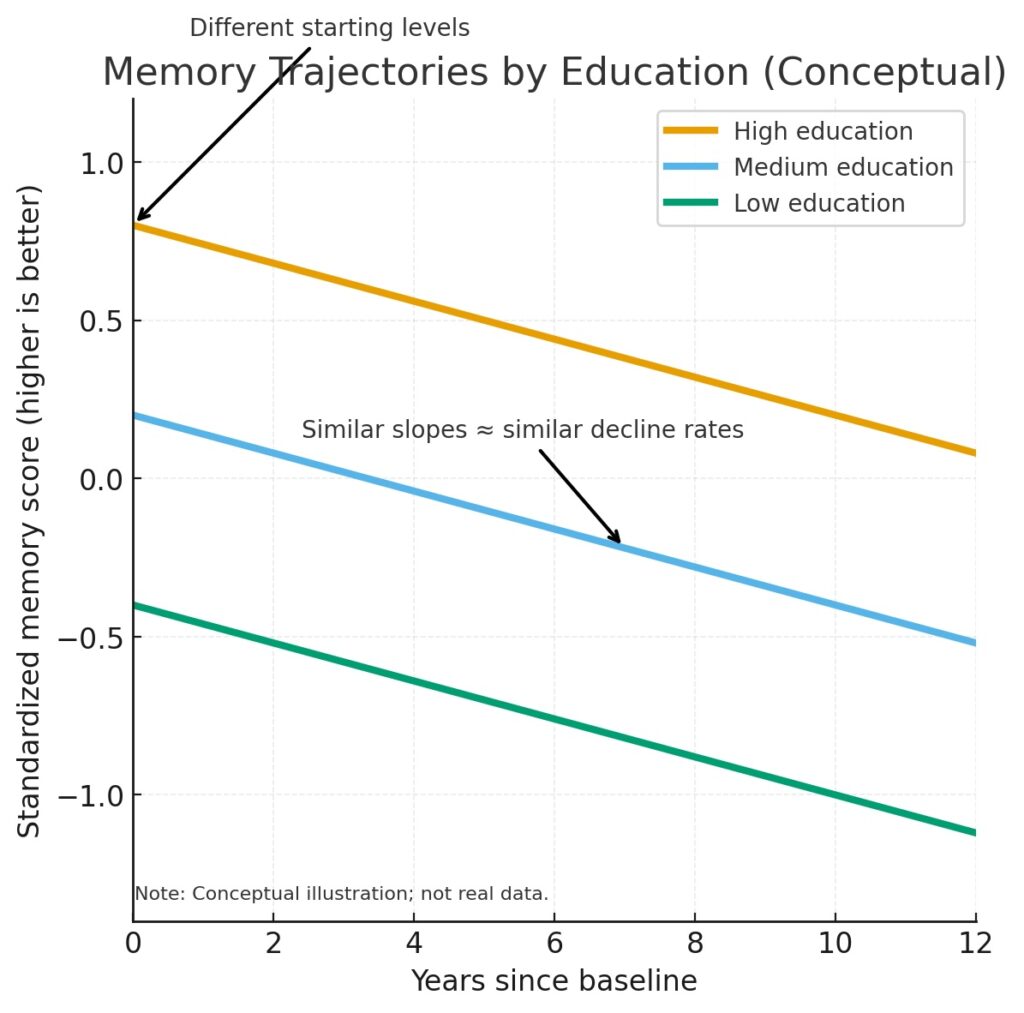
Conceptual Trajectories of Memory by Education Level
Y = Standardized Memory Score (higher is better) / X = Years Since Baseline
4. Why Education Isn’t the Decisive “Anti-Aging” Lever
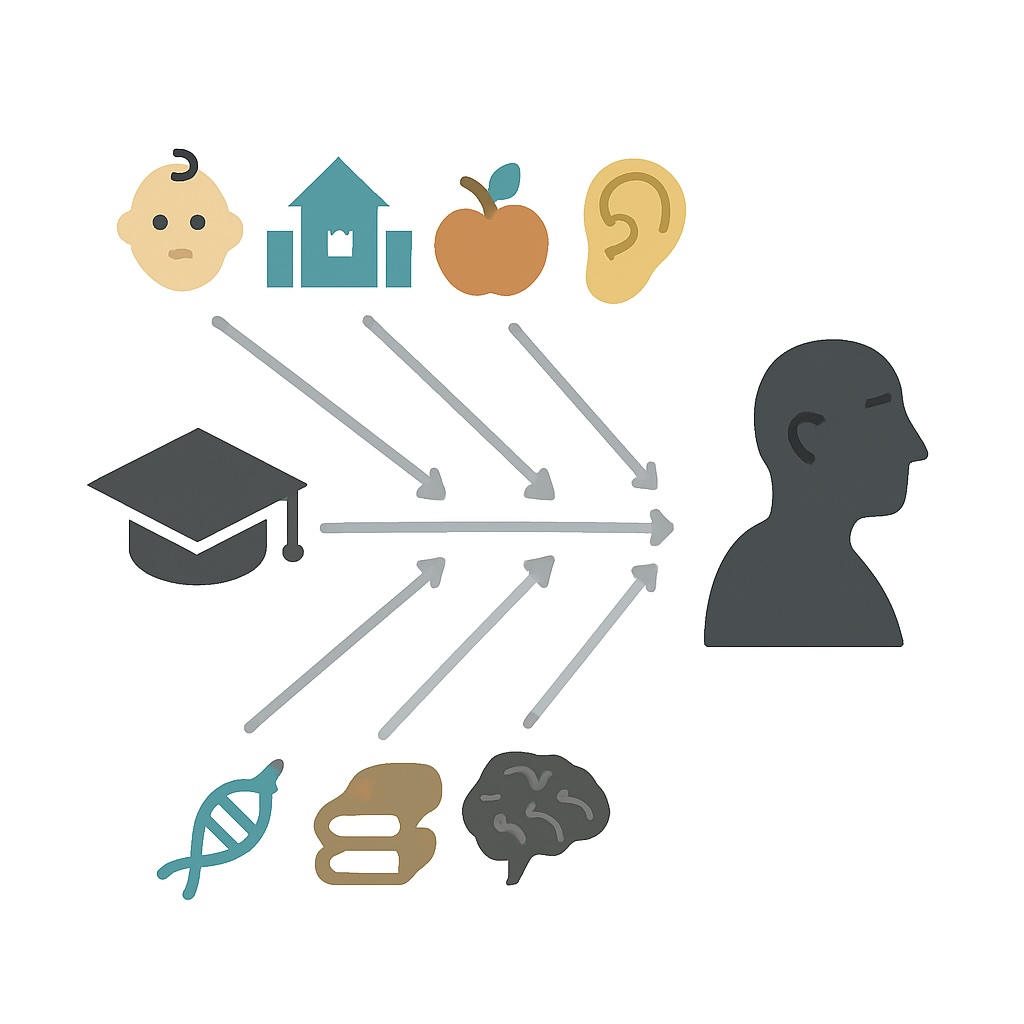
Associations between education and cognition/brain reflect, in part, pre-existing differences and early-life environments (nutrition, health, stimulation, family/community support). Thus, years of education per se may not change the speed of age-related decline. Still, education brings broad benefits—income, health literacy, access to information, and social capital—that indirectly support brain health.
5. What Actually Helps Slow Cognitive Aging? (Actionable)
- Physical activity: Aim for 150 minutes/week aerobic + 2 sessions of resistance training. Frequency beats perfection.
- Sleep: 7–8 hours; cue circadian rhythm (e.g., warm bath ~90 min before bed, morning light).
- Diet: Mediterranean-leaning; go easy on ultra-processed foods; moderate alcohol.
- Social & intellectual engagement: Talk to people; try new learning with novelty and continuity (languages, music, dance, coding).
- Medical care: Manage modifiable risks—hypertension, diabetes, hearing loss—proactively.
Mini Checklist
- Did you hit 150 minutes of movement this week?
- Are bed/wake times fairly consistent?
- Did you talk to someone new or learn something new?
- When was your last hearing check?
6. FAQ
Q. So is “higher education prevents dementia” a myth?
A. It’s an overstatement. There may be a lower risk on average, but it isn’t a decisive shield. Q. Does adult “re-learning” help?
A. Yes—especially when learning is novel and sustained. Daily habits beat credentials. Q. Does this mean children’s education doesn’t matter?
A. It matters a lot. Early-life environments build the foundation for lifelong cognition.
7. Summary (Takeaways)
- Education raises the level of performance, but the decline rate looks similar.
- Think “early, broad, long”: combine lifestyle, clinical care, and social participation.
- Start small: a 10-minute walk, a quick hearing check, a call to a friend.
8. References & Further Reading
- The re-analysis paper examining education, memory decline, and brain aging across multiple countries.(Reevaluating the Role of Education in Cognitive Decline and Brain Aging: Insights from Large-Scale Longitudinal Cohorts across 33 Countries)Jan 29, 2025, medRxiv.)
- General resources on dementia risk reduction, hearing health, and practical sleep/fitness guides.
Edited by the Morningglorysciences Team. | This article is for general information only and is not a substitute for medical advice.


Comments