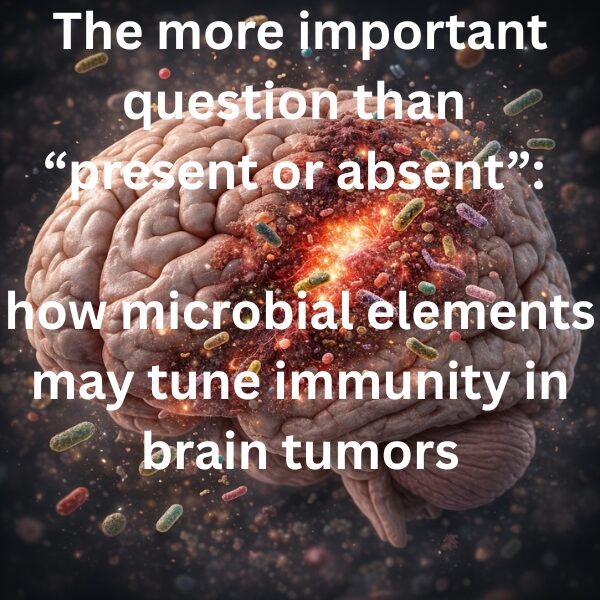
Brain tumors sit at the crossroads of immunology and microbiology, but they are also a uniquely challenging environment to study. The blood–brain barrier (BBB) and the inherently low-biomass nature of brain tissue make it difficult to measure microbial signals without the constant risk of contamination. Meanwhile, a growing body of work across multiple cancer types suggests that tumors can harbor bacteria—or, at minimum, bacterial-derived molecular traces—within the tumor microenvironment (TME).
This article focuses on brain tumors (primary and metastatic) through the lens of microbial elements: not only living bacteria, but also bacterial nucleic acids, cell-wall components (e.g., LPS), and other fragments that can still engage innate immune sensors. Anchored by recent work that links microbial signals to spatially resolved TME programs, we will clarify what the field can say with confidence today, what remains unresolved, and what the most realistic translational paths look like.
Key takeaways (the conclusion upfront)
- Bottom line: Signals consistent with bacteria and/or bacterial-derived elements can be detected in brain tumors, and these signals appear to associate with spatially localized immune and metabolic programs in the TME.
- Critical shift: The field is moving from “are they there?” to what happens where they are detected—the concept of a “microbial context.”
- Three hard questions: Are these signals from viable bacteria (viability)? Who carries them into tumors (carrier)? Are they drivers or passengers (causality)?
- Clinical implication: Before jumping to antibiotics, a more pragmatic path is context-aware stratification and targeting host pathways such as PRR/TLR–NF-κB signaling linked to microbial elements.
Why “brain tumors × bacteria” is gaining momentum now
1) Intratumoral microbes are no longer a fringe idea
Since 2020, evidence has accumulated across diverse tumor types that microbial signals can be found within tumor tissue and, in some contexts, within tumor and immune cells. Importantly, the most compelling studies have progressed beyond simple sequence detection, incorporating localization, spatial organization, and functional consequences.
2) But the brain is a special case (low biomass and contamination risk)
In brain tumors, the small amount of true microbial material means that reagent-, environment-, or workflow-derived contamination can easily overwhelm real signal. Any credible brain-tumor microbiome study must therefore embed rigorous negative and environmental controls, plus orthogonal validation that does not rely on sequencing alone.
3) That is exactly why “function” matters more than “presence”
Even if living bacteria are not stably colonizing brain tumors, bacterial-derived molecules can still reach the TME and reshape host programs. The meaningful biological question becomes: when microbial elements are detected, what immune and metabolic states co-occur in the same spatial neighborhood?
What the recent spatial work adds: “microbial context” in the TME
1) The backbone: multi-cohort, multi-sample, multi-method (orthogonal design)
The central study highlighted here is notable for its design philosophy: assume contamination is a real threat, then counter it with layered controls and orthogonal methods. Crucially, it does not stop at detection; it connects microbial signals to spatially resolved transcriptional programs—an approach that enables a more mechanistic discussion.
2) What counts as “microbial” here (not necessarily viable bacteria)
The key point is that the measurable entities are often signals consistent with bacterial 16S rRNA and bacterial structural components such as LPS. These findings are best interpreted under the umbrella of microbial elements, rather than assuming a stable, diverse, viable intratumoral bacterial community. The emphasis shifts from “a living tumor microbiome is established” to “microbial elements are detectable as part of the TME.”
3) The most important contribution: tying location to function
The core insight is the linkage between regions with high microbial signal (e.g., “16S-high” areas) and local TME programs enriched for innate immune/antimicrobial pathways (PRR/TLR–NF-κB), stress responses, metabolic rewiring, and cell-death/autophagy-related processes. This enables a discussion that is less about abstract detection and more about spatially defined biology.
What “microbial context” looks like: spatial rewiring of immunity and metabolism
1) Common programs observed in microbial-signal–rich regions
Across designs and tumor types, microbial-element–rich neighborhoods tend to align with a subset of host programs such as:
- Innate immune and antimicrobial responses: PRR/TLR engagement, NF-κB-related programs, antimicrobial effectors
- Stress responses: oxidative stress, ER stress, DNA damage response features
- Metabolic shifts: signals consistent with lipid/metabolic adaptation in certain contexts
- Cell death/autophagy: potentially linked to the processing of microbial material
2) Why this is not just “generic inflammation”
A key nuance is that these spatial programs do not always map cleanly onto a single generic inflammatory axis. This supports the idea that the observed signatures may reflect PAMP-driven contexts rather than inflammation alone. In other words, tumors may not simply be inflamed and therefore contaminated; there may be a more specific microbial-element–associated immune context in certain niches.
3) The next determinant: which cells are responding?
Microbial elements can plausibly reside within tumor cells, within phagocytic immune cells (including macrophages/microglia), or in extracellular compartments. Spatial biology can reveal association, but translation requires clarifying the responding cell types. That distinction shapes whether the most actionable target is “the microbe” or the host pathway engaged by microbial elements.
Origin hypotheses: from oral/gut reservoirs to brain tumors? (colonization is not guaranteed)
1) What overlap with oral/gut profiles may suggest
Some analyses indicate overlaps between intratumoral microbial signals and metagenomic profiles from saliva or stool, which may point to oral or gut reservoirs. This aligns with broader literature where oral or gut microbes can correlate with systemic inflammation and cancer-related outcomes.
2) Why origin is difficult to assert definitively
Overlap alone is not proof of origin, especially under low-biomass constraints where pipeline differences and contamination can distort apparent similarities. More importantly, even a true origin does not imply stable colonization. The tumor signal could reflect transported fragments, transient material, or circulating PAMPs rather than living intratumoral bacteria.
3) Candidate carriers: immune cells, tumor cells, or circulating PAMPs
- Immune-cell carrier model: monocytes/macrophages uptake microbial material and deliver it into the TME
- Tumor-cell uptake model: tumor cells internalize microbial elements and trigger PRR responses
- Circulating PAMP model: bacterial molecules (e.g., LPS) reach tumors via blood and modulate local immunity
Disentangling these models is essential for causality and for deciding what “intervention” should even mean.
The three big controversies: contamination, viability, and causality
1) Contamination: the defining challenge of low-biomass work
Brain-tumor microbial studies must assume contamination unless proven otherwise. The baseline requirements include robust negative/environmental controls, careful batch/lot tracking, analytic transparency, and orthogonal approaches that integrate visualization and spatial context rather than sequencing alone.
2) Viability: culture-negative does not equal absence
Failure to culture bacteria does not prove that microbial elements are absent, nor does it prove they are non-viable. The tumor environment can be incompatible with standard culture, and the measurable entity may be non-living material. Addressing viability likely requires complementary strategies (RNA integrity, metabolic activity readouts, ultrastructural imaging, and tracing in model systems).
3) Causality: driver or passenger?
Association between microbial elements and immune programs does not automatically imply directionality. Tumor-driven barrier disruption or immune recruitment could create conditions that accumulate microbial material. Establishing causality demands time-aware designs and interventions—adding, blocking, or tracing microbial elements and testing whether TME states shift accordingly.
Clinical and translational implications: start with stratification and pathways, not antibiotics
1) Biomarker potential (microbial-score and microbial-context signatures)
A plausible near-term application is to treat microbial elements as a context marker rather than a pathogen target. Combining spatial microbial signals (e.g., 16S/LPS) with host signatures (PRR/TLR–NF-κB, stress, metabolism) may support prognostic or response stratification in subsets of patients.
2) Why “just use antibiotics” is not an obvious solution
Given established links between the gut microbiome and immunotherapy responsiveness in other cancers, indiscriminate antibiotics can be harmful at the systemic level. Additionally, if the relevant entity is microbial material rather than living bacteria, antibiotic benefit may be limited. A more realistic translational approach is to modulate host sensing pathways and inflammation programs connected to microbial elements.
3) A parallel axis: microbial antigen presentation and adaptive immunity
Recent work in glioblastoma has reported bacteria-derived peptides within the HLA-presented immunopeptidome and the capacity to activate tumor-infiltrating lymphocytes. This expands the concept beyond innate sensing: microbial elements may also influence antigen presentation and adaptive immune targeting. For brain tumors, the implication is not simply that immunity is “weak,” but that relevant contexts may be hidden unless we look at what is presented where.
Conclusion: what we know, what we don’t, and what matters next
What appears solid
- Brain tumors can contain detectable signals consistent with bacteria and/or bacterial-derived elements.
- These signals can associate with spatially localized immune and metabolic programs in the TME.
What remains unresolved
- Whether the dominant entity is viable colonization or non-living microbial material.
- Who carries microbial elements into tumors and how time and causality unfold.
What matters next
- Viability: test activity/viability with orthogonal readouts and tracing
- Carrier: map cellular localization and neighborhood effects with integrated spatial tools
- Causality: move from correlation to intervention-based inference
- Translation: prioritize context-aware stratification and host pathway modulation
My Thoughts and Future Outlook
Debates about bacteria in brain tumors often get stuck on contamination, and for good reason: low biomass makes false positives dangerously easy. The more useful shift, however, is to treat “microbial elements” as a context rather than a binary presence call. For beginners, two ideas help: microbial elements are not synonymous with living bacteria, and spatial biology asks “what happens where the signal is detected,” not merely whether a sequence exists.
From an expert and science-writer standpoint, the field now has a clearer roadmap: viability, carrier, and causality are the three pillars that must be addressed before any intervention claims are credible. Still, connecting microbial signals to spatially defined TME programs is a meaningful step forward. I suspect the first translational wins will come from stratification and pathway tuning—PRR/TLR–NF-κB-linked contexts—rather than blunt antibiotic approaches. Brain tumors may not be uniformly immunologically “cold”; instead, they may contain underappreciated micro-contexts that we are only beginning to resolve.
References
- Morad G, et al. Microbial signals in primary and metastatic brain tumors. Nature Medicine. 2025.
- AACR Cancer Discovery News. Bacteria Detected in Brain Tumors May Shape Tumor Microenvironment. 2025.
- Naghavian R, et al. Microbial peptides activate tumour-infiltrating lymphocytes in glioblastoma. Nature. 2023.
- Nejman D, et al. The human tumor microbiome is composed of tumor type–specific intracellular bacteria. Science. 2020.
- Galeano Niño JL, et al. Effect of the intratumoral microbiota on spatial and cellular heterogeneity in cancer. Nature. 2022.
- Geller LT, et al. Potential role of intratumor bacteria in mediating tumor resistance to the chemotherapeutic drug gemcitabine. Science. 2017.
- Kalaora S, et al. Identification of bacteria-derived HLA-bound peptides in tumors. Nature. 2021.
Morningglorysciences Team (This article is for educational and informational purposes based on peer-reviewed literature and public sources. It is not medical advice.)
Related Articles





Comments