

Key Takeaways
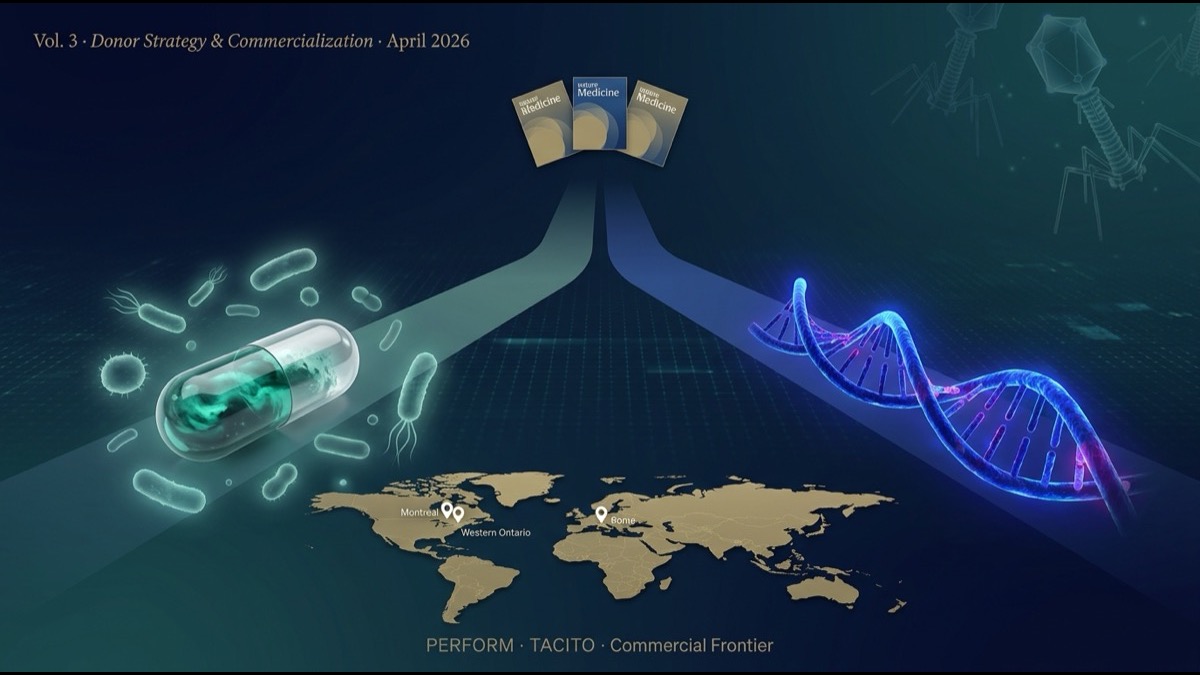
- The final volume dissects two metastatic renal cell carcinoma (mRCC) trials side-by-side: PERFORM (healthy donor, ipi/nivo backbone, phase 1) and TACITO (ICI complete-responder donors, pembrolizumab+axitinib backbone, randomized phase 2). Same cancer type, different donor strategies and ICI combinations — the contrast reveals what works and what doesn’t, and where commercialization is heading.
- Segatella copri, the cross-trial toxicity-driving taxon, induces severe irAEs only in the context of ipi/nivo (dual ICI). Under anti-PD-1 monotherapy or pembrolizumab+axitinib, the same bacterium is harmless. Toxicity is determined by the bacterium × ICI-backbone combination — a major structural finding for trial design.
- The commercial map is settling into three layers: (1) “addition”-type LBPs (Seres, Vedanta, Exeliom), (2) “subtraction”-type phages (Locus, Eligo), and (3) rationally designed consortia (Vedanta next-generation, academic spinouts). The FDA Live Biotherapeutic Products framework has lowered regulatory hurdles.
- Japan has three structural opportunities: (a) phage therapy infrastructure (deep research at U Tokyo IMSUT, AIST Q-uAT, Osaka U RIMD), (b) donor-screening diagnostic kits (assays to exclude donors with abundant deleterious bacteria), (c) F. prausnitzii / Akkermansia strain supply for global pipelines. NewXus Fund could anchor this thesis.
- Series synthesis: April 2026’s three Nature Medicine trials in one issue mark the “clinical-translation year” for FMT × ICI. Over the next 3–5 years, “FMT, the blunt instrument” evolves into “precision microbial cocktails.”
Introduction — Same Renal Cancer, Different Answers
Volumes 1 and 2 covered the field-level overview of the three-paper landing in April 2026 Nature Medicine, and the cross-trial mechanism (loss of deleterious bacteria as the active principle). The final volume drops one level deeper to compare two trials head-to-head: “same cancer, different donors, different ICIs.”
Saman Maleki Vareki and colleagues at Western University (Canada) ran PERFORM. Gianluca Ianiro and colleagues at Catholic University of the Sacred Heart (Rome) ran TACITO. Both enrolled treatment-naive mRCC patients and tested whether FMT plus ICI improves outcomes over ICI alone. But the designs were opposite.
- PERFORM: healthy-donor encapsulated FMT (LND101); ICI was 80% ipilimumab + nivolumab (dual checkpoint blockade); phase 1 (n=20).
- TACITO: ICI complete-responder–derived stool; ICI was pembrolizumab + axitinib (PD-1 + VEGFR TKI); randomized phase 2a (n=50).
Reading the two side by side, the field’s biggest implementation questions become tractable: healthy donor vs complete-responder donor — which is better? Does the ICI backbone change how FMT works? Where is the optimal commercialization path?
This article walks through PERFORM in detail, then TACITO, the cross-trial S. copri problem, the commercial map, and Japan’s positioning — closing the series.
Main Body
1. PERFORM Dissected — Healthy-Donor FMT × Dual ICI
PERFORM tested LND101, an encapsulated FMT product developed at Lawson Health Research Institute (Canada), in 20 treatment-naive mRCC patients (IMDC intermediate / poor risk) given alongside ICI-based therapy.
| Item | Value / Result |
|---|---|
| Primary endpoint | Safety (grade 3+ irAE rate) |
| Result | grade 3+ irAE 50% (10/20) → within expected, met |
| FMT dose | One full (80–100 g stool) + two halves (50–60 g) |
| ICI combinations | ipi/nivo 80% (16/20), pembro + axi/lenva 20% |
| ORR | 50% (9/18 evaluable), CR 11% (2/18) |
| Median PFS | 11.15 months (per protocol) |
| Median OS | 36 months (ITT) |
| Response–toxicity decoupling | Among 9 responders, only 1 (11%) had grade 3+ irAE; among 9 non-responders, 8 (89%) did, P=0.005 |
PERFORM’s most distinctive finding was a pattern opposite to the conventional ICI rule of thumb: “responders had fewer side effects.” Normally, ICI responders show stronger immune activation and therefore more autoimmune-style adverse events (irAEs). With healthy-donor FMT added, response and toxicity were decoupled.
Mechanistically, patients with high α-diversity and durable engraftment of donor anti-inflammatory functional pathways (short-chain fatty acid producers in particular) had both less toxicity and higher response rates. Conversely, patients who developed grade 3+ irAEs showed enrichment of Segatella copri (formerly Prevotella copri clade A) and elevated IL-10 and G-CSF.
Commercially, LND101 represents a standardized healthy-donor product capable of being reused across multiple trials — moving from a custom recipe into a “product.” Donor screening, GMP manufacturing, and regulatory filings put it on the trajectory toward formal Live Biotherapeutic Product (LBP) approval.
2. TACITO Dissected — Complete-Responder–Donor FMT × Pembrolizumab + Axitinib
TACITO randomized 50 treatment-naive mRCC patients 1:1 to receive donor FMT (d-FMT, sourced from two ICI complete responders) or placebo FMT (p-FMT), administered alongside the KEYNOTE-426 standard regimen of pembrolizumab + axitinib. It is a double-blind, placebo-controlled phase 2a RCT.
| Item | Value / Result |
|---|---|
| Primary endpoint | 12-month PFS rate |
| Result | d-FMT 70% vs p-FMT 41%, P=0.053 (not quite at threshold) |
| Median PFS (FAS) | d-FMT 24.0 vs p-FMT 9.0 months, HR 0.50, P=0.035 ★ significant |
| Median PFS (IMDC int/poor) | d-FMT 18.8 vs p-FMT 5.1 months, P=0.033 |
| Median OS | d-FMT 41.0 vs p-FMT 28.3 months, HR 0.36, P=0.167 |
| ORR | 52% vs 32% |
| FMT dose | Initial colonoscopy + capsules at weeks 12 and 24 (3 total) |
| Microbiome correlate | Donor strain engraftment rate (DoSER) did NOT predict 12-month PFS. Blautia wexlerae (SCFA producer) acquisition correlated with response. |
TACITO’s headline could read “primary endpoint not met (P=0.053),” but the secondary endpoint of median PFS showed a 2.7× difference (24.0 vs 9.0 months, HR 0.50). The authors argue that 12-month PFS is a single-time-point snapshot that may underestimate FMT effects, which take time to manifest.
The microbiome findings echo Volume 2’s “subtraction mechanism.” Donor engraftment did not predict response. Specific strain acquisitions ( Blautia wexlerae = SCFA producer) and specific strain losses ( E. coli SGB10068) did.
The most striking detail: under TACITO’s pembrolizumab + axitinib backbone, even when Segatella copri engrafted, severe irAEs did not occur. The same bacterium that caused toxicity in PERFORM (ipi/nivo) was harmless here. This is the discovery of “bacterium × ICI-backbone” combination dependence.
3. PERFORM vs TACITO — Side by Side
| Axis | PERFORM | TACITO |
|---|---|---|
| Donor source | Healthy donors (LND101 standardized product) | 2 ICI complete responders |
| ICI backbone | ipi/nivo (80%), pembro + axi/lenva (20%) | pembro + axitinib |
| Trial design | phase 1, single-arm, single-center | phase 2a, RCT, double-blind, placebo-controlled |
| N | 20 | FAS 45 (d-FMT 23 vs p-FMT 22) |
| FMT delivery | Oral capsules × 3 | Initial colonoscopy + capsules × 2 |
| Primary endpoint | Safety (met) | 12-mo PFS rate (near miss, P=0.053) |
| Key efficacy result | ORR 50%, mPFS 11.15 mo | mPFS 24.0 vs 9.0 mo (HR 0.50, P=0.035) |
| Toxicity driver | Segatella copri (under dual ICI) | Not applicable (same bacterium harmless) |
| Commercialization path | LND101 → CanBiome2 successor | Single-donor dependence is a limitation, consortium next? |
The two trials’ strengths are complementary.
- PERFORM’s strength: a standardized “product” (LND101) demonstrating reproducible endpoints across multiple ICI regimens. Clear commercialization trajectory.
- TACITO’s strength: the field’s first proper RCT, completed, showing a 2.7× median-PFS gap. Concept validation for ICI-complete-responder donor strategy.
Both share common weaknesses: small sample sizes, large donor-individual effects, need for long-term follow-up. The next-generation trials require standardized donor screening and larger RCTs.
4. The Cross-Trial Problem — Segatella copri “Context-Dependent Toxicity”
The most important cross-trial finding shared across all three April 2026 trials is the “context-dependent toxicity” of Segatella copri (formerly Prevotella copri clade A).
In FMT-LUMINate’s melanoma cohort (dual ICI), one specific donor (donor 5, Prevotella-rich) caused most of the severe irAEs (grade 3+ irAE 60%, myocarditis 15%). The same donor caused zero toxicity in the MIMIC trial (melanoma × anti-PD-1 monotherapy) and zero in the FMT-LUMINate NSCLC cohort (anti-PD-1 monotherapy).
In PERFORM, patients with S. copri >10 CPM (from baseline or donor) under ipi/nivo had markedly elevated grade 3+ irAE rates. Under pembro + axi/lenva, the same S. copri levels caused no toxicity.
In TACITO, S. copri engrafted under pembro + axitinib backbone — but no severe irAEs.
The pattern: S. copri drives toxicity only in regimens containing anti-CTLA-4. The combination of CTLA-4-blockade-induced loss of peripheral tolerance and Prevotella-induced Th17/CD4+ T-cell subsets may synergize to produce autoimmune-style inflammation.
Operational implications are clear. Trials including ipi/nivo must screen out Prevotella-rich donors at the donor-selection stage. The CanBiome2 trial (NCT06623461, planned n=128) has already adopted this exclusion rule and lists myocarditis as an AE of special interest.
5. Donor Screening — The Implementation Challenge
“Different donors, different outcomes” creates heavy industrial challenges.
The requirements of a standardized donor-screening protocol:
- Compositional profiling: shotgun metagenomics quantifying S. copri, Enterocloster, Clostridium innocuum, and other deleterious-taxa candidates. Donors above thresholds are excluded.
- Functional enzyme profiling: tryptophan-pathway enzymes (IDO-related), short-chain fatty acid producers, secondary bile-acid converters. Confirm anti-inflammatory profile.
- Infectious-disease screening: HIV, HCV, HBV, C. difficile, drug-resistant organisms, Shiga-toxin-producing E. coli (one PERFORM donor was excluded for this).
- Diet and antibiotic history: recent 6-month antibiotic use, vegetarian/omnivore, probiotic intake history.
- Backbone-specific eligibility tags: separate qualification for dual-ICI / anti-PD-1 monotherapy / VEGF combination.
Through this screening, only ~5% of applicants qualify (FMT trial empirics). Scalability is a major constraint, generating structural pressure to move from “healthy human donor” to rationally designed consortium LBPs.
6. The Commercial Map — From FMT to Next-Generation Modalities
Commercialization of FMT × ICI organizes into three layers.
| Layer | Key player | Pipeline | Stage |
|---|---|---|---|
| “Addition”-type LBP | Seres Therapeutics (US) | VOWST/SER-109 (C. difficile approved); cancer indication Phase 1 | Approved + expanding |
| Vedanta Biosciences (US, Flagship) | VE800 (melanoma + ICI) | Phase 1/2 | |
| Exeliom Biosciences (FR) | EXL01 (F. prausnitzii-based, ICI combination) | Phase 1 | |
| “Healthy-donor standardized” FMT | Lawson Health Research Institute (CA) | LND101 (used in PERFORM) → CanBiome2 | Phase 2 RCT preparing |
| Finch Therapeutics (US, retreating) | Cancer pipeline scaled down, focus on C. difficile | Strategy review | |
| “Subtraction”-type phage | Locus Biosciences (US) | CRISPR-Cas3-engineered phages, E. coli-targeting Phase 2 | Phase 2 |
| Eligo Bioscience (FR) | Targeted-bacterium selective phage therapy | Phase 1/2 | |
| Rationally designed consortia | Vedanta next-generation | Competitive-exclusion type LBP for deleterious bacteria | Preclinical–Phase 1 |
As of April 2026, Seres Therapeutics’ VOWST is closest to approval ( C. difficile approved; cancer indication in early Phase 1 safety phase). Vedanta and Exeliom will read out from Phase 1/2 next.
Phage therapy commands attention as the “subtraction” modality, but ICI-combination phage trials remain few. Locus is in Phase 2 with E. coli targeting; Enterocloster– or Clostridium innocuum–targeting phages are next-generation candidates under discussion.
7. Regulatory Landscape — FDA Live Biotherapeutic Products Framework
US FDA regulation of FMT and related products has evolved substantially over the past five years.
- FDA Live Biotherapeutic Products (LBP) guidance (2016 final): established CMC (chemistry, manufacturing, controls) requirements for live-bacteria therapeutics as drugs.
- 2023 VOWST/SER-109 approval: first FDA-approved oral live-bacteria product (recurrent C. difficile). The template trajectory for cancer-indication FMT/LBP.
- FMT itself remains investigational: FDA has applied “FMT enforcement discretion” since 2013, effectively allowing FMT for C. difficile; oncology use is investigational only.
- EU EMA: in 2024 placed LBPs under the Advanced Therapy Medicinal Products (ATMP) framework. Japan is discussing within the regenerative-medicine product category.
Regulatory hurdles are lowering, but development risk remains high in three areas: long-term safety (years-long effect of donor-derived bacterial engraftment), manufacturing consistency (live-bacteria quality control), and clinical endpoints (PFS vs OS, long-term safety endpoints).
8. Japan’s Position
To organize Japan’s structural opportunities, examined throughout this series:
- Leveraging phage therapy infrastructure: research at U Tokyo IMSUT, the National Institute of Infectious Diseases, AIST Q-uAT, Osaka U RIMD, Yokohama City U is world-class. There is room to lead in Enterocloster – or Clostridium innocuum–targeting phage cocktail development. NewXus Fund could anchor this thesis.
- Donor-screening diagnostic kit business: as long as healthy-donor FMT continues, demand for “screen donor candidates by microbiome composition” persists structurally. Opportunity for partnership with Sysmex / Roche, or for diagnostic-startup entry.
- F. prausnitzii / Akkermansia strain supply: Japan’s sake/fermented-food–derived unique strains and the deeply characterized Japanese-cohort gut-microbiome samples from longevity research can serve as a feedstock for global pharmaceutical pipelines. Connection to NCGG (National Center for Geriatrics and Gerontology) is feasible.
- Clinical trial platform: Japanese cancer centers (NCC, Osaka U Hospital, Kyoto U Hospital) can serve as regional FMT-trial hubs. Asian-cohort subgroup analyses provide diversity data needed for global approval.
These should be read not as isolated opportunities but as a chance to build a cross-disciplinary ecosystem. A “Japan-edition microbiome-immuno-oncology cluster” that integrates phage, diagnostics, strain supply, and clinical trials is a structurally sound construct.
Series Synthesis — The Meaning of Three Papers in One April 2026 Issue
Across the three-volume series “Making Cancer Immunotherapy Work with FMT,” we dissected the meaning of the three-trial landing in Nature Medicine Volume 32, Number 4, April 2026.
Volume 1 (three trials in one issue) showed that cross-tumor-type FMT × ICI clinical translation has moved from “promising hypothesis” to “clinical application” — with NSCLC ORR 80%, mRCC mPFS 24 vs 9 months as the headline numbers.
Volume 2 (subtraction, not addition) traced the field’s mechanistic pivot. The “move good bacteria from donor” model was rewritten as the “lose your own bad bacteria” model, with mouse causality and a tryptophan-metabolism mechanism making the case. FMT/LBP design philosophy shifted from “addition” to “subtraction.”
Volume 3 (this article) compared PERFORM and TACITO’s contrasting donor strategies, the cross-trial Segatella copri context-dependent toxicity, the commercial map, and Japan’s position.
April 2026’s three-paper landing is a symbol of the field’s “clinical-translation year.” From “FMT, the blunt instrument” to rationally designed consortium LBPs and subtraction phage therapy — the next 3–5 years will refine the toolkit. The CanBiome2 trial (NCT06623461, 128-patient RCT), Locus Biosciences’ phage Phase 2, and Vedanta’s next-generation pipeline reading out in 2026–27 will decisively determine the field’s direction.
My Thoughts and Outlook
The deepest structural insight of the series is this: cancer immunotherapy efficacy is determined not by the cancer cell or by the immune cell, but by the upstream gut microbiome. The locus of intervention has moved one layer upstream. Watching this field as a researcher and industry observer for the past 25 years, I would say: the past mainstream of cancer immunotherapy (checkpoint, CAR-T, bispecifics, ADC) operated at the tumor-immunity interface. Now we are moving to interventions in the systemic metabolic-immune environment — a more upstream front.
Three structural implications for the global ecosystem. First, the geography of innovation will reshuffle. Phage therapy expertise is concentrated in specific regions (US East Coast academia–Locus, French ecosystem–Eligo / Pasteur, Israeli microbiome research clusters), and the next wave of clinical-grade phage cocktails for ICI-resistance will likely emerge from these centers. Second, donor-screening diagnostics is an underbuilt category. As long as healthy-donor FMT and consortium LBPs continue, demand for compositional and functional screening assays grows structurally — a pure-play opportunity for diagnostic specialists rather than therapeutic developers. Third, regulatory convergence around live biotherapeutics is accelerating. The FDA’s LBP framework, the EMA’s ATMP designation for live therapeutics, and emerging APAC regulatory pathways will determine which products reach which markets and how quickly. Companies that build regulatory strategy across all three jurisdictions early will compound advantage.
2026 is the year AI is rapidly commoditizing knowledge work. That makes the value of domains AI cannot replace — clinical interventions requiring physical presence, regulatory dialogue requiring human bodies, physical infrastructure requiring long-term commitment — go up, not down. Cancer immunotherapy × gut microbiome is precisely such a “value-rises-in-the-AI-age” field. I hope to continue sharing this field’s developments with the readers who completed this series.
Edited by the Morningglorysciences team.
Related Articles
- The Day Three Major FMT × Immunotherapy Trials Landed Together in Nature Medicine — Reshaping Cancer Immunotherapy with the Gut Microbiome | Making Cancer Immunotherapy Work with FMT, Vol. 1
- FMT Is Subtraction, Not Addition — How FMT-LUMINate Dissected the Real Mechanism Behind Microbiome-Empowered Cancer Immunotherapy | Making Cancer Immunotherapy Work with FMT, Vol. 2


Comments