

Key Takeaways
- From 2024-26, headlines around AI drug discovery have grown — “first AI-designed drug enters clinical trial,” “Big Pharma signs major AI licensing deal.” Insilico Medicine, Recursion Pharmaceuticals, Isomorphic Labs (Alphabet), Schrödinger, Exscientia — public and private AI drug discovery companies are drawing increasing attention.
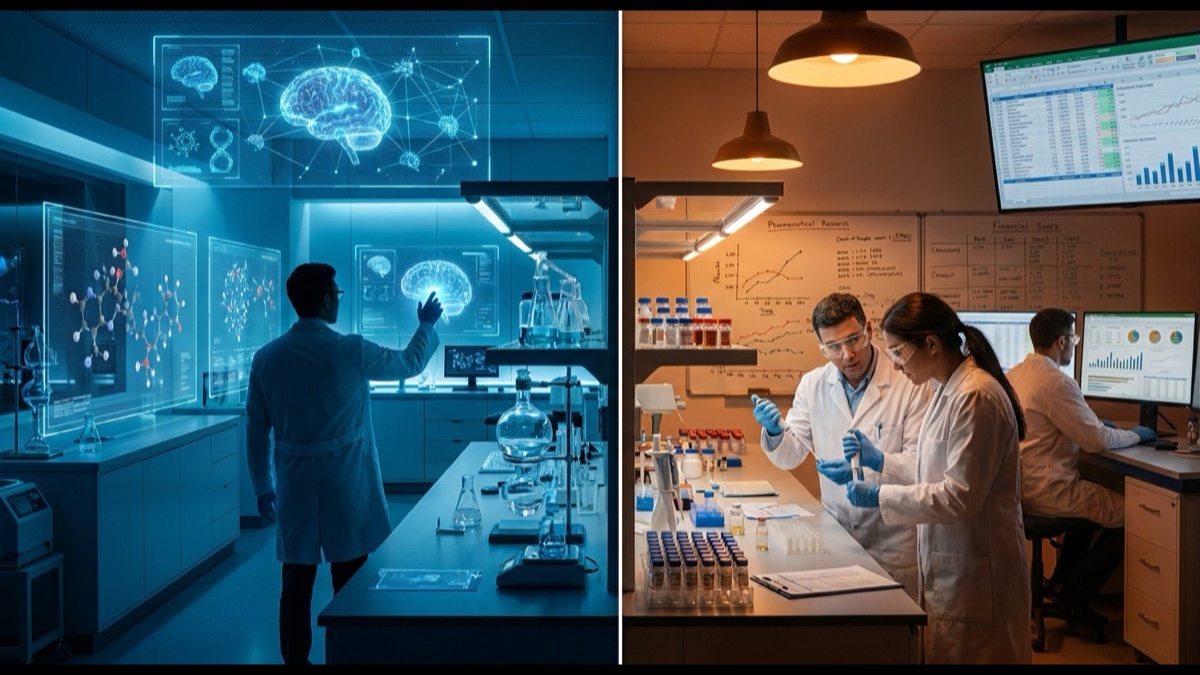
- However, what truly moves pharma’s P&L is not the splashy “AI designed a new drug molecule” news, but rather the unglamorous operational improvements in clinical trials, regulatory documentation, manufacturing management, and pharmacovigilance. As BioSpace’s February 2026 industry analysis demonstrated, where AI is changing pharma’s cost structure is in the middle-to-late stages of development, not the front-end discovery.
- Understanding the two-layer structure of “splashy AI drug discovery” and “unglamorous AI business improvement” reveals the true essence of pharma’s AI transformation. This 5-volume series will dissect each layer in turn.
- Volume 1 (this article) outlines this two-layer structure and surveys the 2026 AI drug discovery company map — Insilico, Recursion, Isomorphic, Schrödinger, Exscientia, etc. — covering strategy, pipelines, and track records.
Introduction — The Background of “AI Made a Drug” Headlines
Representative AI drug discovery news from 2020-26:
- 2020: DeepMind’s AlphaFold dominated the CASP14 protein structure prediction competition, demonstrating that AI can solve protein structure prediction.
- 2022: Insilico Medicine started Phase 1 of INS018_055 (idiopathic pulmonary fibrosis IPF treatment) — celebrated as “the first fully AI-designed drug.”
- 2023: Alphabet subsidiary Isomorphic Labs founded, applying AlphaFold technology to drug discovery.
- 2024: Recursion and Exscientia merged, becoming the largest publicly listed AI drug discovery company.
- 2024: Eli Lilly partnered strategically with OpenAI to accelerate antibiotic development.
- 2024: Novo Nordisk struck a $2.7B deal with Valo Health for AI-driven cardiovascular and metabolic drug discovery.
- 2025: Isomorphic Labs signed multi-year contracts with Novartis and Lilly, up to $2.9B total.
While these flashy headlines accumulate, “approval of an AI-designed drug” has not yet been achieved. INS018_055 is in Phase 2 as of 2026; other AI-designed candidates are mostly in Phase 1. The reality of 2026 is that “AI-made-the-drug” as a main theme has not yet produced final clinical or commercial outcomes.
So what has changed? This article explores the “front-page headlines” and “back-end profit structure” two layers.
Main Body
1. The “AI Drug Discovery Companies” Map — 2026 Version
| Company | HQ | Founded | Core platform | Major partners | 2025 revenue |
|---|---|---|---|---|---|
| Insilico Medicine | Hong Kong / NY | 2014 | Pharma.AI (generative + target ID) | Sanofi, Exelixis, Fosun | Undisclosed (IPO planning) |
| Recursion Pharmaceuticals | Salt Lake City | 2013 | Cell imaging + machine learning | Bayer, Roche, Novartis, Tempus integration | $80M (NASDAQ: RXRX) |
| Isomorphic Labs | London | 2021 (Alphabet sub) | AlphaFold + structure-based | Novartis, Eli Lilly | Undisclosed (within Alphabet) |
| Schrödinger | NY | 1990 | Physics-based computational chemistry + AI | Many (licensing revenue) | $200M (NASDAQ: SDGR) |
| Exscientia | Oxford | 2012 | AI-driven small molecule | Sanofi, BMS, Bayer (2024 Recursion merger) | Post-merger |
| Atomwise | San Francisco | 2012 | Deep learning + structure-based | Multiple small licensing | Undisclosed |
| BenevolentAI | London | 2013 | Knowledge graph + machine learning | AstraZeneca | $10M (LSE: BAI) |
2. Front-Page News — AI-Designed Drug Stages
Major AI-designed drug clinical stages:
- Insilico INS018_055 (IPF): Phase 2 ongoing (2026)
- Insilico ISM3091 (USP1 inhibitor, BRCA-mutant cancer): Phase 1 ongoing
- Exscientia DSP-1181 (OCD): Phase 1 complete (some early termination)
- Exscientia DSP-0038 (Alzheimer’s psychiatric symptoms): Phase 1 complete
- Recursion REC-994 (cerebral cavernous malformation): Phase 2 ongoing
- Recursion REC-2282 (Neurofibromatosis Type 2): Phase 2/3 ongoing
These could produce a first wave of approvals in 2027-30. But considering Phase 2/3 failure rates (industry average 60-70%), the realistic timeline for the first “fully AI-designed drug approval” is 2028-30.
3. Back-End Profit Structure — The Unglamorous Layer AI Is Changing
BioSpace’s February 2026 industry analysis pointed out that where AI applications are truly changing pharma’s profit structure is the middle-to-late development stages, not the front-end (target ID, molecule design). Specifically:
- AI-automated clinical trial operations: patient recruitment, case file management, safety data aggregation
- AI-generated regulatory documentation: automated drafting of CTD (Common Technical Document) sections
- AI-optimized manufacturing process management: real-time control of continuous production, yield improvement, impurity prediction
- AI-driven pharmacovigilance: automatic adverse event signal extraction from medical literature, social media, public databases
- AI-driven compound management: re-evaluation of in-house compound libraries, drug repurposing
These don’t make flashy headlines, but lift pharma annual operating profits by hundreds of millions to billions of dollars. Volumes 2-5 dissect these in turn.
4. Major Pharma AI Strategies
Two-tier structure prominent as of 2026:
“Strategic partnership-focused” type:
- Novartis: multiple contracts with Isomorphic Labs, Recursion, Exscientia
- Eli Lilly: strategic partnerships with OpenAI, Isomorphic Labs, Valo Health
- Sanofi: multi-year deals with Insilico, Exscientia
- AstraZeneca: long-term strategic partnership with BenevolentAI
“In-house AI-focused” type:
- Pfizer: in-house AI team (hundreds-strong), internal platform construction
- Roche / Genentech: CGTV (Computational Genomics Team Volume) strengthening
- Bayer: hybrid in-house + strategic partner
Which is superior remains unclear. Hybrid type “use external AI, accumulate operational know-how internally” appears to be the realistic winning approach.
5. JPM2026 and AI Drug Discovery Market Narrative
At the JP Morgan Healthcare Conference (JPM2026) in January 2026, the AI drug discovery market narrative organized as follows:
- Target identification: machine-learning-driven biomarker discovery, expanding target numbers 10-100×
- Small molecule design: generative AI to increase candidate molecule number and diversity
- Antibody design: AlphaFold-based structure prediction enhances antibody engineering precision
- Clinical trial design: synthetic control arms, digital twins, patient stratification
- Regulatory affairs: document drafting, regulatory dialog simulation
- Manufacturing: process optimization, quality prediction
AI applications are progressing across all 6 areas, but as of 2026, true commercial scale is more often achieved in the latter (clinical trials → manufacturing) areas.
6. Economic Impact Estimates
Major consulting firm estimates (McKinsey, BCG, Boston Consulting):
- Total drug development cost reduction: $2.6B → $1.5B (~40% reduction) within 10-15 years
- Development time shortening: 12-15 years → 8-10 years (25-35% shorter)
- Success rate improvement: Phase 1 → approval success rate 10% → 15-20%
- Industry-wide annual profit improvement: $50-100B scale by 2030
These are optimistic estimates; even half of these would significantly impact pharma.
7. AI Drug Discovery Limitations and Concerns
AI drug discovery limitations should be understood:
First, data quality wall. AI models depend on training data quality and quantity. Past drug discovery data (compounds, targets, clinical) is locked inside pharma, limiting the quality of external AI company models.
Second, biological complexity. Human clinical trials carry complexity that cannot be predicted from cell culture or mouse models. AI “learns from data”, so phenomena outside training data are unsupported.
Third, regulatory environment. FDA, EMA, PMDA are still developing regulatory frameworks for AI-driven drug discovery. “AI decided so it’s approved” doesn’t apply; human clinicians and regulators remain final decision-makers.
Fourth, AI ethics. Multiple ethical issues: AI model explainability, bias, training data copyright/privacy.
8. 2026 Market Valuation
Financial market valuation of AI drug discovery companies:
- Recursion (NASDAQ: RXRX): market cap ~$3B (May 2026), post-2024 Exscientia merger
- Schrödinger (NASDAQ: SDGR): market cap ~$2.5B
- BenevolentAI (LSE: BAI): market cap $200M (post-2024 decline)
- Insilico Medicine: private, recent valuation ~$3B estimated
- Isomorphic Labs: within Alphabet, valuation undisclosed (~$5-10B estimated)
2024-25 was a stock price adjustment phase for AI drug discovery companies. The post-hype cooling period, with Phase 1/2 failure cases (Exscientia DSP-1181 early termination, etc.) cooling market expectations.
Summary
- 2026 AI drug discovery has a two-layer structure: “front-page headlines” (AI-designed drug clinical progression) and “back-end profit structure” (clinical trials/regulatory/manufacturing/pharmacovigilance AI automation).
- Major AI drug discovery companies: Insilico, Recursion+Exscientia, Isomorphic Labs (Alphabet), Schrödinger, BenevolentAI, Atomwise. Different technical platforms and strategic partnerships.
- Major pharma strategies: strategic partnership-focused (Novartis, Lilly, Sanofi, AstraZeneca) vs in-house-focused (Pfizer, Roche, Bayer). Hybrid is the realistic winning approach.
- Economic impact estimates: 40% development cost reduction, 25-35% timeline shortening, 10%→15-20% success rate. Annual $50-100B industry profit lift (2030).
- Limitations: data quality, biological complexity, regulatory environment, AI ethics — four walls.
- Market valuation: 2024-25 stock price adjustment, Phase 1/2 failures cooled expectations. True clinical and commercial track record concentrated in 2027-30.
My Thoughts and Outlook
The true value of AI drug discovery is not the romantic narrative of “AI designs a new drug molecule” but “organizational transformation that redesigns pharma operations entirely with AI.” Volumes 2-5 will explore implementation value in compound management, preclinical-to-clinical transition, virtual trials, and pharmacovigilance.
Three structural implications for the global pharma ecosystem. First, the boundary between “tech company” and “pharma company” continues to blur. Alphabet’s Isomorphic Labs, Microsoft’s strategic AI investments in healthcare, and major pharma’s internal AI teams are converging on a hybrid technology-pharmaceutical model. The next FAANG-level entrant to pharmaceutical R&D may be a tech company with AI core capabilities. Second, training data becomes a strategic asset. Foundation Medicine’s clinical genomic database, Tempus AI’s multi-modal cancer database, Recursion’s cell-imaging library — these proprietary datasets are increasingly the moat that determines AI drug discovery competitive advantage. M&A motivated by data acquisition (rather than pipeline) will accelerate. Third, regulatory frameworks for AI-augmented drug development are evolving. The FDA’s CDRH and CDER are developing AI-specific guidances (2024-26 release), with the first AI-driven CDx approval likely in 2027-28. Companies that engage regulators early gain compounding advantage.
2026 is the year AI is rapidly commoditizing knowledge work. AI drug discovery sits at the augmentation zone — AI accelerates target identification, molecule design, trial operations, and regulatory drafting, but humans (clinicians, regulators, executives) remain decision-makers. The next 5 years will see “headlines transition to performance” in this field. Volume 2 onward dissects the back-end profit structure already at commercial scale.
Coming Next
Volume 2 covers “Compound Management — The Unglamorous Revolution.” How AI is re-evaluating pharma’s compound libraries (millions of compounds), discovering new indications and optimal combinations from existing drugs. Drug repurposing, internal library re-inventory, compound property prediction — the unglamorous performance lift in the shadow of “splashy drug discovery.”
Edited by the Morningglorysciences team.

Comments