


“KRAS is undruggable” — that was conventional wisdom through the 2010s. It took just three years from the first KRAS G12C inhibitor approval (sotorasib / Lumakras, Amgen, 2021) for the field to enter a fundamentally new phase. By May 2026, G12C resistance mechanisms are resolved at high resolution, and the “next wave” — G12D inhibitors, pan-RAS inhibitors, KRAS degraders, mRNA neoantigen vaccines, SHP2/SOS1 modulators — is advancing in parallel. A target that didn’t move for 30 years is now one of the most active in oncology drug development.
This hub article is the complete map of our “KRAS Frontier” series (3 parts): (1) the structural arc of the series, (2) each Vol’s key points, (3) cross-cutting strategic perspectives, and (4) cross-cluster context (e.g., DXd platform expansion). Use it as an entry point if you haven’t read the series, or as a master index for revisits.
What This Hub Covers
- The 3-year arc that turned KRAS from “undruggable” to “the most active target”
- G12C inhibitors sotorasib / adagrasib in the 2026 frontline and the 5 axes of resistance
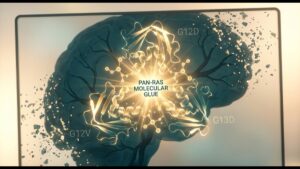
- The “next wave” map: pan-RAS (daraxonrasib), G12D (zoldonrasib), degraders, mRNA vaccines
- Competitive map of 7 Big Pharma × 7 biotech players, and the 2026 leader
- 2027–2030 reshuffling scenarios across PDAC 1L, NSCLC 1L, and CRC
- Cross-cluster: links to TROP2 ADC Datroway (same Daiichi Sankyo/AstraZeneca alliance)
Series Structural Map (3 Vols)
Vol.1 — Where Are KRAS G12C Inhibitors Heading? Sotorasib, Adagrasib, and the 5 Axes of Resistance
Built around the two approved KRAS G12C inhibitors — sotorasib (Lumakras, Amgen, 2021) and adagrasib (Krazati, BMS/Mirati, 2022) — Vol.1 maps where G12C therapy stands in 2026 and the resistance mechanisms shaping its next phase. NSCLC and CRC standard-of-care positioning, sotorasib vs. adagrasib differentiation, the KRYSTAL-7 ICI combination, the anti-EGFR combination approval in CRC, and the 5 axes of resistance (switch II mutations, RTK reactivation, CDK4/6 pathway, EMT, STK11/KEAP1 co-mutations). The opening chapter on “the most established KRAS inhibitor’s clinical reality.” → Read Vol.1
Vol.2 — Redrawing the KRAS Map: G12D, Pan-KRAS, and Degraders Open 4 New Frontiers
The next wave after G12C. Revolution Medicines‘ daraxonrasib (RMC-6236, pan-RAS) achieving OS 13.2 vs 6.7 months in Phase 3 PDAC (previously treated) — a result rarely seen in pancreatic cancer. The same company’s zoldonrasib (RMC-9805, G12D-selective) earning FDA Breakthrough Designation in NSCLC. Plus KRAS degraders (PROTAC), SHP2/SOS1 inhibitors, and upstream modulators — four new frontiers redrawing the map. The chapter where the axis shifts from mutation-specific to pan-RAS / degraders. → Read Vol.2
Vol.3 (Finale) — Where Will KRAS Drug Discovery Be Beyond 2027? Player Map and 5 Reshuffling Scenarios
The series finale. Seven Big Pharma (Amgen, BMS, Roche, Eli Lilly, Novartis, Boehringer Ingelheim, Pfizer) and seven biotechs (Revolution, BridgeBio Oncology, Frontier, Mirati lineage, Jacobio, BioNTech, Moderna) in active competition. Revolution Medicines is the clear 2026 leader; Amgen is close behind via the LumiAtlas platform. Five reshuffling scenarios for 2027–2030: (1) PDAC 1L reshaped by daraxonrasib, (2) NSCLC 1L new standard via adagrasib + ICI, (3) CRC adoption of KRAS-mutation + anti-EGFR combo, (4) personalized mRNA vaccines establishing in PDAC adjuvant, (5) indication expansion (NSCLC → CRC → PDAC → biliary → endometrial → rare cancers). → Read Vol.3 (finale)
Cross-Cluster Context: KRAS Is Not a Standalone Story
KRAS drug discovery doesn’t exist in isolation. In parallel, Morning Glory Sciences also covers:
- TROP2 ADC (Datroway / datopotamab deruxtecan) — the same Daiichi Sankyo / AstraZeneca alliance that runs KRAS-adjacent oncology won 1L mTNBC (PD-(L)1 ineligible) FDA approval on May 22, 2026. Strategic context: the DXd platform’s continued expansion. → Datroway approval
- Cancer Origins Research series — KRAS-driver origins in PDAC, NSCLC, CRC and resistance plasticity are adjacent themes
- AI Drug Discovery: Two Layers series — how Revolution, Lilly, and others use AI for compound design and preclinical prediction; cross-industry context
Strategic Perspective / My Thoughts
The fact that a field stuck for 30 years was redrawn in 3 years is a strong signal for the pharma/biotech industry. Technically: improved protein-structure resolution, modality diversification (covalent inhibitors, degraders, pan-selective inhibitors), and deeper diagnostic partnerships all moved in parallel. Strategically: Revolution Medicines emerged as the clear biotech leader (~$10B market cap), and Big Pharma is using acquisition and partnership to fill internal gaps — a classic late-stage biotech value-creation pattern. Whether you’re an investor, BD lead, researcher, or clinician, the three axes the series builds (clinical reality / next wave / player map) become a durable information asset for predicting the 2027–2030 landscape.
Upcoming follow-up: (1) Revolution Medicines’ pipeline readouts (elironrasib G12C-selective, zoldonrasib G12D Phase 3), (2) KRAS-targeted mRNA vaccines in implementation, (3) the AI drug discovery × KRAS drug discovery intersection (Insitro and others). New readers — start with Vol.1; returning readers — revisit the chapters most relevant to your strategy. The KRAS map becomes three-dimensional when all three are held in context.
Full Series Links
- Vol.1: Where Are KRAS G12C Inhibitors Heading? Sotorasib, Adagrasib, and the 5 Axes of Resistance in 2026
- Vol.2: Redrawing the KRAS Map: G12D, Pan-KRAS, and Degraders Open 4 New Frontiers
- Vol.3 (Finale): Where Will KRAS Drug Discovery Be Beyond 2027? Player Map and 5 Reshuffling Scenarios
※This hub article is the consolidated index for Morning Glory Sciences’ “KRAS Frontier” series (3 parts). For clinical data, competitive strategy, and 2027–2030 projections, refer to each Vol.



Comments