

Key Takeaways
- One of pharma’s biggest black boxes is the “preclinical (mouse model) → Phase 1 (human)” bridge. Over 90% of compounds effective in animal experiments fail at Phase 1 — a long-standing challenge. The fusion of AI and mechanistic modeling is now lowering this barrier.
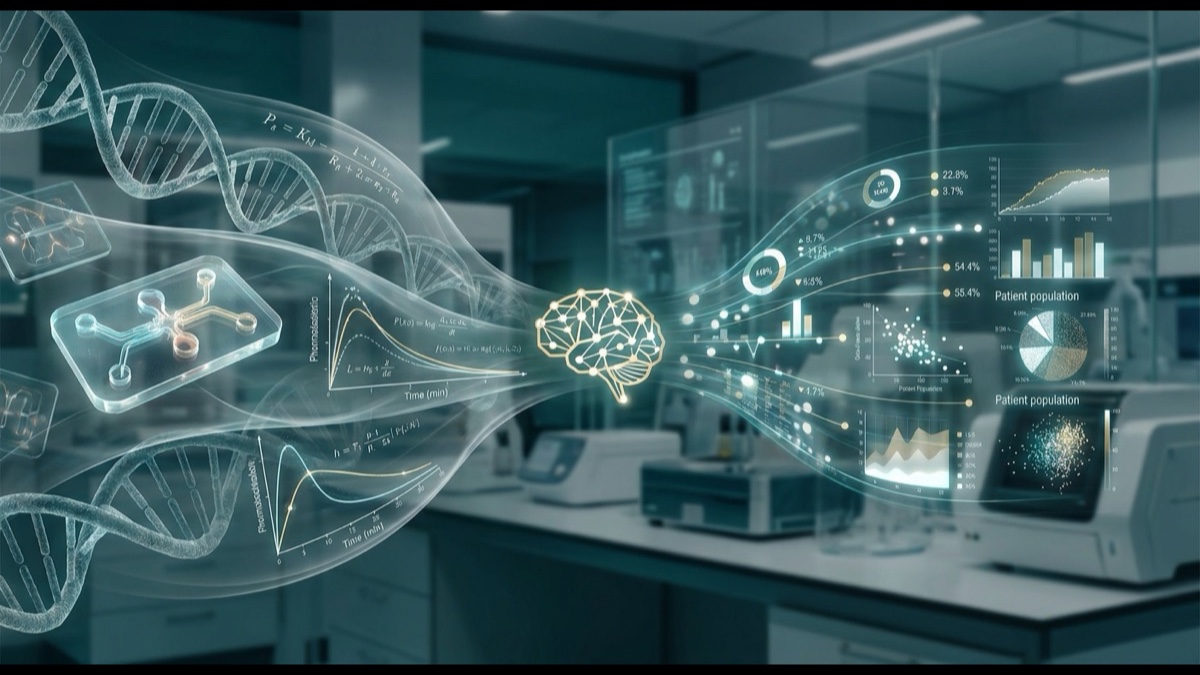
- Major technologies: PBPK (physiologically-based pharmacokinetic models), QSP (quantitative systems pharmacology), digital twins. These combine 30 years of computational chemistry / pharmacokinetics research with machine learning to predict human drug behavior, efficacy, and toxicity before Phase 1.
- Concrete applications: (1) First-in-human dose determination (AI-driven PBPK predicts starting and maximum doses), (2) Population PK/PD (modeling individual variability), (3) Toxicity prediction (QSP + machine learning predicts adverse event signals), (4) Phase 1 design optimization (cohort design, patient selection, interim analysis).
- Commercial value: reducing Phase 1 failure rate from 90% to 70-80% would save the industry approximately $10-20B per year. Genentech, Pfizer, Schrödinger, Certara, Simcyp, Unlearn.AI lead this market.
Introduction — Solving “Works in Mice, Doesn’t Work in Humans”
An industry joke: “Cancer has been cured many times in mice, but not yet in humans.” Most compounds showing activity in mouse models fail at Phase 1 due to dose-limiting toxicity (DLT), pharmacokinetic mismatch, insufficient efficacy. Phase 1 overall failure rate is 40-50%; through Phase 2, 80-90%.
This wall is the “translatability gap.” Mouse vs human differences:
- Body weight, metabolic rate, pharmacokinetics (mouse 20g vs human 60kg)
- Immune system differences (mice are MHC-uniform; humans are diverse)
- Microbiome (mouse SPF environment vs diverse human)
- Disease model approximation (mouse tumor models don’t fully reproduce human tumor biology)
The fusion of AI and mechanistic modeling is now closing this translatability gap. This article covers PBPK, QSP, digital twin fundamentals, AI integration, and commercial applications.
Main Body
1. PBPK (Physiologically-Based Pharmacokinetic Modeling)
PBPK “divides the human body into multiple organ compartments and computer-simulates how a drug distributes, metabolizes, and is excreted in each”. Established methodology over 30 years of pharmacokinetics research.
Typical PBPK model:
- 10-15 organ compartments (liver, kidney, brain, heart, lung, muscle, fat, bone, etc.)
- Each organ’s blood flow, volume, tissue-blood partition coefficient
- Metabolic enzymes (CYP3A4, CYP2D6, UGT, etc.) expression and activity
- Drug property parameters (logP, pKa, protein binding, permeability)
Solving these as coupled differential equations predicts “what concentration reaches each organ at what time post-administration.” Used as a tool for predicting human behavior from animal data via interspecies scaling (allometric).
AI integration:
- Machine-learning parameter prediction: drug properties (logP, protein binding) predicted from molecular structure with AI
- Individual variability modeling: individual PBPK parameters adjusted by AI based on age, sex, polymorphisms, comedications
- Real-World Data integration: learning individual variability patterns from EHR, prescription data
2. QSP (Quantitative Systems Pharmacology)
QSP extends PBPK by computer-modeling “how a drug affects biological systems (protein pathways, cellular responses, tissue reactions).” Connects target protein inhibition levels, downstream signaling pathways, cell proliferation/differentiation, and tissue-level responses.
Application areas:
- Immunology: inflammation, autoimmune, cancer immunotherapy response
- Oncology: tumor cell proliferation, apoptosis, resistance development mechanism
- Neuroscience: neurotransmission, neurodegeneration, cognitive function
- Metabolic / cardiovascular: glucose metabolism, lipid metabolism, cardiac response
Major AI integration directions:
- Hybrid machine learning + mechanistic models: combining data-driven (relationships among known variables) with mechanism-driven (biological constraints) parts
- Automated parameter estimation: maximum likelihood estimation of QSP model parameters from observed data
- Virtual patient population generation: generating heterogeneous virtual patient populations for Phase 1 simulation
3. Digital Twins — “Computational Models of Individual Patients”
Digital Twin technology “reproduces individual patient physiological and clinical state as a computational model.” A concept developed in manufacturing (aircraft, automotive engines) being applied to medicine.
Medical digital twin components:
- Foundation model: PBPK + QSP mechanistic models
- Individualization layer: patient age, sex, comedications, polymorphisms, blood tests, imaging
- Dynamic update: continuous incorporation of treatment course, new test data into model
- Simulation: virtual treatment selections tested computationally, optimal selection presented
Application examples:
- Unlearn.AI (US): neurodegenerative disease (Parkinson’s, ALS, Alzheimer’s) digital twins. Regulatory authorities are starting to accept these as synthetic control arms for Phase 2/3 trials
- Tempus Labs: oncology digital twins, individual treatment response prediction
- Siemens Healthineers: cardiovascular digital twins, cardiac function simulation
4. AI Optimization of Phase 1 Design
AI-driven Phase 1 design elements:
First-in-Human Dose (FIH):
- AI-driven PBPK calculates predicted human dose from animal data
- Optimization of safety factor from NOAEL (no observed adverse effect level)
- Pharmacological minimum effective dose prediction based on target engagement
Dose escalation protocol design:
- Traditional “3+3 design” optimized with AI-driven BLRM (Bayesian Logistic Regression Model)
- Dynamic adjustment of escalation rate, prediction of patient enrollment speed
Patient selection:
- AI-optimized patient stratification based on molecular biomarkers (mutations, expression)
- Phase 1 prediction of “likely responders” improves dose-determination trial efficiency
Interim analysis and adaptive design:
- Dynamic protocol adjustment based on emerging data (Adaptive Design)
- Early detection of inactivity / toxicity, avoidance of futile cohorts
5. Major Players
Major companies in AI × mechanistic modeling:
- Certara (NASDAQ: CERT): PBPK/PopPK veteran. Simcyp platform is industry standard.
- Schrödinger (NASDAQ: SDGR): physics-based computational chemistry + AI, structure-based prediction strength.
- Genentech / Roche: world-class internal PBPK / QSP team, dozens of staff.
- Pfizer: internal AI × PBPK integrated platform, used across all targets in development.
- Unlearn.AI: neurodegenerative digital twins, regulatory approval use case established.
- BioGears: open-source medical simulator, used in military medicine etc.
- Atomic AI: RNA target AI-driven QSP modeling.
6. Regulatory Environment — FDA Model-Informed Drug Development
FDA has been advancing the MIDD (Model-Informed Drug Development) initiative since 2018. PBPK, QSP, and digital twins are being formally integrated into the regulatory approval process.
Specific progress:
- 2018: MIDD pilot program started, major pharma and FDA conduct case studies of PBPK model use
- 2020: PBPK guideline update, expanded use in regulatory submissions
- 2022: Unlearn.AI digital twins authorized as synthetic control arms for Phase 2/3 trials
- 2024: Draft regulatory submission guidance for QSP modeling published
- 2026: MIDD expansion, detailed regulatory frameworks for AI-integrated models
EMA and PMDA are moving similarly; international regulatory harmonization is progressing.
7. Limitations and Caveats
AI × mechanistic modeling limitations:
First, model validity. Computational models are “simplified reality”; they don’t reproduce all of human physiology. Risk of overlooking factors outside the model (individual variability, rare toxicities).
Second, data requirements. PBPK / QSP requires hundreds-thousands of physiological / pharmaceutical parameters. Acquisition and standardization is costly.
Third, regulatory conservatism. FDA / EMA are advancing MIDD, but individual approvals still emphasize real data. “Model said so, therefore approval” doesn’t apply.
Fourth, specialized personnel. PBPK / QSP modelers are scarce; mid-small biotechs cannot internalize this. Heavy dependence on service companies like Certara.
8. Commercial Value
Economic value of AI × mechanistic modeling:
- Reducing Phase 1 failure rate from 40% to 30% (synthetic control arm adoption, FIH precision)
- Reducing Phase 2 failure rate from 50% to 40% (patient stratification, adaptive design)
- Combined $10-20B annual industry-wide cost reduction
- Individual market: Certara, Schrödinger software license + service market $2-5B
Summary
- The pharma preclinical → Phase 1 translatability gap is a long-standing problem; over 90% of animal-effective compounds fail Phase 1.
- AI × mechanistic modeling (PBPK, QSP, digital twins) is rapidly developing as the technology to close this gap.
- Applications: FIH dose determination, Population PK/PD, toxicity prediction, Phase 1 design optimization, synthetic control arms, patient stratification, adaptive trials.
- Major players: Certara, Schrödinger, Roche/Genentech, Pfizer, Unlearn.AI, BioGears, Atomic AI.
- Regulatory: FDA MIDD, Unlearn.AI digital twin Phase 2/3 synthetic control approval, international regulatory harmonization in progress.
- Commercial value: $10-20B annual cost reduction via Phase 1/2 failure reduction. Software market $2-5B.
- Limitations: model validity, data requirements, regulatory conservatism, scarce specialized personnel.
My Thoughts and Outlook
The article’s core insight: “AI drug discovery’s true value lies in improving preclinical-to-clinical translation accuracy, which generates economic effects far greater than splashy molecule design.” Computational models filling the translatability gap may fundamentally change pharma’s R&D productivity.
Three structural implications for the global ecosystem. First, mechanistic modeling becomes pharma’s universal infrastructure. Every major pharma needs internal PBPK/QSP teams or service contracts with Certara/Simcyp. The first AI-augmented mechanistic modeling platform that becomes the de facto industry standard will be a long-tail dominant business. Second, regulatory frameworks for digital twins continue to expand. The FDA’s acceptance of Unlearn.AI’s digital twins for Phase 2/3 synthetic control arms is the leading edge. EMA and PMDA harmonization will accelerate. By 2028-30, digital twin-based “virtual patient populations” may become standard in Phase 2/3 design. Third, the boundary between “drug development” and “computational science” continues to blur. Pharma R&D departments increasingly recruit computational physicists, machine learning researchers, and pharmacometricians. This talent shift has structural consequences for academic-industry pipeline development.
2026 is the year AI is rapidly commoditizing knowledge work. Mechanistic modeling sits in the augmentation zone — AI accelerates parameter estimation, virtual population generation, and trial design optimization, but biologists, pharmacologists, and clinicians remain essential decision-makers. Volume 4 onward dissects clinical trial AI automation.
Coming Next
Volume 4 covers “Will Virtual Trials Change Clinical Trials?” Synthetic control arms, digital twins, remote trials, wearable-integrated data — how these new technologies are transforming traditional RCT (randomized controlled trial) models, and the evolution of regulatory and evidence frameworks.
Edited by the Morningglorysciences team.


Comments