

Key Takeaways
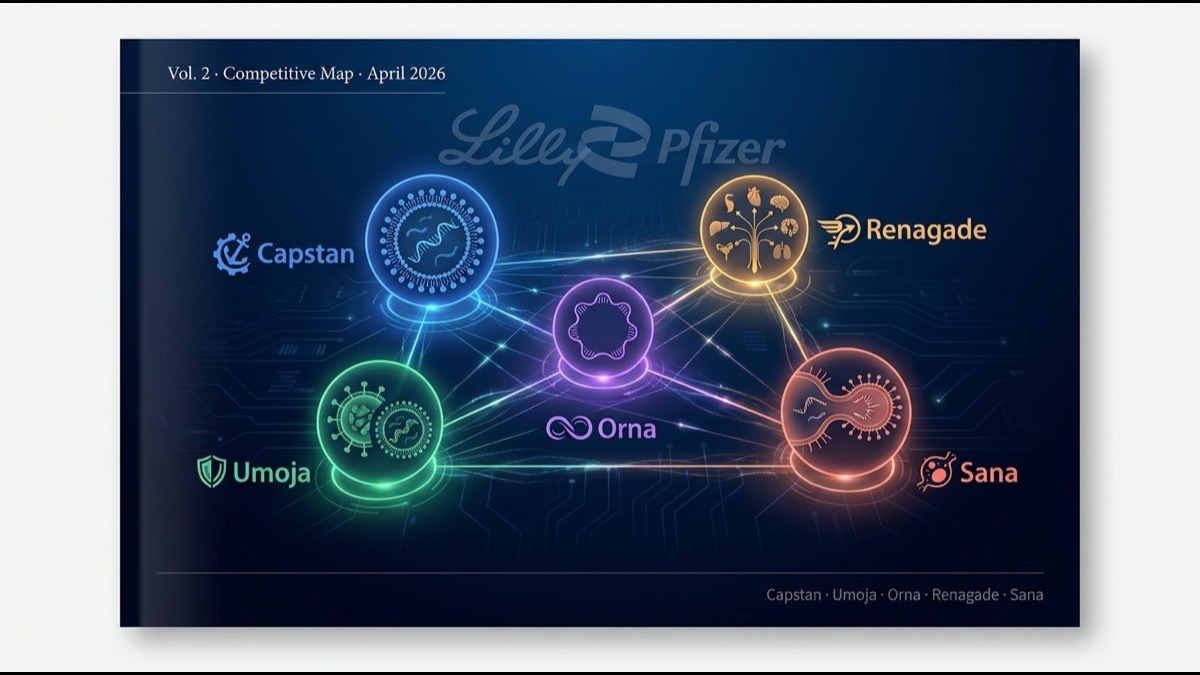
- Following AbbVie’s $2.1B acquisition of Capstan in June 2025 and Lilly’s two consecutive 2026 acquisitions (Orna on Feb 9 for up to $2.4B, Kelonia on Apr 21 for up to $7B), attention has shifted to the in vivo CAR-T main players: AbbVie-owned Capstan, Lilly-owned Orna, and the independent remainders Umoja, Renagade, Sana. Each has built distinct differentiation across LNP platform, CAR target, indication focus, and strategic partnerships.
- The standout pre-acquisition was Capstan Therapeutics (now an AbbVie subsidiary, $2.1B, June 2025). Lead candidate CPTX2309 (CD19 in vivo CAR-T, B-cell-driven autoimmune diseases, Phase 1) is integrated into AbbVie’s immunology franchise. Capstan now stands alongside Lilly’s Orna+Kelonia as the core of in vivo CAR-T autoimmune therapy.
- Umoja Biopharma takes a unique route with VivoVec™ lentivirus-LNP hybrid, aiming for permanent CAR expression. Orna (now Lilly-owned) bets on circular RNA for greater mRNA stability. Renagade builds a multi-organ-selective LNP platform, while Sana uses a CD8-fusogen pseudotyped lentivirus for unique delivery.
- Mapping each company’s strengths and weaknesses sets up the field-reshuffling scenarios. With Lilly’s two-modality Orna + Kelonia camp and AbbVie-Capstan’s autoimmune LNP-mRNA axis as the central blocs, the question becomes which of the remaining independent players (Umoja, Renagade, Sana) Roche, Novartis, BMS, Merck, and Pfizer will partner with — or whether they will build their own platforms. Expect another wave of large deals in the next 12-24 months.
Introduction — Comparison Axes for the Main Players
Volume 1 covered Lilly’s 2026 two-step acquisition (Orna + Kelonia) and the resulting structural change: major pharma’s serious entry into in vivo CAR-T. But Orna and Kelonia are not technically “the strongest” — multiple startups have been running parallel for several years, each making distinct technology bets.
This article dissects the main in vivo CAR-T players — Capstan, Umoja, Orna (Lilly subsidiary), Renagade, Sana — across five comparison axes:
- Delivery platform: LNP, lentivirus, circular RNA, pseudotyped virus, etc.
- CAR target: CD19, BCMA, CD8, CD3, etc.
- Indication focus: B-cell lymphoma, multiple myeloma, autoimmune disease (lupus, RA, MS)
- Clinical stage: preclinical, Phase 1, Phase 2
- Strategic partnerships: pharma major partnerships, investments, acquisition options
Main Body
1. Capstan Therapeutics — AbbVie’s Autoimmune In Vivo CAR-T Lead
Headquarters: San Diego. Founded: 2022. Lead VCs (pre-acquisition): Pfizer, RA Capital, Novartis Venture Fund, Versant, OrbiMed. Total raised (pre-acquisition): ~$200M (including 2024 Series B). Current status: Acquired by AbbVie on June 30, 2025, for up to $2.1B in cash at closing. Integrated into AbbVie’s immunology franchise.
- tLNP (targeted LNP)-mRNA platform: selectively delivers CAR mRNA to CD8-expressing cytotoxic T cells without lymphodepletion preconditioning or complex ex vivo manufacturing. A different LNP technology stream from Kelonia’s lentivirus iGPS®.
- Lead candidate CPTX2309: a first-in-class tLNP anti-CD19 CAR-T in Phase 1 for B-cell-driven autoimmune diseases (lupus, rheumatoid arthritis, multiple sclerosis).
- Position post-AbbVie: synergizes with AbbVie’s immunology franchise (Humira → Skyrizi/Rinvoq, etc.). Direct technology competitor to Lilly-owned Orna (circular RNA + LNP, autoimmune).
Capstan’s strength: focus on the massive autoimmune market (lupus alone has 5M+ patients globally) combined with AbbVie’s autoimmune commercial infrastructure. Regulatory hurdles are arguably lower than oncology; chronic disease aligns with repeated-dosing models. In autoimmune in vivo CAR-T, an AbbVie-Capstan vs Lilly-Orna two-camp structure has now formed.
Weakness: head-to-head with Lilly-Orna’s circular RNA. Capstan’s linear mRNA may have shorter expression duration than oRNA, potentially requiring more frequent dosing. On the other hand, linear mRNA’s safety has been validated in COVID vaccines at billion-patient scale, conferring a regulatory and clinical-acceptance edge. AbbVie’s resources and CPTX2309 Phase 1 data may make it the first approved in vivo CAR-T for autoimmune indications.
2. Umoja Biopharma — VivoVec™ Lentivirus-LNP Hybrid
Headquarters: Seattle. Founded: 2019. Lead VCs: Cambridge Innovation Capital, RTW Investments, Eli Lilly. Total raised: ~$400M.
- VivoVec™ platform: surface-engineered lentiviral vectors achieve T-cell-selective uptake and permanent CAR expression. Unlike mRNA-transient approaches, this aims for permanent (memory T cell) CAR-T even in vivo.
- Lead candidates: UB-VV111 (CD19 CAR-T), UB-VV400 (CD3 CAR-T): B-cell lymphoma first, then expansion to autoimmune and solid tumors.
- Eli Lilly investment (2023 Series B): the fact that Lilly invested in Umoja before acquiring Kelonia suggests strategic multi-bet positioning.
Strength: “permanent CAR expression” aiming for ex vivo-equivalent durability in vivo. mRNA-LNP transient expression may be inferior for long-term complete remission; VivoVec™ may resolve this.
Weakness: lentiviral manufacturing cost. GMP lentivirus production remains expensive and low-throughput compared to LNP. Additionally, insertional mutagenesis risk from permanent gene insertion requires careful long-term safety evaluation.
3. Orna Therapeutics — Lilly’s Circular RNA Platform
Headquarters: Cambridge, MA. Founded: 2019. Lead VCs (pre-acquisition): MPM Capital, F-Prime Capital, RA Capital. Total raised (pre-acquisition): ~$320M. Current status: Acquired by Eli Lilly on February 9, 2026, for up to $2.4B ($upfront + milestones). Integrated into Lilly’s immunology research and early clinical development units, with the Cambridge MA research hub maintained.
- Circular RNA (oRNA™) platform: oRNA is 10× more stable inside cells than linear mRNA, with 5-10× higher protein expression. Encapsulated in T-cell-selective LNPs.
- Lead candidate ORN-252: a clinical-trial-ready, CD19-targeting in vivo CAR-T designed to treat B cell-driven autoimmune diseases.
- Position post-Lilly: synergizes with Lilly’s autoimmune franchise (Olumiant, Taltz, Ebglyss); combined with Kelonia (lentivirus iGPS®, oncology) gives Lilly a two-modality, two-indication portfolio.
Strength: physical advantage of RNA stability. Even in the same T cells, oRNA expresses CAR longer than linear mRNA — sitting between ex vivo permanence and in vivo transience on the spectrum.
Weakness: limited clinical track record for circular RNA. Linear mRNA has been administered to billions of people post-COVID and proven safe; oRNA has near-zero regulatory or clinical experience. The “first oRNA therapy” carries both risk and reward — though Lilly’s resources and regulatory dialogue capacity should accelerate ORN-252’s clinical-stage progression.
4. Renagade Therapeutics — Multi-Organ-Selective LNP Platform
Headquarters: Cambridge, MA. Founded: 2022. Lead VCs: MPM Capital, F-Prime Capital, OrbiMed, GV. Total raised: ~$300M (2023 Series B).
- Multi-organ-selective LNP platform: targets not just T cells but also liver, lung, CNS, hematopoietic stem cells with cell-type-specific LNP designs. In vivo CAR-T is one of many indications.
- Multiple programs: cancer, rare disease, chronic disease across multiple organs.
- Strategic partners: undisclosed (likely in negotiations with multiple pharma).
Strength: platform horizontal expansion. Unlike Capstan/Kelonia betting on a single indication, Renagade applies one LNP design logic across multiple indications. Major pharma find “a platform usable across multiple areas” highly attractive for acquisition or partnership.
Weakness: limited validation per organ. Multi-organ ambition is theoretically attractive but reaching clinical stage in each requires time and resources. Risk of “broad but shallow.”
5. Sana Biotechnology — CD8 Fusogen Pseudotyped Lentivirus
Headquarters: Seattle / South San Francisco. Founded: 2018. NASDAQ-listed (SANA): 2021 IPO at $675M. Total raised: $1.0B+.
- CD8 fusogen pseudotyped lentivirus: lentiviral vector surface presents engineered CD8-binding fusogen (Hendra virus F protein variant). T-cell-selective uptake with permanent CAR expression aiming for ex vivo-equivalent clinical effect.
- Lead candidates: SC291 (CD19 CAR-T, autoimmune Phase 1), SG295 (cancer).
- Broad pipeline: iPSC-derived allogeneic cell therapies, hypoimmune technology — multiple frontiers running parallel.
Strength: public-company financing power and multi-modality pipelines. NASDAQ listing (SANA) provides public capital access; multiple risks can run in parallel.
Weakness: “broad but shallow” risk and stock-price volatility. As a public company, quarterly earnings pressure may compromise long-term R&D consistency vs VC-backed startups. SC291 Phase 1 data expected in 2026 — a key milestone.
6. Five-Company Comparison Table
| Company | Delivery | CAR persistence | Lead indication | Stage | Lead partner |
|---|---|---|---|---|---|
| Capstan | tLNP-mRNA | Transient | Autoimmune (CPTX2309) | Phase 1 | AbbVie subsidiary (Jun 2025, $2.1B) |
| Umoja | LV+LNP (VivoVec) | Permanent | Cancer→autoimmune | Phase 1 | Lilly (investor) |
| Orna | circular RNA-LNP | Sub-persistent | Autoimmune (ORN-252) | Preclinical→Phase 1 | Lilly subsidiary (Feb 2026, $2.4B) |
| Renagade | Multi-organ LNP | Transient | Multi-indication | Preclinical | Undisclosed |
| Sana | Fusogen pseudotyped LV | Permanent | Autoimmune→cancer | Phase 1 | NASDAQ-listed |
| Kelonia (ref.) | LNP-mRNA | Transient | Cancer | Phase 1 starting | Lilly (acquired) |
7. Industry Reshuffling Scenarios
From the five-company differentiation, projected scenarios for the next 12-24 months:
Scenario 1: AbbVie expands Capstan’s pipeline / Pfizer pursues alternative in vivo CAR-T (medium probability). AbbVie-Capstan was completed in June 2025, so this scenario splits into two axes: (1) AbbVie advances Capstan’s follow-on candidates (CPTX23xx series) into clinic, and (2) Pfizer — Capstan’s prior strategic investor — considers fresh investment or acquisition of one of the remaining independents (Umoja, Renagade, etc.). Timing: Q3-Q4 2026.
Scenario 2: Roche / Novartis × Renagade (medium). Multi-indication platform-oriented majors partner with or partially acquire Renagade (multi-organ LNP). Orna is already inside Lilly, so Renagade emerges as the next prime independent platform target. Timing: 2026-27.
Scenario 3: Sana stays independent or strategically acquired (medium). As a public company, may continue independent or be acquired by a major after Phase 1 readout. Timing: Q4 2026 onward.
Scenario 4: Lilly fully acquires Umoja (low-medium). Lilly already owns Kelonia, but Umoja’s VivoVec™ (permanent expression) is complementary technology — possible additional acquisition. Timing: 2027.
If these scenarios play out, in vivo CAR-T converges to 5-7 pharma-major-led oligopolistic structure, with a few independent niche players remaining.
8. Limitations and Caveats
First, accuracy of pipeline and financial data. Independent private companies (Umoja, Renagade) report through IR materials and public statements that may diverge from internal reality. Capstan (now inside AbbVie), Orna and Kelonia (both inside Lilly) will be disclosed under their parents’ reporting cadences — pipeline details may shift after integration.
Second, adjacent uncovered players. This article focuses on five companies. Tessera Therapeutics, Beam Therapeutics (in vivo editing), Verve Therapeutics, and other adjacent players also operate at the in vivo cell therapy boundary and may reshape the field.
Third, technical benchmarking is hard. Until Phase 1 data emerges in 2026-27, true differentiation efficacy is unconfirmed. Theoretical advantages may not translate to clinical results.
Summary
- Triggered by AbbVie × Capstan (Jun 2025, $2.1B) and Lilly’s Orna (Feb 2026, $2.4B) + Kelonia (Apr 2026, $7B) acquisitions, the differentiation axes of the in vivo CAR-T main players come into focus: AbbVie-owned Capstan, Lilly-owned Orna, and the independent remainders (Umoja, Renagade, Sana).
- Capstan (AbbVie subsidiary, Jun 2025, $2.1B): tLNP-mRNA, lead candidate CPTX2309 (CD19 in vivo CAR-T, autoimmune). Forms the autoimmune in vivo CAR-T two-camp structure with Lilly-Orna.
- Umoja: VivoVec™ LV+LNP hybrid for permanent CAR expression in vivo.
- Orna (Lilly subsidiary, Feb 2026, $2.4B): circular RNA-LNP with 10× mRNA stability, ORN-252 (CD19 CAR-T, autoimmune) as lead candidate.
- Renagade: multi-organ selective LNP platform for horizontal expansion.
- Sana: CD8 fusogen pseudotyped lentivirus, public-company financing, multi-modality pipelines.
- Reshuffling forecast: AbbVie expands Capstan’s pipeline (medium), Pfizer pursues alternative independents (medium), Roche/Novartis × Renagade (medium), Sana independent or acquired (medium), Lilly × Umoja additional (low-medium / less needed given Lilly already has Orna + Kelonia two-modality coverage). Convergence to 5-7 pharma-major-led oligopoly.
My Thoughts and Outlook
The structural insight from this comparison: “in vivo CAR-T is not a single-technology competition but a ‘platform diversity’ era where multiple technology streams run parallel.” tLNP-mRNA (Capstan = AbbVie), lentivirus iGPS® (Kelonia = Lilly), lentivirus systems (Umoja, Sana), circular RNA (Orna = Lilly), multi-organ LNP (Renagade) — each has distinct strengths and weaknesses, and optimal choice may differ by indication. Major pharma must adopt multiple-platform parallel positioning (Lilly’s two-modality Orna + Kelonia strategy is the archetype). This resembles the AAV gene-therapy race of the 2010s-2020s, where Spark/Roche, Bluebird Bio, and Sarepta were locked into specific platforms — but more diverse and distributed.
Three structural implications for the global ecosystem. First, the boundary between “drug” and “cell therapy” continues to blur. In vivo CAR-T is administered like a drug but acts like cell therapy. Regulatory (FDA CBER vs CDER), reimbursement, and manufacturing infrastructure all evolve. The first FDA-approved in vivo CAR-T product (likely 2028-2030) defines the new paradigm. Second, autoimmune disease becomes a major battleground. AbbVie now covers autoimmune via Capstan’s CPTX2309; Lilly covers autoimmune via Orna’s ORN-252 (CD19 in vivo CAR-T) and oncology via Kelonia’s KLN-1010 (BCMA); Sana also focuses on autoimmune. The chronic-disease repeated-dosing model fits in vivo’s pharmacokinetics naturally. Lupus, rheumatoid arthritis, multiple sclerosis become the first wave of indications. Third, regulatory frameworks must adapt to repeated-dose cell therapy. Single-dose ex vivo CAR-T regulatory pathways do not transpose to repeated-dose in vivo. The FDA, EMA, and APAC regulators are quietly reformulating frameworks. The first regulatory definition will reshape what “cell therapy” means.
Volume 3 (final) integrates this multi-platform in vivo with existing ex vivo and allogeneic CAR-T to compare the three commercialization paths — autologous vs allogeneic vs in vivo — across cost, manufacturing time, efficacy, toxicity profile, regulatory environment, and market scale.
Coming Next
Volume 3 (final) compares “the three CAR-T commercialization paths”: autologous, allogeneic, and in vivo. Per-patient cost, manufacturing time, efficacy, toxicity profiles, regulatory environment, market scale — a structural map for the next decade of CAR-T industry.
Edited by the Morningglorysciences team.








Comments